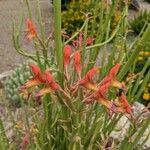
Euphorbia lomelii
Slipper Plant
Description
Source: leafsnapEuphorbia lomelii is a perennial succulent plant native to Sonora, Mexico. Formerly called Pedilanthus macrocarpus Benth. Its common names include slipper plant, ladies slipper and gallito.
Care Guide
💧 Water Every 2 weeks
The slipper plant needs regular watering, typically about once a week, and even more frequently during hot summer days. You should water the plant when the top 2 inches (5 cm) of the soil are dry. Indoor plants also require moisture during their resting season. To prevent overwatering, add water from the bottom of the pot.
☀️ Light Full sun
Originating from dry regions, the Slipper plant performs best in full sun; its native habitat has intense sunlight and very little shade. It can also tolerate partial sun, which gives it some flexibility in how it grows.
What are the sunlight requirements for a Slipper Plant (Euphorbia lomelii)?
The Slipper Plant (Euphorbia lomelii) thrives in different sunlight conditions, depending on what it receives during the day. If the plant is in 'Full sun,' it needs above 6 hours of sunlight daily to reach its full potential. For those in 'Partial sun,' about 3-6 hours of sunlight each day is adequate. It's important to observe the movement of sunlight in your garden to find spots that offer the right mix of light and shade, ensuring your Slipper Plant grows happily and healthily.
🌡️ Temperature 20–37.8°C
The slipper plant does best in warm conditions and needs higher temperatures during the growing season to support growth and metabolic activity. It prefers plenty of sunlight, appropriate moisture, and good air circulation. However, it can be harmed by very low temperatures and by overwatering. Maintaining a balance is important — avoid both excessive heat and overly dry conditions.
What is the botanical name of the Slipper Plant?
The botanical name of the Slipper Plant is Euphorbia lomelii. It is a unique plant belonging to the Euphorbia family, recognized for its distinct appearance and characteristics.
💨 Humidity
🪴 Soil 0-0
🌱 Fertilizer
For the Slipper plant, small amounts of fertilizer applied once or twice a year during the growing season are sufficient. Do not fertilize in winter or summer when the plant is dormant. Reduce feeding for repotted plants and wait a couple of months after repotting before applying fertilizer. Fertilizing helps maintain healthy growth and encourages flowering.
🪴 Pot & Repot Every 2 years
✂️ Pruning
The slippery plant is characterized by its tubular stems and sparse foliage, requiring minimal pruning. For best results, prune the plant in early spring to encourage growth by removing any dead stems and shaping the plant as needed. However, be careful not to over-prune, as this can stress the plant. Pruning helps improve airflow, reduces the risk of disease, and enhances the plant's appearance while controlling its spread.
🌿 Propagating
🐛 Diseases & pets
☠️ Toxicity
Even though the slipper plant has a stunning appearance, it is somewhat toxic. It produces a milky white latex-containing sap that is slightly poisonous to humans and animals. Additionally, it might induce dermatitis if handled. It contains a carcinogen as well.
Characteristics
- Plant Type
- Succulent, Shrub
- Life Cycle
- Perennial
- Genus
- Euphorbia
- Family
- Euphorbiaceae
- Hardiness Zone
- 9-11
- Mature Height
- 30 cm
- Mature Spread
- 49 cm
- Leaf Color
- Green, Dark Green
- Leaf Type
- Evergreen
- Flower Color
- Yellow
- Flower Size
- 1.02 cm to 1.52 cm
- Bloom Time
- All year round
- Planting Time
- Spring, Summer, Autumn
- Harvest Time
- Late spring, Summer, Fall, Winter
- Native Area
- Mexico