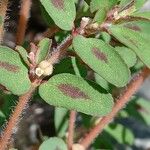
Euphorbia maculata
Spotted spurge · Spotted sandmat · Milk-purslane · Prostrate Spurge · Blotched Spurge
Description
Source: leafsnapEuphorbia maculata, commonly known as spotted spurge, is a low-growing annual plant in the Euphorbiaceae family. Native to North America, it thrives in diverse habitats, including lawns, gardens, fields, and waste areas. The plant features a prostrate growth habit with stems that can extend up to 45 cm in length. Its small, oval-shaped leaves are notable for their reddish spots. The flowers of Euphorbia maculata are small and inconspicuous, with greenish-yellow petals that encircle a central cluster of male flowers. Blooming from June to October, the plant's flowers are subtle yet persistent. Spotted spurge is often considered a weed by gardeners due to its rapid spread through seeds that can remain viable in the soil for up to five years. However, Native Americans historically used the plant for medicinal purposes, employing it as an herbal remedy for various conditions such as skin infections and digestive problems. Overall, Euphorbia maculata is an intriguing plant species with both positive and negative attributes, depending on the perspective of those who encounter it in their environment or garden.
🌳 A notable characteristic of spotted spurge is its use as a bioindicator of soil compaction and soil health. Gardeners and ecologists will often regard the plant's presence as a sign of compacted soils, using its appearance to indicate that the soil needs aeration and improvement.
🎭 Cleanliness, safeguarding and insight
Care Guide
💧 Water Every 7 days
Spotted spurge is a drought-tolerant plant well-suited for arid regions. It needs to be watered weekly to thrive. This plant flourishes in full sun and is highly efficient at conserving water during hot summers. Its characteristics make it an ideal choice for gardeners in dry climates.
How should I water my Spotted spurge?
To water Spotted spurge, you have several options such as using a garden hose with a spray nozzle, a watering can, or any other common watering tool. The plant is not too particular about the type of water it receives, as it can thrive with rainwater, tap water, or even filtered water. However, it's generally best to avoid watering the plant from above as it can harm the leaves and flowers and potentially cause disease. A drip irrigation system is often the most effective method for watering Spotted spurge as it provides even and direct moisture to the soil. For Spotted spurge grown in containers, you can use a similar watering technique but adapt the tools to include a cup, watering can, or tap to apply water directly to the soil.
What should I do if I give my Spotted spurge too much or too little water?
To prevent underwatering Spotted spurge, simply water it regularly once you notice it lacks moisture. Overwatering, however, can be a more serious problem. It can cause diseases that lead to the decline and death of the plant. To avoid this, choose a suitable location with ample sunlight and good drainage. If you overwater Spotted spurge in a pot, consider transferring it to a new pot with better drainage and loose soils.
How many times should I water my Spotted spurge?
To properly care for your Spotted spurge throughout the growing season, it is important to water it regularly. In the spring, watering once a week should be sufficient. However, as the weather gets warmer, you may need to increase the frequency to two or three times a week. It is crucial not to exceed this range, as it can harm your Spotted spurge. Additionally, it is important to maintain moist soil without overwatering. If your Spotted spurge is in a pot, you should water it more frequently compared to if it is planted in the ground. Potted plants can heat up and dry out faster, so watering a few times a week is generally necessary. In contrast, an in-ground plant can be watered just once a week.
How much water does my Spotted spurge require?
There are a few different ways to determine how much water your Spotted spurge needs. Some gardeners prefer to check the soil moisture by feeling it and water until the first six inches are moist. Alternatively, you can use a set measurement like two gallons per week, adjusting for temperature and soil dryness. However, be cautious not to overwater if your plant requires less. When growing Spotted spurge in a container, you should moisten all layers of dry soil or check for moisture by sticking your finger in the soil. You can also water until you see a slight trickle of excess water from the drainage holes.
How do I know if I'm giving enough water to my Spotted spurge?
Avoiding overwatering your Spotted spurge can be a bit difficult. These plants have deep roots and need weekly soil moisture, but they are also prone to root rot and browning if overwatered. Underwatering is less of a concern as these plants can survive without extra watering for a while, but if left too long without water, they may wilt and develop dry leaves.
☀️ Light Full sun
Spotted spurge thrives in high sunlight exposure, but can also withstand less sunny environments. Its natural environment is typically one with ample sun. Diminished light can impinge on its growth, whereas too much light can be managed although it may eventually induce stress.
What are the sunlight requirements for spotted spurge (Euphorbia maculata)?
Spotted spurge requires full sun, defined as above 6 hours of sunlight daily, to thrive best. It can also adapt to partial sun conditions, which means about 3-6 hours of sunlight daily. It's important to observe how sunlight moves through your garden to find spots that provide a balanced environment for your plants to flourish. This approach ensures their health and happiness by giving them the optimal amount of light and shade they need.
How does spotted spurge react to different light conditions?
Spotted spurge flourishes under extensive sun exposure, aligning with its native habitat's plentiful sun condition. However, it can survive in less sunlit conditions too. Insufficient light tends to weaken its growth, displaying a survival mechanism by slowing down or halting growth to conserve resources. On the flip side, while the plant can tolerate excessive sunlight, it may lead to stress over time. Artificial lighting serves as a vital solution in less sunny spaces or during winter, promoting healthier growth by mimicking natural light conditions.
What are the common symptoms of light deficiency in spotted spurge?
When cultivated indoors with inadequate light, spotted spurge may show symptoms like small new leaves, leggy or sparse growth, faster leaf drop, slower or no new growth, and lighter-colored or chlorotic new leaves. Additionally, excessive sunlight can cause symptoms such as sunscald, leaf curling, wilting, and leaf scorching. These symptoms indicate the need to adjust the plant's light exposure to ensure optimal growth and health.
How can we optimize light conditions for indoor spotted spurge?
To optimize light conditions for spotted spurge indoors, gradually move your plant to a sunnier location each week until it receives at least 6 hours of direct sunlight daily, ideally using a south-facing window. If the plant is large or not easily movable, consider using artificial light, such as a desk or ceiling lamp left on for at least 8 hours daily, or invest in professional plant grow lights. This gradual adjustment helps in maximizing sunlight exposure and promotes nutrient accumulation for the plant's growth.
What are the solutions to address light deficiency in outdoor and ground planted spotted spurge?
For outdoor plants, gradually moving them to sunnier spots each week helps them adapt without the risk of sunburn. This strategy involves avoiding sudden changes in light intensity. In case the sunlight is obstructed, identify and reduce these obstructions, like pruning tree branches that cast shade on your plants. For smaller plants that need relocation, transplant them during their dormant period in late winter or early spring to a location with ample sunlight and good drainage, ensuring their new growth after increasing light exposure will be healthy.
🌡️ Temperature 10–35°C
Spotted spurge is indigenous to atmospheres with temperatures fluctuating between 68 and 95 °F (20 to 35 ℃). It prospers in balmy conditions. For the best growth, keep these temperature conditions sustained over different seasons.
What is the native temperature range for spotted spurge to thrive?
Spotted spurge is native to environments with temperatures ranging from 68 to 95 °F (20 to 35 °C). It thrives in warm conditions, and for optimal growth, maintaining these temperatures across different seasons is crucial.
Does spotted spurge require special frost protection measures during winter?
Spotted spurge has strong cold resistance, so special frost protection measures are usually not necessary during winter. However, if winter temperatures are expected to drop below the growth limit temperature, it is important to provide cold protection by covering the plant with materials such as soil or straw. Additionally, watering the plant abundantly before the first freeze in autumn is recommended to ensure the soil remains moist and enters a frozen state, which helps prevent drought and water scarcity during winter and early spring.
How does low temperature affect spotted spurge and what are the solutions?
Spotted spurge is cold-tolerant and thrives best when the temperature is above its suitable growth temperature minimum. During wintertime, it is advisable to keep it above the tolerable growing temperature minimum. When temperatures fall below its growth limit temperature, there might not be noticeable changes during winter, but there can be a decrease in sprouting or even no sprouting during springtime. In spring, removing any parts that have failed to sprout is a recommended solution.
What should be done if spotted spurge experiences high temperatures?
During summer, it is crucial to keep spotted spurge below its suitable growth temperature maximum. When the temperature exceeds its tolerable growing temperature maximum, the leaves may become lighter in color, prone to curling, susceptible to sunburn, and in severe cases, the entire plant may wilt and become dry. The solutions include trimming away the sunburned and dried-up parts, moving the plant to a shaded location especially from the midday and afternoon sun, or using a shade cloth to create shade. Additionally, watering the plant in the morning and evening to keep the soil moist is beneficial.
💨 Humidity
🪴 Soil 6-7
🌱 Fertilizer
The growth of healthy leaves in Spotted spurge can be enhanced by regular, mild applications of fertilizer. This plant should be fertilized roughly every month throughout the summer. Nitrogen plays a significant role in leaf development, and the use of nitrogen-rich supplements can aid in the flourishing of Spotted spurge.
🪴 Pot & Repot
✂️ Pruning
🌿 Propagating
🐛 Diseases & pets
☠️ Toxicity
Characteristics
- Plant Type
- Herb
- Life Cycle
- Annual
- Genus
- Euphorbia
- Family
- Euphorbiaceae
- Hardiness Zone
- 6-10
- Mature Height
- 30 cm
- Mature Spread
- 15 cm to 46 cm
- Leaf Color
- Green, Red, Purple
- Leaf Type
- Deciduous
- Flower Color
- White, Pink, Green
- Flower Size
- 2.54 cm
- Bloom Time
- Early summer, Mid summer
- Planting Time
- Spring
- Harvest Time
- Mid summer, Late summer
- Native Area
- Bahamas, Mexico, Belize