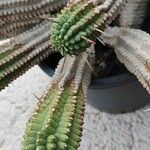
Euphorbia mammillaris
فرفیون مامیلاریس · Corncob-cactus · Corkscrew · Corncob euphorbia · Indian corn cob
Description
Source: leafsnapEuphorbia mammillaris (often mis-spelled Euphorbia mamillaris) is a plant species endemic to Cape Province of South Africa. Euphorbia mammillaris, also known as Indian Corn Cob, is a fast-growing shrublet with thick stems that are chalky green, erect and ribbed. The varigata form has stems that turn rosy pink in colder weather. At maturity, the plant can reach 8-10 inches tall. Each stem can have from 7 to 17 ribs with thick hexagonal tubercles placed next to each other vertically, which resembles the look of a corn cob. The spines are pinkish white, thick and pointy like toothpicks, up to 0.4 inches (1 cm) long and scattered around the stem. From late winter to early summer, Euphorbia mammillaris variegata produces small red and orange flowers from each stem.
Care Guide
💧 Water Every 2-3 weeks
Indian corn cobs, originally adapted to arid regions, are excellent at tolerating drought and only need to be watered once every three weeks. They prefer dry conditions and thrive in well-draining soil, which helps prevent root rot. This makes them an ideal low-maintenance indoor plant.
What should I do if I give too much or too little water to my Indian corn cob?
If you forget to water your Indian corn cob plant for a month or more, it may show signs of being underwatered such as a dull appearance, wrinkles, dryness, browning, or dropping leaves. To address this, you should give the plant plenty of water by fully submerging the pot for 5-10 minutes until the soil feels moist. Overwatering is a danger to Indian corn cob plants and can lead to root rot, which prevents the roots from absorbing nutrients and water. Symptoms of overwatering include yellow, swollen, and translucent organs, which may burst open if filled with too much water. To remedy this, adjust the growing conditions by improving air ventilation and reducing water frequency. Saving an overwatered plant is challenging but possible if caught early. Start by removing the plant from its pot and examining the roots and soil. Remove any wet soil and rinse the roots in room-temperature water to eliminate fungus and assess their health. If the majority of the roots are affected by root rot, it may not be salvageable. However, if only a portion is affected, remove the unhealthy roots, dip the remaining healthy ones in fungicide, and repot the plant in fresh, well-draining soil. While not always successful, most plants will recover and grow new stems in the next growing season.
How much water does my Indian corn cob need?
Determining how often to water Indian corn cob isn't an exact science. The general rule is to water only when the soil is completely dry. To check this, you can insert your finger or a moisture meter into the pot to test the moisture below the surface. If you plant the corn cob in a deep pot, you can use a stick or chopstick to gauge the moisture level. If the soil feels even slightly moist, wait a few days before checking again. In general, during summer you'll likely need to water Indian corn cob every two weeks, and during winter, once a month. However, several factors can affect the frequency of watering. The following section provides some considerations that can help you determine how often to water.
What do I need to think about when watering my Indian corn cob?
There are a few things to consider when watering your Indian corn cob. The size of the container you use, the type of soil, the temperature, and the humidity all play a role. First, the container and soil will determine how often and how much water to use. Make sure the container has drainage holes so extra water can escape. A smaller container holds less moisture, so it needs to be watered more frequently. On the other hand, a larger pot stays wet longer and requires less frequent watering. Avoid using an oversized pot, as this can lead to overwatering. When repotting, go up just one size larger than the current container. In terms of the season, Indian corn cob needs less water in winter and more in the active growing seasons of spring and autumn. During winter, growth slows down and less water is used. Cool air in winter also leads to less evaporation, so the soil stays wet for longer. The climate where you live also affects watering frequency. In a humid area with plentiful rain, you'll need to water less often compared to a dry, arid climate. Keep in mind that conditions can vary within the same geographic location depending on the season and the use of indoor heating and air conditioning. If your Indian corn cob is planted in the ground, it typically doesn't need extra water beyond what it receives naturally. However, during long dry periods, occasional watering may be necessary. In areas where container planting is necessary, you can move the plant outside in the spring and summer, but bring it back indoors when temperatures drop. Keep in mind that a potted Indian corn cob kept outside will require more water due to increased sun exposure, even on a shaded porch.
How should Indian corn cob be watered?
The best way to water Indian corn cob is to thoroughly soak it and then let it dry out before watering again. This plant can tolerate dry conditions, so it's okay to let it get quite dry before watering. It's better to give too little water than too much. When watering, make sure to evenly soak the entire pot's soil, not just one spot. Watering around the whole rim of the planter ensures that all sides of the plant get wet. The amount of water needed depends on the container size and soil absorption. Water the plant until it drains out of the drainage holes, then let the drained water sit in the saucer for 20-30 minutes to absorb into dry soil. Discard any excess water in the saucer to avoid overwatering the soil. Bottom-watering, by placing the pot in a saucer of water, is also a great method because it ensures the soil gets thoroughly moistened. You'll know the soil has enough water when the top layer is moist. This method takes longer but guarantees even water distribution. Indian corn cob is native to a relatively dry habitat with intermittent rainfall. You can imitate this by bottom-watering the plant when the soil is completely dry. It's better to deeply water the soil than to water lightly but frequently.
☀️ Light Full sun
The Indian corn cob grows best with plenty of sunlight but can also do well in spots with less light. Coming from regions with abundant sunshine, its health and growth are largely dependent on light. Still, too much sun can be harmful, and too little light can impede its development.
What are the sunlight requirements for Indian corn cob?
Indian corn cob requires abundant sunlight to thrive, indicative of its natural habitat. Full sun exposure, or above 6 hours of direct sunlight, is ideal, while it can also tolerate partial sun, meaning about 3-6 hours of sunlight. However, it's vital to ensure a balance between light and shade as both overexposure and insufficient light can be detrimental. Overexposure may lead to symptoms like chlorosis, sunscald, and leaf scorching, while inadequate light might cause small leaves, leggy growth, and slower or no new growth.
How can artificial lighting support Indian corn cobs indoors?
When natural sunlight is lacking, especially during winter or in less sunny spaces, artificial lighting becomes crucial for sustaining the growth of Indian corn cobs indoors. It's recommended to use LED lights, which can be customized to provide specific light wavelengths needed by the plant. For full sun plants, 30-50W per square foot is required; partial sun plants need 20-30W per square foot, and full shade plants necessitate 10-20W per square foot. Position the light source 12-36 inches above the plant and ensure it receives 8-12 hours of light per day to mimic natural sunlight conditions.
What are the signs of insufficient sunlight in Indian corn cobs, and how can it be addressed?
Symptoms of insufficient sunlight in Indian corn cobs include smaller new leaves, leggy or sparse growth, faster leaf drop, retarded or ceased new growth, and lighter-colored or chlorotic leaves. To address these, gradually introduce more sunlight by moving plants closer to a south-facing window or provide artificial light for at least 8 hours daily. For outdoor plants, relocate them weekly to sunnier spots to adapt without shock. Pruning or transplanting can also improve sunlight accessibility. Although damaged parts may not recover, new growth will emerge healthy with adequate light.
🌡️ Temperature 20–37.8°C
Indian corn cob originates from warm regions and thrives at temperatures of 68 to 100 °F (20 to 38 °C). During seasonal shifts, it’s recommended to keep indoor temperatures near its natural range to promote optimal growth.
What are the ideal growing conditions for Indian corn cob?
Indian corn cob, or Euphorbia mammillaris, thrives in warm environments with temperatures ranging from 68 to 100 °F (20 to 38 °C). It prefers being kept indoors during seasonal changes to maintain temperatures close to its natural habitat for optimal growth. As a heat-loving plant, the Indian corn cob gradually stops growing and enters a dormant state during winter. It's important to move the plant indoors when the outdoor temperature drops below 0°C, positioning it near a south-facing window to ensure it receives as much sunlight as possible. Supplemental lighting can be used if there's insufficient natural light. During colder periods when temperatures fall below 20°C, its growth slows, and watering should be reduced or ceased to prevent root rot. For those grown outdoors, halt watering in low temperatures and consider insulating with a temporary greenhouse or wrapping the plant with plastic film or fabric for added warmth.
How does low temperature affect Indian corn cob and what should you do?
Indian corn cob is not tolerant of low temperatures and performs best when the temperature remains above 20°C. In winter, it's crucial to keep the plant above 0°C to avoid damage. Exposure to temperatures below -5°C can make the plant weak, cause wilting, and increase susceptibility to root rot. Following mild frost damage, symptoms might not appear immediately, but the plant could wither gradually over a week. The recommended solution involves trimming off the frostbitten areas and checking for root rot. If the roots have rotted, they must be removed, and the plant can be propagated through cuttings. It's essential to then move the plant to a warm environment indoors, near a south-facing window, to ensure it gets enough sunlight. Supplemental lighting should be used if natural light is insufficient.
What are the effects of high temperature on Indian corn cob and how to manage them?
During the summer, it's essential to keep Indian corn cob below 38°C to prevent adverse effects. Temperatures exceeding 43°C halt the plant's growth, leading to water loss, wilting, and an increased risk of sunburn. To manage these conditions, remove the sunburned and rotten parts of the plant and protect it from direct afternoon sunlight until it begins to recover and grow anew. In cases of root rot, cease watering the plant until new roots have started to form. This careful management helps in recovering and maintaining the health of the Indian corn cob in extreme temperatures.
💨 Humidity
🪴 Soil 6-7
🌱 Fertilizer
For Indian corn cob plants, light applications of fertilizer once or twice a year during the growing season are sufficient. Do not fertilize in winter or summer when the plant is dormant. Reduce feeding for repotted plants and wait a couple of months after repotting before applying fertilizer. Fertilizing helps maintain healthy growth and promotes flowering.
Why do I need to put fertilizer on my Indian corn cob?
Fertilizing Indian corn cob provides nutrients to the growing medium and supports healthy growth. Although it already stores water and nutrients, applying plant food during the growing season can further enhance its growth. Fertilizing also encourages mature specimens to produce blooms in the growing season.
When should I fertilize my Indian corn cob for the best results?
Indian corn cobs require a small amount of fertilizer during the growing season. It is recommended to fertilize them in the spring and autumn, but not during the winter or summer when they are dormant. If you have repotted the plants, be cautious with the amount of fertilizer you use and wait a few months before applying any.
When is it not a good idea to put fertilizer on my Indian corn cob?
Indian corn cob, like many plants, goes through a dormancy period where it stops growing. It's important to avoid applying fertilizer during this period in both summer and winter. When repotting in the spring, it's also recommended to wait a couple of months before resuming fertilizing.
What kind of fertilizer does my Indian corn cob need?
When fertilizing Indian corn cob, it is recommended to use a liquid plant food specifically made for succulents and cacti. Dilute the fertilizer with water so that it is half strength to avoid buildup in the soil. Apply the fertilizer to the base of the plant, ensuring excess moisture drains properly from the container or into the ground.
How can I make my Indian corn cob grow better?
When fertilizing Indian corn cob, it is easier to use liquid plant food instead of granules. Make sure to follow the directions on the packaging and dilute liquid fertilizers to half-strength. Regardless of whether you are using granules or liquid plant food, always apply it to the soil. Cover any granules with a thin layer of soil and water the plant, no matter which type of plant food you are using.
🪴 Pot & Repot 2-3 years
Repot the Indian corn cob during the warmer months. Select a pot only slightly larger than the current one that provides good drainage. Use a well-draining cactus or succulent potting mix. Handle the roots and caudex carefully when repotting. After repotting, wait about a week before watering to avoid root rot. Place it in a sunny location for optimal growth.
✂️ Pruning
These plants need little or no upkeep. Euphorbias tend to be root-bound and have fine, shallow roots. Only repotting, and not pruning, should be done every two or three years. Plants should be up-potted into a container that is 2 inches bigger in diameter to allow them plenty of opportunity to thrive.
🌿 Propagating
🐛 Diseases & pets
☠️ Toxicity
All Euphorbia plants have a poisonous sap that is very hazardous if consumed and extremely irritating if it comes into contact with the skin. Keep pets and young children out of reach. When handling this plant, use gloves and use extreme caution.
Characteristics
- Plant Type
- Succulent
- Life Cycle
- Perennial
- Genus
- Euphorbia
- Family
- Euphorbiaceae
- Hardiness Zone
- 9-11
- Mature Height
- 34 cm
- Mature Spread
- 49 cm
- Leaf Color
- Dark Green
- Leaf Type
- Evergreen
- Flower Color
- White
- Flower Size
- 2.54 cm
- Bloom Time
- Late spring, Summer, Early fall
- Planting Time
- Spring, Summer, Autumn
- Harvest Time
- Late summer, Fall
- Native Area
- South Africa