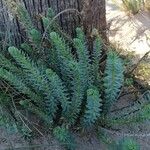
Euphorbia paralias
Sea spurge · Sand Spurge · Приморска млечка
Description
Source: leafsnapEuphorbia paralias, the sea spurge, is a species of flowering plant in the family Euphorbiaceae, native to Europe, northern Africa and western Asia.The species is widely naturalised in Australia. It invades coastal areas, displacing local species and colonising open sand areas favoured by certain nesting birds. Major eradication programmes have been undertaken in some areas, for example by Sea Spurge Remote Area Teams in Tasmania, with great success.
Care Guide
💧 Water Every 7 days
Adapted to sandy coastal soils, sea spurge thrives in harsh conditions with limited salt and water availability. Its succulent leaves demonstrate its drought tolerance, requiring only weekly watering for moderate hydration. The plant exhibits resilience by adjusting its water storage capabilities during periods of high salinity or drought.
How should I water my Sea spurge plant?
To ensure the Sea spurge plant stays healthy, it is recommended to water it with filtered water at room temperature. Tap water may contain harmful particles, so it is best to use filtered water. Additionally, the water should not be cold as the plant is used to warm environments and cold water can shock it. It is also advised to avoid overhead watering, which can cause issues with the foliage. Instead, simply apply filtered room temperature water directly to the soil until it is fully soaked. This helps the roots to absorb moisture and spread through the soil to collect necessary nutrients.
What should I do if I give my Sea spurge too much water or too little water?
Overwatering is a common issue for Sea spurges and can cause wilting, yellowing leaves, and even diseases like root rot, mold, and mildew. Underwatering is less common but can result in brittle, brown leaves. It is important to notice the signs of overwatering early as some diseases may not be fixable if left too long. To address overwatering, reduce watering and ensure the soil drains well. To tackle underwatering, increase watering until the signs improve.
How often do I need to water my Sea spurge plant?
If your Sea spurge plant is in a pot, the most accurate way to determine if it needs water is by sticking your finger into the soil. If you find that the top two to three inches of soil are dry, it means it's time to water it. If you're growing Sea spurge outdoors in the ground, you can use a similar method to test the soil. Once again, if you notice that the top few inches of soil have dried out, it's a sign that you should water it. Usually, during spring and early fall, you'll need to water this plant approximately once a week using this method. However, during extremely hot weather, you may need to increase the frequency to about twice or even more per week. Nevertheless, mature and well-established Sea spurge plants have an impressive ability to tolerate drought.
How much water does my Sea spurge plant need?
To ensure that your Sea spurge is properly watered, don't hold back on the amount of water you give it. Wait until the top two to three inches of soil are dry and then give it a good, deep watering. Make sure to thoroughly soak the soil. You'll know you've added enough water when you see excess water flowing out of the drainage holes at the bottom of the pot. If you don't see any excess water draining, you may have not watered enough. However, be cautious not to let water accumulate in the soil, as this can be harmful to the plant. On the other hand, if water doesn't seem to drain properly, it could indicate that the soil doesn't drain well, which is not good for the plant's health. If your Sea spurge is outdoors, one inch of rain per week should be enough.
How do I water my Sea spurge at different stages of growth?
The water needs of Sea spurge vary depending on its growth stages. In the first few years or after transplanting, it requires more water because it focuses on developing new roots to support future growth. These roots perform best with slightly higher moisture levels. After a few seasons, Sea spurge requires less water. Additionally, during the bloom period, the plant may need more water as flower development utilizes a significant amount of moisture.
☀️ Light Full sun
Sea spurge favors locations with substantial exposure to sunlight. Throughout its growth cycle, sunlight is vital for its healthy development. Coming from environments with little or infrequent shade, it performs well with abundant solar radiation. Excessive shading can lead to poorer growth, while very strong sun does not present a problem for it.
What are the sunlight requirements for Sea Spurge?
Sea Spurge requires full sun, which means it needs above 6 hours of sunlight daily to thrive. However, it can also tolerate partial sun, about 3-6 hours of sunlight. It's important to observe how sunlight moves through your garden to find spots that offer the perfect balance of light and shade, ensuring the plants' happiness and healthy growth. Sea Spurge naturally grows in habitats with abundant sunlight and minimal shade, so excessive shade could hinder its growth, but it's generally not troubled by too much sun.
What are the essentials for growing Sea Spurge in terms of sunlight?
Sunlight is crucial for the optimal growth of Sea Spurge, which prefers considerable exposure to sunlight throughout its growth cycle. Originating from habitats with sparse shading, it thrives under ample solar energy. While excessive shaded conditions can lead to suboptimal growth, too much sun does not usually pose a problem. For indoor plants, adequate lighting is essential, especially when natural sunlight is not sufficient. Artificial lighting, such as LED lights, can be used to provide the necessary wavelengths of light. For full sun plants, 30-50W/sq ft of artificial light is needed, for partial sun plants, 20-30W/sq ft, and for full shade plants, 10-20W/sq ft. It's also important to determine the right placement and duration for artificial lighting to mimic natural sunlight effectively.
What are the symptoms of light deficiency in Sea Spurge?
When Sea Spurge does not receive adequate light, several symptoms may manifest, indicating light deficiency. These include the growth of smaller new leaves, leggy or sparse growth, faster leaf drop, slower or halted new growth, and lighter-colored or chlorotic new leaves. Additionally, symptoms of excessive sunlight exposure, such as sunscald, leaf curling, wilting, leaf scorching, and chlorosis, could also occur, affecting the plant's ability to photosynthesize and its overall health.
What solutions can be implemented to address light-related issues in Sea Spurge?
To ensure optimal growth for Sea Spurge, gradually acclimate the plant to receive at least 6 hours of direct sunlight daily. For indoor plants, consider using artificial light if the plant is large or not easily movable, with at least 8 hours of light daily. For outdoor plants, gradually move them to sunnier locations each week to avoid sunburn. If sunlight is obstructed, identify and minimize obstructions or consider transplanting smaller plants during their dormant period to locations with more sunlight and good drainage. Note that parts of the plant affected by insufficient sunlight may not recover, but new growth should be healthy with increased light exposure.
🌡️ Temperature 15–35°C
Sea spurge comes from temperate areas and favors mild conditions, with temperatures between 59 and 95 °F (15 to 35 ℃). During the cooler months, make sure temperatures do not fall below 15 ℃. In summer, avoid letting them go above 35 ℃.
What are the ideal temperature conditions for Sea Spurge?
Sea Spurge, or Euphorbia paralias, thrives in temperate regions and prefers mild conditions. The ideal temperature range for this plant is between 59 to 95°F (15 to 35°C). During the cooler months, it's important to ensure the temperature does not drop below 15°C to maintain its health. Conversely, in the summer months, efforts should be made to not exceed a temperature of 35°C. Sea spurge has some level of cold tolerance and generally does not require special care when temperatures are above -5°C. However, if temperatures are forecasted to drop below -5°C, it is advisable to take temporary protective measures such as wrapping the plant in plastic film, fabric, or other materials to insulate it against the cold.
How does Sea Spurge respond to extreme temperatures and how should I care for it?
Sea Spurge can moderately tolerate low temperatures, but it performs best when the temperature remains above 15°C. If winter temperatures fall below -5°C, its leaves may start to droop, and, if temperatures go below -10°C, they might wilt and eventually fall off. In these cases, you should trim off the frost-damaged parts and, before facing low temperatures again, wrap the plant with non-woven fabric or cloth, and construct a wind barrier to protect it from cold winds. During high temperature periods, especially when it exceeds 41°C, the leaves may lighten in color, dry, curl, and the plant can become more susceptible to sunburn. To counteract this, trim away the sunburned and dried-up parts, move the plant to a shaded area away from direct midday and afternoon sun, or use shade cloth. Additionally, ensure to water it in the morning and evening to maintain soil moisture.
💨 Humidity
🪴 Soil 6-8
🌱 Fertilizer
Applying fertilizer one time in spring is typically enough for Sea spurge, although repeated feedings can boost growth. Apply fertilizer about every month to six weeks. Fertilizing improves leaf look and function, helping maintain even color and a healthy texture. It also encourages root development and better nutrient uptake for the plant's long-term health.
🪴 Pot & Repot Every 2 years
✂️ Pruning
Sea spurge has fleshy, spiky leaves and yellow-green flowers. To encourage growth and improve air circulation, prune the plant from early to late spring, which also helps manage its spread. Be cautious of the milky sap, as it can be irritating. For more detailed guidelines, consult reputable sources such as the Royal Horticultural Society.
🌿 Propagating
🐛 Diseases & pets
☠️ Toxicity
Characteristics
- Plant Type
- Herb
- Life Cycle
- Perennial
- Genus
- Euphorbia
- Family
- Euphorbiaceae
- Hardiness Zone
- 8-10
- Mature Height
- 61 cm
- Mature Spread
- 30 cm to 49 cm
- Leaf Color
- Green, Blue
- Leaf Type
- Deciduous
- Flower Color
- Yellow
- Flower Size
- 0.15 cm
- Bloom Time
- Summer
- Planting Time
- Spring
- Harvest Time
- Late summer, Early fall, Mid fall
- Native Area
- Libya, Egypt, Turkey, Montenegro, Croatia, Morocco, Slovenia, Russia, Romania, Belgium, Portugal, France, Netherlands, Tunisia, Cyprus, Bulgaria, Greece, Ukraine, Serbia, Lebanon, Syria, Italy, Spain, Albania, Ireland, United Kingdom, Algeria