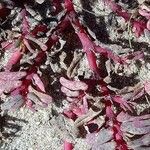
Euphorbia peplis
Purple spurge · Euphorbe peplis · Spurge
Description
Source: leafsnapEuphorbia peplis, the purple spurge, is a species of Euphorbia, native to southern and western Europe, northern Africa, and southwestern Asia, where it typically grows on coastal sand and shingle.It is a small, prostrate annual plant, the stems growing to 10–20 cm (4–8 in) long, typically with four stems from the base. The leaves are opposite, oval, 1–2 cm (0.4–0.8 in) long, grey-green with reddish-purple veins.At the northern edge of its range in England, it has always been rare, and is now extinct.
Care Guide
💧 Water
Purple spurge thrives in areas with moderate water availability and prefers balanced moisture levels. Native to regions with consistent rainfall, it benefits from weekly watering to maintain optimal health. As an evergreen plant, purple spurge keeps its leaves year-round, which helps it absorb water continuously, even during drier seasons.
How should I water my Purple spurge plant?
To water Purple spurge, you have a few options. You can use a garden hose with a spray nozzle, a watering can, or any other common watering tool. Purple spurge is not too fussy about how it gets water; it can survive with rainwater, tap water, or filtered water. It's best to avoid watering this plant from above, as it can harm the leaves and flowers and potentially cause disease. A drip irrigation system is often the most effective way to water Purple spurge, as it provides even and direct watering to the soil. For Purple spurge in a container, you can use a similar approach but adjust the tools you use. Use a cup, watering can, or tap water to apply water directly to the soil.
What should I do if I give my Purple spurge too much or too little water?
To prevent underwatering, simply water your Purple spurge more regularly when you notice it lacks moisture. Overwatering, on the other hand, can be a serious issue if not detected early. It can cause diseases and ultimately, the death of your plant. To avoid overwatering, choose a suitable location for your Purple spurge with ample sunlight and good drainage to prevent waterlogged soil. If you've overwatered a potted Purple spurge, consider transferring it to a new pot with proper drainage. Use loose soil and a pot that drains efficiently when repotting.
How often should I give water to my Purple spurge?
To keep your Purple spurge healthy, it is important to provide it with regular watering during the growing season. In the spring, water it once a week. As the season progresses and the temperature rises, you may need to increase the watering frequency to two to three times per week. However, be careful not to overwater, as this can harm the plant. It is crucial to keep the soil moist but not wet. When it comes to Purple spurge in a pot, you will need to water it more frequently compared to one planted in the ground. The soil in a pot tends to dry out faster, so watering a container-grown Purple spurge a few times per week is usually necessary.
How much water does my Purple spurge require?
Determining how much water to give your Purple spurge can be done in a few different ways. Some gardeners prefer to feel the soil to gauge moisture levels. For this method, make sure the first six inches of soil are moist before stopping watering. Alternatively, you can use a set measurement, usually around two gallons per week, taking into account factors like temperature and soil dryness. However, it's important to avoid overwatering if your plant requires less than two gallons. When growing Purple spurge in a container, a different approach is needed. Ensure all layers of dry soil are moistened by either using your finger to test for moisture or observing a slight trickle of excess water from the drainage holes.
How do I know if I'm giving enough water to my Purple spurge plant?
Avoiding overwatering your Purple spurge can be tricky due to its deep roots that need regular watering. However, Purple spurge is prone to root rot and browning from excess water. Underwatering is less of a concern as the plant can survive without extra watering, but if you neglect to water it for too long, it may wilt and develop dry leaves.
☀️ Light Full sun
Purple spurge prefers ample sunlight, which promotes its growth. It grows best with plentiful light, though it can tolerate spots with less sun. Too little light can result in stunted growth, while too much exposure may scorch the leaves. This mirrors its original habitat, where sunlight was plentiful.
What are the sunlight requirements for Purple Spurge?
Purple Spurge requires generous sun exposure to thrive, growing best with plentiful light, although it can tolerate areas with less sunlight. It needs full sun, which is above 6 hours of sunlight daily, or partial sun, about 3-6 hours of sunlight. Inadequate light may cause stunted growth, while too much can lead to leaf scorching, reflecting its natural habitat where sunlight was abundant. It's important to observe the sunlight movement in your garden to find the perfect spot that offers a balance of light and shade, meeting the plant's requirements for optimal growth.
How can artificial lighting assist in the growth of indoor Purple Spurge plants?
Indoor Purple Spurge plants can benefit significantly from artificial lighting, especially when natural sunlight is insufficient, such as in winter or less sunny spaces. Artificial lights, like LED, can be customized to provide specific wavelengths of light needed by the plant, mimicking natural sunlight. Full sun plants require 30-50W/sq ft, partial sun plants need 20-30W/sq ft, and full shade plants need 10-20W/sq ft of artificial light. The light source should be placed 12-36 inches above the plant, ensuring 8-12 hours of light daily to promote faster, healthier growth.
What are the symptoms of inadequate lighting in Purple Spurge?
When Purple Spurge is grown indoors with insufficient light, it may exhibit several symptoms indicating light deficiency. These include small leaves, leggy or sparse growth, faster leaf drop, slower or no new growth, lighter-colored new leaves, chlorosis (leaves turning yellow due to chlorophyll breakdown), sunscald, leaf curling as a defense mechanism against excessive sunlight, wilting from moisture loss, and leaf scorching. These symptoms suggest the plant is not receiving the optimal light conditions for its growth.
What solutions can address light deficiency in Purple Spurge, both indoors and outdoors?
To address light deficiency in Purple Spurge, gradually move the plant to a location with at least 6 hours of direct sunlight daily. For indoor plants, use a south-facing window, keep curtains open, or use artificial lights like desk or ceiling lamps for at least 8 hours daily. For outdoor plants, avoid sudden changes in light intensity to prevent sunburn. If obstructions block sunlight, consider pruning or transplanting to a sunnier location. Note that parts of the plant affected by insufficient sunlight may not recover, but new growth will be healthy after increasing light exposure.
🌡️ Temperature 20–37.8°C
Purple spurge is a plant native to areas with moderate temperatures. It grows best when temperatures range from 68 to 100.4 °F (20 to 38 ℃). Specific seasonal temperature adjustments may be necessary, especially during periods of extreme heat or cold.
What is Purple Spurge and where does it originate?
Purple spurge is a plant native to regions with moderate temperatures. It's scientifically known as Euphorbia peplis and thrives in conditions where the temperature ranges between 68 to 100.4 °F (20 to 38 °C). This plant is particularly heat-loving and requires certain seasonal temperature adjustments to grow optimally, especially during extreme weather conditions.
How should Purple Spurge be cared for in extreme temperatures?
In extreme heat or cold, Purple spurge requires specific care to maintain its health. During the cold months of autumn, it's advised to bring outdoor plants indoors and place them near a bright window, albeit at a safe distance from heaters to avoid overheating. The ideal temperature should remain above 20°C to encourage growth, with care taken to avoid temperatures nearing 10°C as they can severely damage the plant.
What are the symptoms and solutions for Purple Spurge exposed to low temperatures?
Exposure to low temperatures is harmful to Purple Spurge, which thrives best above 20°C and requires temperatures to be kept above 10°C during winter. Symptoms of cold damage include lightening of leaves, which may turn brown or black and exhibit wilting or drooping if frost occurs. The solution involves trimming off frost-damaged parts and moving the plant to a warmer indoor setting, ideally near a south-facing window for ample sunlight, while avoiding placement near heaters or air vents to prevent air dryness.
How does high temperature affect Purple Spurge and what are the corrective measures?
During summer, it's crucial to keep Purple Spurge's environment below 38°C to prevent heat stress. Exposure to temperatures above 43°C can lighten the leaves' color and increase susceptibility to sunburn. To mitigate damage, trim away sunburned or dried-up parts and relocate the plant to a shaded spot, especially during the midday and afternoon sun. Ensuring the soil remains moist with morning and evening watering can also help the plant recover from high-temperature stress.
💨 Humidity
🪴 Soil 6-7
🌱 Fertilizer
Purple spurge benefits from frequent, light applications of fertilizer to encourage healthy leaf growth. You should fertilize Purple spurge about once a month during the summer months. Nitrogen is essential for foliage, and supplying nitrogen-rich sources helps Purple spurge thrive.
🪴 Pot & Repot
✂️ Pruning
Purple spurge benefits from pruning between early and late spring. Focus on cutting back overgrown stems and removing any damaged parts to improve air circulation. Regular pruning encourages healthy growth and prevents the plant from becoming leggy. Be sure to use clean, sharp tools, and avoid pruning in late fall to ensure the plant recovers optimally.
🌿 Propagating
🐛 Diseases & pets
☠️ Toxicity
Characteristics
- Plant Type
- Herb
- Life Cycle
- Annual
- Genus
- Euphorbia
- Family
- Euphorbiaceae
- Hardiness Zone
- 11
- Mature Height
- 10 cm to 61 cm
- Mature Spread
- 0.3 m to 3.96 m
- Leaf Color
- Green, Blue
- Leaf Type
- Semi-evergreen
- Flower Color
- Yellow, Green
- Flower Size
- 0.20 cm to 0.25 cm
- Bloom Time
- Summer, Early fall, Mid fall
- Planting Time
- Spring, Summer
- Harvest Time
- Late summer, Fall, Early winter
- Native Area
- Saudi Arabia, Libya, Egypt, Turkey, Tunisia, Montenegro, Cyprus, Bulgaria, Greece, Croatia, Slovenia, Morocco, Yemen, Ukraine, Lebanon, Russia, Serbia, Iraq, Syria, Italy, Spain, France, Albania, Ireland, United Kingdom, Romania, Algeria, Portugal