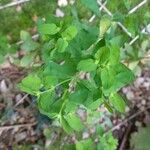
Euphorbia peplus
فرفیون زگیل دار · Γαλατσίδα · Πέπλος (Διοσκουρίδη) · Ευφορβία · Petty spurge
Description
Source: leafsnapEuphorbia peplus (petty spurge, radium weed, cancer weed, or milkweed), is a species of Euphorbia, native to most of Europe, northern Africa and western Asia, where it typically grows in cultivated arable land, gardens and other disturbed land.Outside of its native range it is very widely naturalised and often invasive, including in Australia, New Zealand, North America and other countries in temperate and sub-tropical regions.
💡 All spurges share a common characteristic: they release a milky, latex-like sap when their leaves or stems are crushed. This white and sticky substance can cause intense pain if it gets into a person’s eyes. Therefore, it is important to wear gloves when handling spurge plants, as the latex can irritate the skin. If the latex is not washed off promptly, it will congeal, and you will need an emulsion, such as milk or cream, to remove it.
🌳 Beyond its ordinary presence in gardens, petty spurge serves as an interesting bioindicator. Its growth and condition can indicate the presence of certain metals, such as zinc and lead, in the soil. This information is especially useful for evaluating environmental quality and soil health in ecological studies and restoration efforts.
🎭 Cleanliness, safeguarding and insight
Care Guide
💧 Water
Petty spurge, native to temperate regions, flourishes in conditions of consistent moisture and shows moderate tolerance to drought. It should be watered weekly, with increased frequency during periods of active growth to maintain its lush, herbaceous form, especially when grown outdoors.
How should I water my Petty spurge plant?
When it comes to watering Petty spurge, there are a few options you can choose from. You can use a garden hose with a spray nozzle, a watering can, or any other common watering tool. Petty spurge isn't too particular about the type of water it receives, so rainwater, tap water, or filtered water will do just fine. However, it's best to avoid watering this plant from overhead as it can harm the leaves and flowers and potentially lead to disease. Instead, setting up a drip irrigation system is often the most effective method. This system distributes water evenly and directly to the soil, which is beneficial for Petty spurge. If you have a container-grown Petty spurge, you can still use a similar watering approach but should switch to using a cup, watering can, or your tap to apply water directly to the soil.
What should I do if I give my Petty spurge too much water or not enough water?
The remedy for underwatering Petty spurge is simple: if you notice it lacks moisture, water it more regularly. Overwatering is a more serious issue as it can lead to disease and death. To prevent this, choose a location with plenty of sunlight and good drainage. If you overwater a potted Petty spurge, consider changing to a pot with better drainage and using loose soils when repotting.
How frequently should I water my Petty spurge plant?
Petty spurge requires regular watering throughout its growing season. In spring, you should water the plant once a week. As the season progresses and the weather gets warmer, you may need to increase watering to two to three times per week. However, exceeding this watering rate can harm the Petty spurge. It is important to keep the soil relatively moist but not wet, regardless of how often you water. Watering a potted Petty spurge is slightly different. Generally, you need to water potted plants more frequently because the soil in pots can heat up and dry out faster than ground soil. As a result, you should plan to water a potted Petty spurge a few times per week, compared to once per week for the one planted in the ground.
How much water does my Petty spurge plant need?
Determining the appropriate amount of water for your Petty spurge can be done in a few different ways. Some gardeners prefer to assess the soil's moisture by touch and water until the top six inches feel moist. Others use a specific measurement, typically around two gallons per week, considering factors like heat and soil drying speed. However, adhering strictly to these guidelines may cause overwatering if your plant requires less. When growing Petty spurge in a container, a different approach is necessary. You should water enough to saturate each dry layer of soil, which can be checked by inserting a finger. Alternatively, water until you observe a small amount of excess water draining from the pot's holes.
How can I know if I am watering my Petty spurge enough?
Avoid overwatering your Petty spurge can be a bit challenging. On one hand, you need to water the soil weekly because these plants have deep roots. However, Petty spurge is prone to root rot, which can cause browning. Underwatering is not a big concern for these plants as they can survive without much watering. However, if you go too long without watering, the plant may wilt and the leaves may become dry.
☀️ Light Full sun
Petty spurge prefers a spot that gets plenty of sunlight throughout the day, though it can cope with reduced light. Coming from areas with high sun exposure, it thrives in those conditions. Nevertheless, both excessive and insufficient light can harm its healthy growth.
What are the sunlight requirements for Petty Spurge?
Petty Spurge thrives best with ample sunlight exposure throughout the day, ideally flourishing in environments with significant sunlight. It requires full sun, defined as more than 6 hours of direct sunlight daily, to partial sun, which is about 3-6 hours of sunlight. Although it can manage with less light, ensuring it receives enough sunlight is crucial for its healthy growth. It's essential to observe your garden's sunlight patterns to find spots that offer the right balance of light and shade, as this will significantly impact your plant's happiness and vitality.
How can artificial lighting assist in growing Petty Spurge indoors?
When natural sunlight is insufficient, especially during winter or in less sunlit spaces, artificial lighting can provide a much-needed boost to indoor plants, including Petty Spurge. Selecting the correct type of artificial light, such as LED lights, is crucial as these can be customized to emit specific light wavelengths necessary for plant growth. For full sun plants, 30-50W per square foot is recommended; partial sun plants benefit from 20-30W per square foot, while full shade plants need 10-20W per square foot. Positioning the light source 12-36 inches above the plant simulates natural sunlight, and ensuring your plant receives 8-12 hours of light per day is vital for optimal growth.
What are common symptoms of improper lighting in Petty Spurge?
Improper lighting can lead to various symptoms in Petty Spurge. Insufficient light often results in small, immature leaves, leggy growth, faster leaf drop, and delayed or ceased growth. Conversely, excessive sunlight can cause chlorosis (leaf yellowing), sunscald, leaf curling, wilting, and leaf scorching. These symptoms can significantly affect the plant's health, signaling either a need for increased or decreased light exposure to maintain its vitality.
What solutions exist for Petty Spurge experiencing low sunlight exposure?
To counteract low sunlight exposure for Petty Spurge, gradually acclimate your plant to more sunlight by moving it to a sunnier location each week until it receives at least 6 hours of direct sunlight daily. For indoors, ensure it's placed near a south-facing window or consider artificial lights such as desk or ceiling lamps, or invest in professional grow lights to provide at least 8 hours of light daily. For outdoor plants, moving them gradually prevents sunburn. Remember, parts of the plant damaged by low light may not recover, but new growth will be healthy with increased light exposure. Also, reducing obstructions like tree branches can improve sunlight access. For smaller plants, consider transplanting during their dormant period to a location with better sunlight and drainage.
🌡️ Temperature 5–37.8°C
Petty spurge comes from temperate regions and therefore favors a moderate temperature range of 68 to 100.4°F (20 to 38℃). Depending on the season, adjustments may be made to recreate this environment. Too large a deviation could lead to distress.
What is the preferred temperature range for Petty Spurge?
Petty spurge, known botanically as Euphorbia peplus, thrives in temperate regions with a moderate temperature range between 68 to 100.4°F (20 to 38°C). It is essential to adjust the environment depending on the season to mimic this temperature range as much as possible. Excessive deviation from these temperatures could lead to the plant experiencing distress.
Does Petty Spurge require frost protection during winter?
Petty spurge has strong cold resistance and usually does not require special frost protection measures during the winter. However, if temperatures are expected to drop below the growth limit temperature, it is important to provide cold protection. This can be done by covering the plant with soil, straw, or similar materials. Moreover, it is beneficial to water the plant abundantly before the first freeze in autumn to keep the soil moist, which helps prevent drought and water scarcity for the plant during winter and early spring.
How does low temperature affect Petty Spurge, and what are the solutions?
Petty spurge is quite tolerant to cold and fares best when the temperature stays above its minimum suitable growth temperature. Throughout the winter, it should be maintained above its minimum tolerable growing temperature. If the temperature falls below the lower growth limit temperature, while there might not be visible changes during the winter, the plant may experience decreased sprouting or even fail to sprout in spring. In such cases, the solution is to remove any parts of the plant that have failed to sprout in spring.
How does high temperature affect Petty Spurge, and what are the solutions?
During summer, Petty spurge should be kept below its maximum suitable growth temperature. If the temperature exceeds its maximum tolerable growing temperature, you may notice the plant's leaves becoming lighter in color, curling, becoming prone to sunburn, and in severe cases, the entire plant may wilt and dry out. To combat this, trim away the sunburned and dried-up parts. Move the plant to a shadier location, especially during midday and afternoon, or use a shade cloth. Ensure the plant is watered in the morning and evening to keep the soil moist.
💨 Humidity normal (40-60%)
This plant will thrive in moderate humidity, which is probably the level in your home. However, misting it a few times a week can be very beneficial. Make sure the room has good ventilation.
🪴 Soil 6-7
🌱 Fertilizer
Petty spurge benefits from regular, gentle applications of fertilizer to encourage healthy leaf growth. You should feed Petty spurge about once a month during the summer months. Nitrogen is important for foliage, and providing nitrogen-rich fertilizers helps Petty spurge flourish.
🪴 Pot & Repot
For petty spurge to thrive in pots, it requires excellent drainage.
✂️ Pruning
Petty spurge should be pruned throughout the spring and autumn seasons. To encourage new development, remove any dead or unhealthy branches. Pruning may also be an efficient way to improve flowering.
🌿 Propagating
🐛 Diseases & pets
☠️ Toxicity
Characteristics
- Plant Type
- Herb
- Life Cycle
- Annual, Biennial
- Genus
- Euphorbia
- Family
- Euphorbiaceae
- Hardiness Zone
- 5-11
- Mature Height
- 5 cm to 30 cm
- Mature Spread
- 25 cm
- Leaf Color
- Green, Silver, Gray
- Leaf Type
- Deciduous
- Flower Color
- Green, Yellow
- Flower Size
- 2.54 cm
- Bloom Time
- Mid spring, Late spring, Early summer
- Planting Time
- Spring
- Harvest Time
- Early summer, Mid summer
- Native Area
- Libya, Egypt, Turkey, Austria, Sweden, United Arab Emirates, Slovakia, Montenegro, Croatia, Slovenia, Morocco, Yemen, Belarus, Russia, Iraq, Germany, Oman, Romania, Qatar, Belgium, Moldova, Portugal, Netherlands, Saudi Arabia, France, Tunisia, Czech Republic, Sudan, Cyprus, Bulgaria, Poland, Armenia, Greece, Ukraine, Serbia, Lebanon, China, Norway, Syria, Italy, Spain, Switzerland, Finland, Iran, Albania, Ireland, United Kingdom, Hungary, Algeria, Azerbaijan