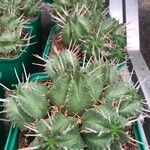
Euphorbia pulvinata
Pricky heaps · Pincushion Euphorbia · Lurking Crab Cactus
Description
Source: leafsnapEuphorbia pulvinata, commonly known as cushion spurge, is a succulent plant native to South Africa. It is a member of the Euphorbia family and is named for its compact, cushion-like growth habit. This low-growing, mat-forming plant produces small, greenish-yellow flowers in the spring and summer. The leaves of Euphorbia pulvinata are small, oval-shaped, and arranged in pairs along the stems. These leaves are covered with fine hairs, giving them a fuzzy appearance. The stems themselves are thick and fleshy, with a reddish-brown coloration. Euphorbia pulvinata thrives in well-draining soil with moderate moisture levels but can also tolerate periods of drought once established. It grows well in full sun or partial shade but needs protection from frost during the winter months. This succulent plant has several medicinal uses, particularly in treating skin conditions such as warts or eczema, thanks to its anti-inflammatory properties. However, it should be handled with care, as it produces toxic sap that can cause skin irritation or even blindness if it comes into contact with the eyes. Overall, Euphorbia pulvinata is an attractive, low-maintenance succulent that adds texture and interest to rock gardens or container arrangements. When used appropriately and under professional guidance, it also offers medicinal benefits.
Care Guide
💧 Water Every 7 days
Pricky heaps is a drought-tolerant succulent native to arid regions, and it thrives with very little water. It only needs to be watered once every three weeks. This plant does exceptionally well outdoors, where it can benefit from natural rainwater. Its low water requirements make it ideal for xeriscaping and rock gardens that emphasize water conservation.
What do I do if I give my Pricky heaps too much or too little water?
Pricky heaps and other succulents are resilient and can go without water for extended periods. However, if you neglect to water them for a month or more, you may notice signs of thirst or damage. Underwatered Pricky heaps will appear lackluster and wrinkled. Some may have dried up completely and turned brown or crispy. The soil will also be completely dry. To revive an underwatered Pricky heaps, soak the pot in water for 5-10 minutes until you feel moisture on the soil's surface. On the other hand, overwatering is dangerous for Pricky heaps and can lead to root rot. Root rot occurs when fungi and bacteria thrive in the overly wet soil, preventing the roots from absorbing nutrients. Symptoms of overwatering include yellow, swollen, and translucent organs that may burst open. If left untreated, the plant may turn brown or black and the leaves may fall off easily. To address overwatering, adjust the growing conditions to improve air ventilation and reduce watering frequency. Saving an overwatered plant is challenging but possible if caught early. Start by removing the plant from its pot and examining the roots and soil. Remove wet soil, rinse the roots in room-temperature water, and check for root rot. If the majority of the roots are affected, it may not be salvageable. However, if only a portion of the roots are affected, there is hope. Trim unhealthy roots with sterilized tools and dip the remaining healthy roots in fungicide. Repot the plant in fresh, well-draining soil. While this doesn't always work, most plants can recover and start growing again in the next season.
How often should I water my Pricky heaps? --> How often do I need to water my Pricky heaps?
Determining how often to water Pricky heaps can be a bit tricky, as there isn't a strict rule. However, there are some easy methods to help you out. Firstly, check the soil regularly and only water when it's completely dry. You can either stick your finger in the pot or use a moisture meter to test the soil beneath the surface. If you're using a deep pot, a stick or chopstick can be used for this purpose. If the soil feels even slightly damp, give it a few more days and check again. In general, during the summer, most people will need to water Pricky heaps around every two weeks, while in winter, once a month is typically sufficient. However, there are different factors to consider that can affect the frequency. The following section provides some considerations that can help you determine how often to water.
What things should I think about when watering my Pricky heaps?
To properly water your Pricky heaps, you need to consider various environmental conditions. These include container size, soil type, temperature, and humidity. Depending on these factors, you will need to adjust the frequency and amount of water you give to your plant. Using a container with good drainage is essential to prevent excessive water accumulation. Smaller containers hold less moisture, so they will require more frequent watering. Conversely, larger pots retain more water and can be watered less often. However, avoid using an oversized pot as this can lead to overwatering. When repotting, only move to a slightly larger container. Shallow containers are ideal for Pricky heaps, as they have shallow root systems. In terms of seasons, Pricky heaps needs less watering during winter when its growth is slow and it doesn't require as much energy or water. The lower evaporation rate in cooler winter air means that the soil stays wet for longer compared to summer. Additionally, the climate in your location also affects watering frequency. If you live in a humid area with regular rainfall, you won't need to water as often compared to a dry, arid climate. Remember that even in the same geographic location, conditions can vary based on the season and indoor heating or air conditioning. For outdoor planting, once Pricky heaps has established its root system in the ground, it generally doesn't need additional watering apart from what it receives naturally through precipitation and dew. However, during long dry periods, occasional watering might be necessary. In areas where Pricky heaps can only be grown in containers, the plant can be moved outside in spring and summer, as long as the temperature is suitable. In such cases, the potted plant will require more water than if it were kept indoors due to increased sun exposure, even on a shaded porch.
How should you water Pricky heaps?
To water Pricky heaps effectively, it is best to thoroughly soak the plant and then allow it to dry out before watering again. This type of plant can tolerate drought, so it is okay to let it become quite dry before watering. It is better to give this plant too little water rather than too much. When watering, make sure the soil throughout the whole pot is thoroughly soaked. Instead of pouring water in just one spot, try to evenly distribute the water around the rim of the planter to ensure all sides of the plant get wet. The amount of water needed will depend on the size of the container and the soil's absorption. Give the plant enough water that it drains out from the drainage holes, and then ideally leave the drained water in the saucer for about 20-30 minutes to allow it to absorb into dry pockets of soil. Afterward, discard any excess water in the saucer to prevent the soil from becoming waterlogged. Bottom-watering is also a great method for watering Pricky heaps as it ensures the soil is thoroughly moistened. This involves placing the pot in a saucer of water and letting the soil absorb moisture through the drainage holes. You will know the soil has absorbed enough water when the top layer feels moist. This method takes a bit more time than top-watering but ensures an even distribution of water throughout the pot. Since Pricky heaps are native to dry habitats with infrequent rain, you can mimic this situation by bottom-watering the plant when the soil is completely dry. Providing deep soil bathing is more beneficial than frequently watering lightly.
☀️ Light Full sun
Native to arid regions, Pricky heaps does best in full sun; its native habitat is marked by intense sunlight and little shade. It also tolerates partial sun, giving it some flexibility in growth.
What are the sun requirements for Pricky heaps?
Pricky heaps requires full sun, which means it thrives in conditions that provide more than 6 hours of sunlight daily. It can also grow under partial sun conditions, receiving about 3-6 hours of sunlight. Observing how sunlight moves through your garden can help you identify the ideal spots that offer a balance of light and shade, which is crucial for the plant's health.
What are the essentials for growing Pricky heaps?
Native to arid regions, Pricky heaps is adapted to environments characterized by strong sunlight and minimal shade. While it thrives in full sun, it can also adapt to partial sun conditions. In indoor settings or places with insufficient natural sunlight, especially during winter or in less sunny spaces, artificial lighting becomes essential for optimal growth. LED lights are recommended for their ability to be customized to the specific light wavelengths needed by plants. The intensity of artificial light should be between 10-50W/sq ft depending on whether the plant is considered full sun, partial sun, or full shade. Proper placement (12-36 inches above the plant) and duration (8-12 hours per day) of the light source are also important to mimic natural sunlight as closely as possible.
What symptoms indicate insufficient light for Pricky heaps?
Symptoms of light deficiency in Pricky heaps include smaller new leaves, leggy or sparse growth, faster leaf drop, slower or halted growth, paler new leaves, chlorosis (yellowing leaves), sunscald, leaf curling, wilting, and leaf scorching. These signs suggest that the plant is not receiving adequate sunlight, which is vital for its health and growth.
How can I address light deficiency symptoms in Pricky heaps?
To combat light deficiency symptoms in Pricky heaps, gradually increasing sunlight exposure is key. For indoor plants, move them closer to a south-facing window or use artificial lighting like desk, ceiling lamps, or professional grow lights for at least 8 hours a day. For outdoor plants, relocate them to sunnier spots gradually to avoid shock and sunburn. Removing obstructions and, for smaller plants, considering transplantation during their dormant period can also help. Unfortunately, parts of the plant already affected by insufficient light may not recover, but new growth should be healthy with improved light conditions.
🌡️ Temperature 20–37.8°C
Although Pricky heaps can tolerate some heat, it mainly thrives and grows in the cooler seasons and becomes dormant in summer. In very hot summer weather, shade should be provided to prevent scorching from intense sunlight. Watering ought to be reduced or stopped during the hottest part of the year to avoid root rot. Winter and spring are when Pricky heaps shows vigorous growth. If temperatures do not fall too low, it will continue to grow steadily.
What are the ideal growing conditions for Pricky heaps?
Pricky heaps, scientifically known as Euphorbia pulvinata, thrives in warm environments. It requires higher temperatures during the growing season to facilitate growth and metabolism. The plant enjoys ample sunlight, appropriate moisture levels, and good ventilation. However, it is susceptible to damage from excessively low temperatures and overwatering. It's crucial to maintain a balance by avoiding excessively high temperatures and overly dry conditions as well. During the winter, Pricky heaps gradually stops growing and enters a dormant state. When temperatures drop below -35°C, it is advisable to move the plant indoors and position it near a south-facing window to ensure it receives as much sunlight as possible. Supplemental lighting can be used if natural light is insufficient. Watering should be reduced or halted when temperatures fall below 0°C to prevent root rot, and for those grown outdoors, watering should be completely stopped during cold weather.
What are the symptoms of temperature stress in Pricky heaps and how can they be addressed?
Pricky heaps shows differing symptoms under low and high temperature stress. For low temperature stress, Pricky heaps is best kept above 0°C and requires protection during winter to stay above -35°C. Below -40°C, the plant may show signs of weakness, wilting, and become prone to root rot. In cases of mild frost damage, symptoms might not appear immediately, but the plant will gradually wither. The solution involves trimming off the frostbitten areas and checking for root rot—rotted roots should be cut off, and the plant can be propagated through cuttings. Moving the plant to a warm indoor environment near a south-facing window can ensure sufficient sunlight, with supplemental lighting as needed. For high temperature stress, when temperatures exceed 45°C, Pricky heaps ceases growth, experiences water loss, wilting, and becomes susceptible to sunburn. The remedy involves removing sunburned and rotten parts and shielding the plant from afternoon sunlight until recovery. If root rot is present, watering should be halted until new roots emerge.
💨 Humidity
🪴 Soil 6-7
🌱 Fertilizer
Pricky heaps need only light fertilizer applications once or twice a year during the growing season. Do not fertilize in winter or summer when the plant is dormant. Cut back on fertilizer for repotted plants and wait a couple of months after repotting before you fertilize. Fertilizing promotes healthy growth and encourages flowering.
🪴 Pot & Repot Every 2 years
✂️ Pruning
🌿 Propagating
🐛 Diseases & pets
☠️ Toxicity
Characteristics
- Plant Type
- Succulent
- Life Cycle
- Perennial
- Genus
- Euphorbia
- Family
- Euphorbiaceae
- Hardiness Zone
- 9-11
- Mature Height
- 30 cm
- Mature Spread
- 49 cm
- Leaf Color
- Dark Green
- Leaf Type
- Evergreen
- Flower Size
- 0.51 cm to 1.02 cm
- Bloom Time
- Mid spring, Late spring, Early summer
- Planting Time
- Spring, Summer, Autumn
- Harvest Time
- Summer
- Native Area
- South Africa, Eswatini, Lesotho