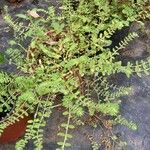
Euphorbia thymifolia
Chickenweed · Gulf sandmat · Thyme-leaved spurge · Dwarf spurge · Red caustic creeper
Description
Source: wikipedia (CC BY-SA)Euphorbia thymifolia, the red caustic-creeper, is a prostrate annual herb of the family Euphorbiaceae. Native to tropical and subtropical America, it grows in seasonally dry tropical biomes and produces milky sap. The plant has velvet-hairy red stems up to 25 cm long, with small ovate leaves and minute cyathia flowers in the leaf axils. Widely used as a traditional medicine in Africa and Asia, it is also harvested as food and traded in local markets.
Care Guide
💧 Water
Gulf sandmat thrives in humid, moist conditions similar to its tropical habitat. It prefers consistent hydration, needing weekly watering to keep the soil moist without becoming waterlogged. For optimal growth, it is best cultivated indoors in areas with high humidity.
☀️ Light Full sun
Gulf sandmat requires plentiful sunshine to thrive. While it can tolerate partially sunny exposures, it prefers places that receive abundant sunlight. Its native habitat shows this, since it is adapted to sun-rich environments. Both excessive and insufficient sunlight can impair its growth and overall health.
What are the sunlight requirements for Gulf Sandmat?
Gulf Sandmat thrives in environments with an abundance of sunshine, showing a preference for locations that receive full sun, defined as above 6 hours of sunlight daily. It can also manage in partial sun, which amounts to about 3-6 hours of sunlight. Observing how sunlight moves through your garden is crucial for choosing the optimal spots that offer a balance of light and shade, ensuring your plants' health and happiness.
How does the Gulf Sandmat's origin relate to its sunlight needs?
The Gulf Sandmat originates from habitats rich in sunlight, indicating its strong preference for sunny locations to prosper. Although it can tolerate semi-sunny exposures, its optimal growth and health are observed in generously sunlit environments. Too much or too little sunlight can affect the plant’s growth negatively, showcasing the importance of the right amount of natural light.
What role does artificial lighting play for indoor Gulf Sandmat plants?
For indoor Gulf Sandmat plants, when natural sunlight is insufficient, especially during winter or in less sunny spaces, artificial lighting becomes crucial for optimal growth. LED lights are recommended due to their ability to be customized to provide specific wavelengths needed by plants. Depending on the plant's sunlight needs, the amount of artificial light required varies from full sun plants needing 30-50W/sq ft to full shade plants needing 10-20W/sq ft. The light source should be placed 12-36 inches above the plant, mirroring natural sunlight conditions, and provided for 8-12 hours per day to promote healthy growth.
What are the symptoms of inadequate light for Gulf Sandmat?
Gulf Sandmat displays several symptoms when it gets insufficient light, including new leaves growing smaller in size, leggy or sparse growth due to increased space between leaves or stems, faster leaf drop as a survival strategy, slower or halted growth, leaves appearing lighter in color or yellow (chlorosis), and physical damage like sunscald, leaf curling, wilting, or leaf scorching from too much sunlight. These symptoms indicate that the lighting conditions need to be adjusted to meet the plant's needs.
How can light exposure be optimized for Gulf Sandmat?
To optimize light exposure for Gulf Sandmat, gradually move plants to sunnier locations to meet their requirement of at least 6 hours of direct sunlight daily. For indoor plants that are large or not easily movable, consider using artificial lighting, keeping lamps on for at least 8 hours daily. Outdoor plants should be relocated to the best sunlight spots gradually to prevent sunburn. Minimizing obstructions, like pruning trees blocking sunlight, or transplanting to sunnier areas, can also help, especially during the plant's dormant period for reduced stress.
🌡️ Temperature 20–37.8°C
Gulf sandmat comes from tropical areas, where the climate is generally warm and humid. Consequently, it is adapted to high heat and humidity. It does not respond well to sudden temperature changes and prefers a steady temperature, so avoiding indoor temperature fluctuations is important. It typically cannot tolerate cold and needs warmer conditions to grow. If the surrounding temperature becomes too low, the plant may stop growing or even die.
💨 Humidity
🪴 Soil 6-7
🌱 Fertilizer
Gulf sandmat responds well to regular, diluted fertilizer applications to encourage healthy leaf growth. You should fertilize Gulf sandmat roughly once a month during the summer months. Nitrogen is essential for foliage, and providing nitrogen-rich sources helps Gulf sandmat thrive.
🪴 Pot & Repot
✂️ Pruning
Pruning the Gulf sandmat, a ground-covering plant, in early to late spring can be very beneficial. By removing dead stems and trimming overgrown areas, you can encourage healthy growth and improve airflow, which reduces the risk of disease. Be sure to use sterilized tools to prevent introducing pathogens and ensure optimal plant health.
🌿 Propagating
🐛 Diseases & pets
☠️ Toxicity
Characteristics
- Plant Type
- Herb
- Life Cycle
- Annual
- Genus
- Euphorbia
- Family
- Euphorbiaceae
- Hardiness Zone
- 9-11
- Mature Height
- 5 cm
- Mature Spread
- 10 cm to 30 cm
- Leaf Color
- Green, Dark Green
- Leaf Type
- Evergreen
- Flower Color
- White, Red
- Flower Size
- 0.01 cm to 0.03 cm
- Bloom Time
- Late spring, Summer, Fall
- Planting Time
- Spring, Autumn
- Harvest Time
- Summer, Fall, Early winter
- Native Area
- Burkina Faso, Belize, India, Malaysia, Mexico, Guatemala, Madagascar, Pakistan, Nigeria, Niger, Tanzania, Jamaica, Benin, Cuba, Sierra Leone, Indonesia, Cambodia, Cameroon, Liberia, Mozambique, Venezuela, Brazil, Ghana, Congo, Honduras, Peru, Philippines, Zambia, Bangladesh, Laos, Guinea, Panama, Chad, China, Colombia, Bolivia, Vietnam, Japan, Guyana, El Salvador, Senegal, Nicaragua, Iran, Ecuador, Côte d'Ivoire, Costa Rica, Congo (DRC), Thailand, Gabon