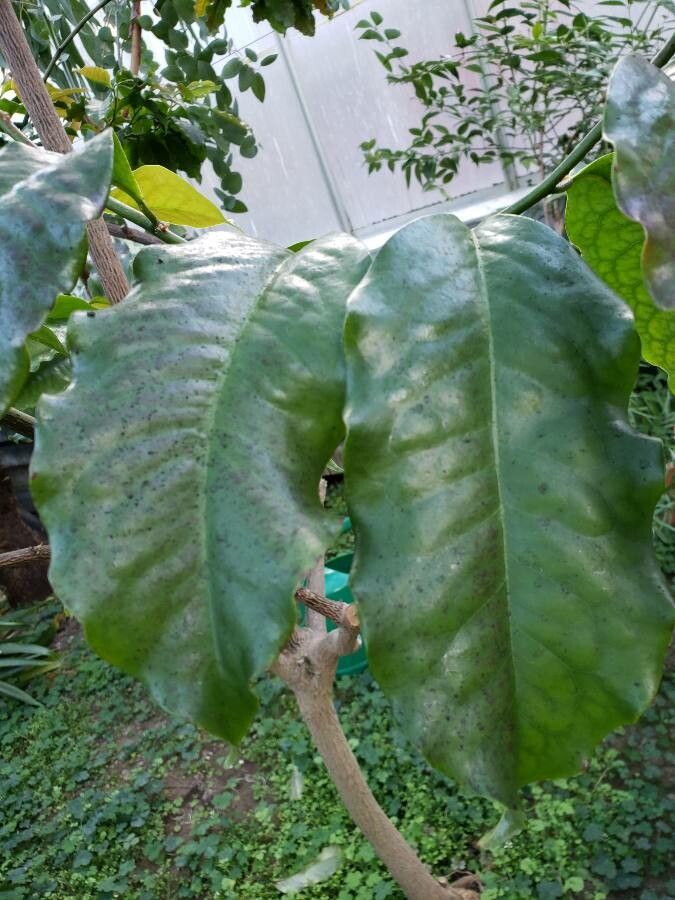
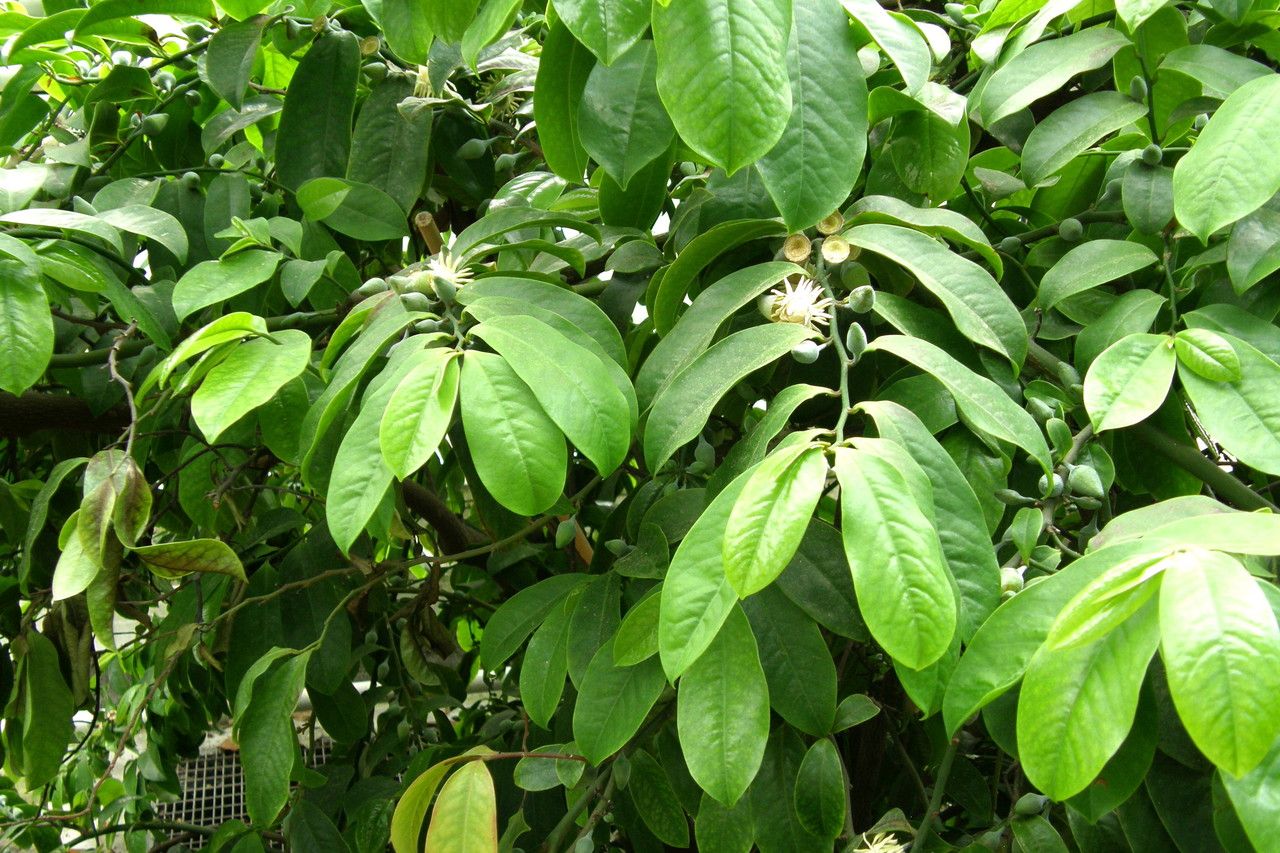
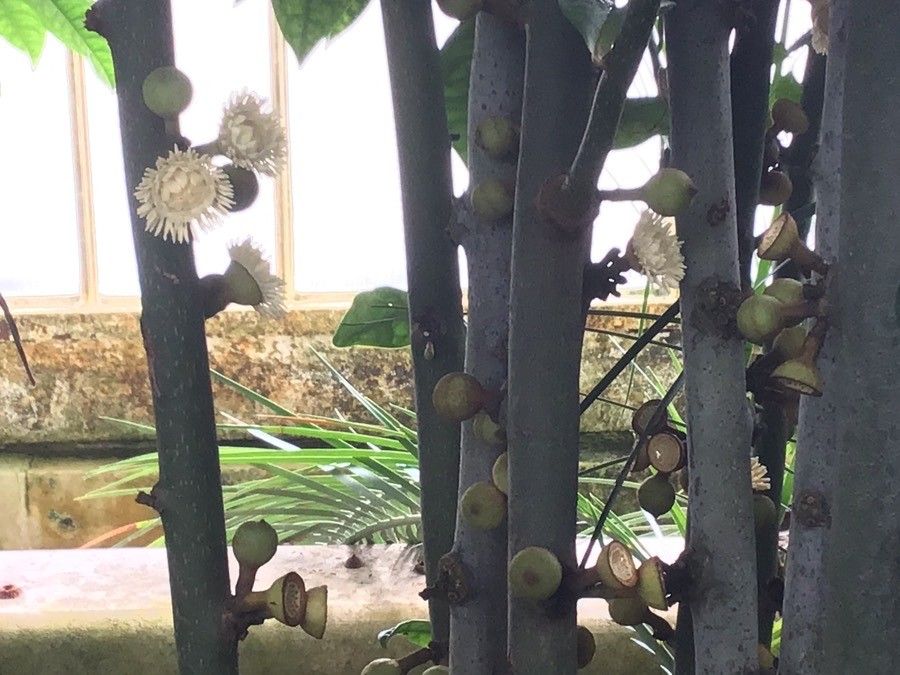
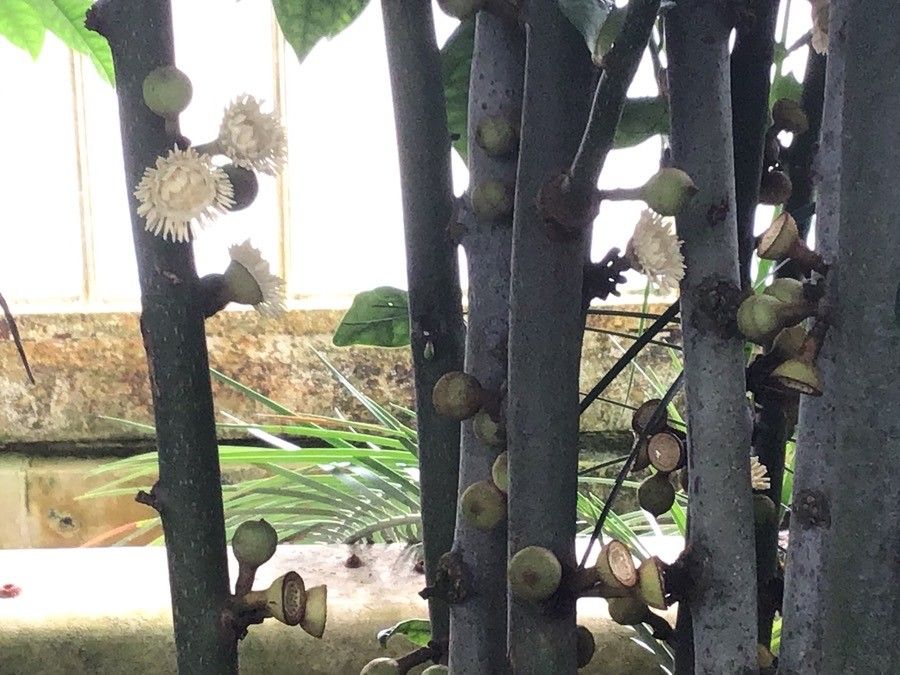
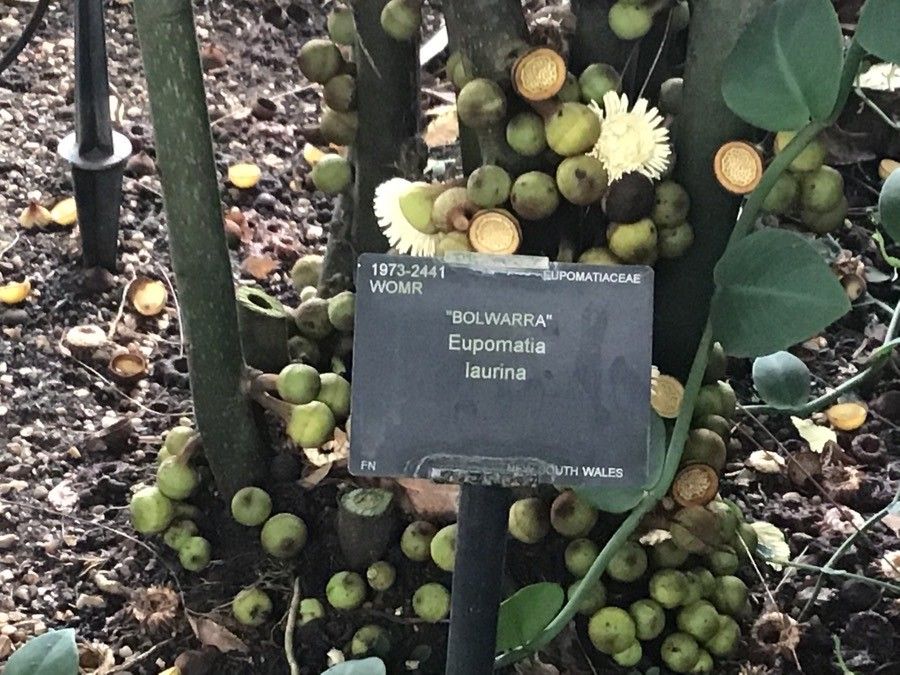
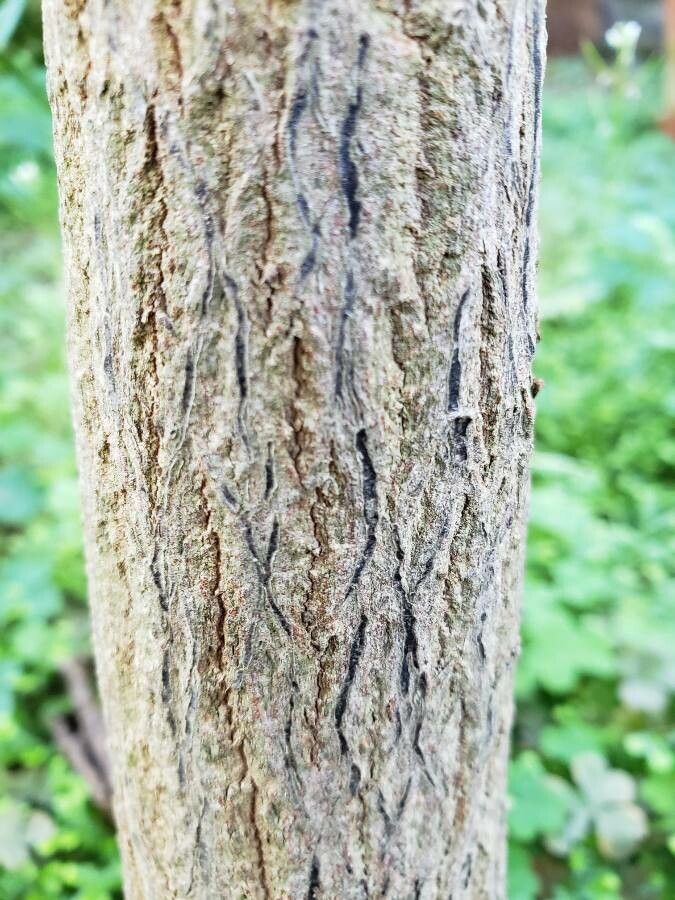
Eupomatia laurina, commonly named bolwarra, native guava or copper laurel, is a species of plant in the primitive flowering-plant family Eupomatiaceae, endemic to Australia and New Guinea. It grows to between 3 and 5 m (10 and 16 ft) tall, but larger specimens may attain a height of 15 m (50 ft) and a trunk diameter of 30 cm (12 in). In Australia, it is found in humid forests of the east coast, from as far south as Nowa Nowa in Victoria, north through New South Wales and Queensland to tropical Cape York Peninsula. It usually grows as an understorey plant in rainforests or humid Eucalypt forests.It has glossy, ovate to elliptic leaves, from 5 to 20 cm (2 to 8 in) long. The branches bear globose to urn-shaped fruits which are green in colour and measure 15–20 mm (0.6–0.8 in) in diameter. They yellow when ripe and contain pale-coloured, edible, jelly-like flesh inside, with many non-edible seeds (similar appearance to guava contents). Germination from fresh seed commences after around three weeks and completes after five weeks, with a high rate of germination. Flowers are pollinated by small weevils, including Elleschodes hamiltoni and others in the same genus. Cuttings are not advised as a method of regeneration.The sweet, aromatic fruit is used as a spice-fruit in cooking and in beverages, jams and desserts. It is best used in combination with other ingredients that complement its strong flavour, and hence should be considered one of the Australian spices. In cultivation E. laurina is frost sensitive and prefers a protected, semi-shaded site. It can be propagated from seed or cuttings. Cutting propagated trees produce fruit after two years. Seedlings take four to six years to fruit.
Native guava exhibits good disease resistance and is generally not prone to disease. In terms of care, the plant is relatively low-maintenance. When grown outdoors it needs minimal watering, and larger plants typically do not require pruning. Smaller plants, however, should be pruned after they have bloomed. Native guava is suitable for anyone with outdoor space, such as a garden or deck, and does not demand much care experience.
How to keep Eupomatia Laurina.
Light
The native guava prefers sites where it gets sunlight for most of the day, though it can also tolerate spots with more filtered, lower-intensity light. In its natural habitat it does best in full sun. Excessive shade can inhibit its growth and damage its health, while too much sun generally does not cause problems.
Water
Native guava, which comes from Australian rainforests, thrives in conditions with consistent moisture and moderate humidity but can tolerate short dry spells. It should be watered every 2-3 weeks, taking advantage of its drought resistance. When grown outdoors, native guava benefits from natural rainfall patterns, which improve its growth cycles and water uptake efficiency.
Temperature
Native guava shows good temperature adaptability, tolerating high heat and wide temperature fluctuations. In hot weather, attention should be paid to watering and providing suitable shade to prevent sunburn. However, Native guava is relatively intolerant of low temperatures. While it can withstand some cold, very low temperatures can cause frost damage.
Fertilizer
The timing for fertilizing Native guava is important. Start fertilizing in early spring and continue once a month through early summer. Fertilizer promotes attractive blooms and supplies energy during both dormant and active growth phases.
Pruning
The native guava is an evergreen shrub known for its fragrant flowers and edible fruit. To maintain its health, prune the plant during early to late winter while it is dormant. This involves removing dead wood and thinning branches to improve air circulation. Regular pruning encourages healthy growth and boosts fruit production.
Botanical profile.
- Plant Type
- Shrub
- Life Cycle
- Perennial
- Genus
- Eupomatia
- Family
- Eupomatiaceae
- Hardiness Zone
- 9-11
- Mature Height
- 3.05 m to 14.94 m
- Mature Spread
- 2.13 m to 4.88 m
- Leaf Color
- Green, Blue
- Leaf Type
- Evergreen
- Flower Color
- White, Cream
- Flower Size
- 2.54 cm
- Bloom Time
- Winter
- Planting Time
- Spring, Summer
- Harvest Time
- Spring
Other names.
Reader questions.
What are the sunlight requirements for Native Guava (Eupomatia laurina)?
Native Guava (Eupomatia laurina) thrives best under full sun conditions, requiring more than 6 hours of sunlight daily. It can also adapt to partial sun, with about 3-6 hours of sunlight. However, it's essential to monitor the sunlight throughout your garden to ensure your plants receive a balance of light and shade for optimal growth. In its natural habitat, Native Guava flourishes under a full sun regime; too much shade can hinder its growth and health, but it generally manages well under excessive sun exposure without significant threats.
How does artificial lighting support indoor Native Guava plants?
When natural sunlight is insufficient, especially during winter or in less sunny spaces, artificial lighting becomes crucial for the growth of indoor Native Guava plants. To support optimal growth with artificial lights, follow these recommendations: Choose LED lights for their ability to provide specific wavelengths needed by plants. Full sun plants require 30-50W/sq ft, partial sun plants need 20-30W/sq ft, and shade plants require 10-20W/sq ft of light. The light source should be placed 12-36 inches above the plant to mimic natural sunlight, and most plants benefit from 8-12 hours of light per day.
What are the symptoms of insufficient light in Native Guava plants?
Native Guava plants may show several symptoms when exposed to suboptimal lighting, including the growth of smaller new leaves, leggy or sparse growth, accelerated leaf drop, stalled growth, pale new leaves, chlorosis (yellowing leaves due to chlorophyll breakdown), sunscald, leaf curling, wilting, and leaf scorching. These symptoms indicate the plant's struggle with insufficient light, leading to reduced health and growth.
What solutions can optimize light exposure for indoor and outdoor Native Guava plants?
To improve light exposure for Native Guava plants, consider the following solutions: For indoor plants, gradually shift them to sunnier locations until they receive at least 6 hours of sunlight daily. If plants are large or not easily movable, use artificial lights like desk or ceiling lamps, or invest in professional grow lights for at least 8 hours daily. For outdoor plants, move them to sunnier spots gradually to avoid shock. Parts of the plant damaged by insufficient light may not recover, but new growth will be healthy with improved light exposure. Additionally, for ground plants, reduce obstructions by pruning trees or branches blocking sunlight and consider transplanting smaller plants during their dormant period to a sunnier location with good drainage.