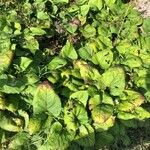
Eurybia macrophylla
Bigleaf aster · Large-Leaf Wood-Aster · Large-leaved Aster · Big-leaved Aster · Large-leaved Wood Aster
Description
Source: leafsnapEurybia macrophylla, commonly known as the bigleaf aster, large-leaved aster, largeleaf aster or bigleaf wood aster, is an herbaceous perennial in the family Asteraceae that was formerly treated in the genus Aster. It is native to eastern North America, with a range extending from eastern and central Canada (from Nova Scotia to Manitoba) through the northeastern deciduous and mixed forests of New England and the Great Lakes region and south along the Appalachians as far as the northeastern corner of Georgia, and west as far as Minnesota, Missouri and Arkansas. The flowers appear in the late summer to early fall and show ray florets that are usually either a deep lavender or violet, but sometimes white, and disc florets that are cream-coloured or light yellow, becoming purple as they mature. It is one of the parent species of the hybrid Eurybia × herveyi.
🌳 Large-leaved aster is an excellent choice for adding a splash of color to your garden, especially because it blooms late and for a long time, well into autumn. While other flowers begin to fade, it continues to provide food for pollinators. This makes it ideal for cottage gardens, woodland gardens, and wildlife gardens in its native regions. Additionally, it performs well on banks and slopes. With its relatively tall and bushy growth, it is particularly suitable for mid-bed positions.
🎭 Affection
Care Guide
💧 Water Every 7 days
The large-leaved aster thrives in woodland settings where the soil is consistently moist. To support its growth, it's important to water it weekly and apply mulch to help retain moisture. This approach replicates its natural environment and meets its water needs during active growth periods.
How should I water my Large-leaved aster plant in the best way possible?
For the best care of the Large-leaved aster, it's recommended to use filtered water at room temperature. Tap water may contain harmful particles. This plant prefers warmer water, as it is native to warm environments, and cold water can be a shock to its system. Avoid watering from above to prevent problems with the foliage. Instead, thoroughly water the soil with filtered room temperature water until it is completely soaked. This helps moisten the roots and support their growth and nutrient absorption.
What should I do if I give too much or too little water to my Large-leaved aster?
Overwatering is a common problem for Large-leaved asters. When this happens, the stems and leaves wilt and turn yellow. Over time, it can also lead to root rot, mold, and mildew, which can kill the plant. Underwatering is less common, but still possible. In this case, the leaves become brittle and brown. It's important to recognize the signs of overwatering early on. Some diseases caused by overwatering may not be reversible if left untreated. If you see these signs, reduce watering immediately and check the soil drainage. If it drains poorly, replace it with a well-draining potting mix. If your plant is not getting enough water, simply increase your watering schedule until the signs improve.
How frequently do I need to water my Large-leaved aster plant?
If your Large-leaved aster is in a pot, the best way to check if it needs water is by sticking your finger into the soil. If the top two to three inches are dry, it's time to water. If you're growing it outdoors in the ground, you can use the same method. When the top few inches of soil are dry, add water. During spring and early fall, watering once a week is usually enough. In extremely hot weather, you may need to water twice or more per week. However, mature and well-established Large-leaved asters have a great ability to withstand drought.
How much water does my Large-leaved aster require?
When watering your Large-leaved aster, don't be afraid to give it a generous amount of water. Make sure the first two to three inches of soil are dry before watering, and then give it a thorough soaking. The water should be enough to make it flow out of the drainage holes at the bottom of the pot. If you don't see excess water draining, it means you haven't given enough water. But be careful not to let water accumulate in the soil, as this can harm the plant. If there is no water draining from the pot, it could indicate that the soil doesn't drain well, which is not good for the plant's health. If the plant is outside, 1 inch of rain per week will be enough.
How do I water my Large-leaved aster plant as it grows?
The water needs of the Large-leaved aster can vary based on its growth stages. When the plant is young or recently transplanted, it requires more water to support root development and future growth. As the plant matures, it will need less water. During the bloom period, the plant may require additional water for flower development.
☀️ Light Partial sun
The large-leaved aster prefers substantial but not excessive sunlight, yet it tolerates a wide range of light conditions, from full-day sun to very low-light locations. Its native habitat indicates a cool environment, and too much sun can hinder its growth while too little light can impair its healthy development.
What are the sunlight requirements for Large-leaved aster?
Large-leaved aster, or Eurybia macrophylla, thrives under varying sunlight conditions, from significant exposure to the sun to resilience in full day illumination and very low-light areas. The plant appreciates about 3-6 hours of sunlight, known as partial sun, but can also grow in conditions labeled as full shade or full sun, which is less than 3 hours of sunlight. It's crucial to watch how sunlight moves through your garden to ensure you place your plants in spots that provide a perfect balance for their health.
How can you provide adequate lighting for Large-leaved aster indoors?
For Large-leaved aster grown indoors, especially where natural sunlight is insufficient, artificial lighting becomes essential. You can use LED lights to customize and provide the specific wavelengths of light needed, with full sun plants requiring 30-50W/sq ft, partial sun plants 20-30W/sq ft, and full shade plants 10-20W/sq ft of artificial light. The light source should be placed 12-36 inches above the plant, mimicking natural sunlight, and ensuring the plant receives 8-12 hours of light per day.
What symptoms indicate light deficiency in Large-leaved aster?
Symptoms of light deficiency in Large-leaved aster include smaller new leaves, leggy or sparse growth, faster leaf drop, slower or no new growth, lighter-colored new leaves, chlorosis, sunscald, leaf curling, wilting, and leaf scorching. These symptoms can suggest either a lack of sufficient light or overexposure to sunlight, which affects the plant's growth and health.
What solutions can help remedy lighting issues for Large-leaved aster?
To address lighting issues for Large-leaved aster, indoors you can gradually shift plants to sunnier spots each week until they receive 3-6 hours of sunlight daily or use artificial lighting like desk or ceiling lamps for at least 8 hours a day. Outdoors, move plants gradually to sunnier locations to avoid sunburn. Reducing obstructions and transplanting smaller plants to sunnier areas can help outdoor plants receive enough sunlight. Remember, parts of the plant affected by insufficient sunlight may not recover fully, but new growth should be healthy after adjustments.
🌡️ Temperature 5–32.2°C
The large-leaved aster thrives in its native cool-temperate habitat, with temperatures ranging from 5 to 32 ℃ (41 to 90 ℉). In summer, it is recommended to give partial shade and maintain temperatures between 18 and 24 ℃ (64 and 75 ℉). In winter, keep temperatures at 10 to 15 ℃ (50 to 59 ℉) to encourage dormancy.
What are the essential growing conditions for large-leaved aster?
The large-leaved aster (Eurybia macrophylla) thrives in cool-temperate climates with temperatures ranging from 5 to 32°C (41 to 90°F). It prefers native environments that align with these conditions. During the summer months, it's beneficial to provide the plant with partial shade, maintaining the temperature between 18 to 24°C (64 to 75°F). In winter, aiming for temperatures between 10 to 15°C (50 to 59°F) helps promote the plant's dormancy period. The large-leaved aster has strong cold resistance, making special frost protection measures unnecessary for most winter conditions. However, if temperatures are expected to dip below -30°C, it's important to offer cold protection by covering the plant with soil or straw. Additionally, watering the plant abundantly before the first freeze in autumn to keep the soil moist can help prevent drought and water scarcity during the colder months.
How should you care for a large-leaved aster during very low or high temperatures?
For large-leaved aster, coping with extreme temperatures involves specific care strategies. When temperatures drop below -30°C, the plant shows a high level of cold tolerance but may experience a decrease in spring sprouting or fail to sprout entirely. To address this, any non-sprouting parts should be removed in spring. During high temperature periods, particularly when temperatures exceed 35°C, the plant's leaves may lighten in color, curl, become sunburnt, and the plant might wilt or dry out entirely. In such cases, it's recommended to trim away the affected parts. Relocating the plant to a shaded area or using a shade cloth can protect it from direct midday and afternoon sun. Ensuring the plant is watered in the morning and evening will help keep the soil moist and assist in managing heat stress.
💨 Humidity
🪴 Soil 5-7
🌱 Fertilizer
A single fertilizer application in spring is typically adequate for Large-leaved aster, although several feedings can help achieve maximum growth. Apply once every month to six weeks. Fertilizing improves the leaves' look and function, maintaining even color and a healthy texture. It also encourages root development and better nutrient uptake for the plant's long-term health.
Why should I put fertilizer on my Large-leaved aster?
The main structure of the Large-leaved aster is made up of its leaves. Fertilization is crucial for maintaining the appearance and function of these leaves. It will ensure consistent color and a healthy texture. Fertilization also benefits the plant below the soil's surface. It helps generate new roots and maintain existing ones in the root system. This not only keeps the plant healthy presently but also enhances its ability to absorb soil nutrients in the future.
When should I fertilize my Large-leaved aster for the best results?
If you grow your Large-leaved aster outdoors each year, it will start growing new leaves in early spring. This is a signal to start fertilizing the plant for the year. Generally, a single application of fertilizer is enough for the Large-leaved aster in spring. However, if you want to promote maximum growth, you can fertilize it more frequently during spring and early summer. In this case, you can feed the Large-leaved aster about once every month to a month and a half.
When should I not fertilize my Large-leaved aster plant?
During late fall and winter, your Large-leaved aster will go into dormancy, meaning it won't grow new leaves. It's best to avoid fertilizing it during this time. If you do fertilize in spring and summer, start reducing the amount as summer gets closer, since the growth rate of the aster will also slow down. In general, it's not a good idea to fertilize the aster when the weather is unusually hot or the soil is extremely dry, as this can cause stress and lead to premature death.
What kind of plant food does my Large-leaved aster require?
Choosing the best fertilizer for a Large-leaved aster is actually quite simple. These plants do well with a general-purpose garden fertilizer that contains equal parts nitrogen, phosphorus, and potassium, like a 10-10-10 ratio. It's best to avoid fertilizers with high nitrogen levels if you're unsure. Most effective fertilizers for Large-leaved asters are available as slow-release granules, making them easy to apply to the soil. Additionally, feeding your plant with organic soil amendments like compost can be beneficial.
How should I give nutrients to my Large-leaved aster plant?
To care for your Large-leaved aster, wait until its first leaves appear in early spring. Then, apply a granular slow-release fertilizer with a balanced formula to the soil around the base of the plant. You can repeat this process later in the season if desired. Remember to apply the fertilizer to the soil, not to the plant itself. This may require moving some leaves to access the soil above the roots. Additionally, watering the aster before and after fertilizing is usually a good idea.
🪴 Pot & Repot 2-3 years
When repotting Large-leaved aster, choose a pot 1-2 inches (2.5–5.1 cm) larger with ample drainage. Use a well-draining potting mix. Repot in spring or fall, ensuring that the root ball is slightly lower than the rim of the flower pot. Water thoroughly after repotting and place in a warm spot with indirect sunlight.
✂️ Pruning
The large-leaved aster showcases heart-shaped leaves and star-shaped flowers. It thrives when pruned from early to late spring. Key pruning techniques include removing dead stems and cutting back spent blooms to encourage new growth. Trimming just above a leaf node promotes branching, enhances blooming, and reduces stress on the plant.
🌿 Propagating
🐛 Diseases & pets
☠️ Toxicity
Characteristics
- Plant Type
- Herb
- Life Cycle
- Perennial
- Genus
- Eurybia
- Family
- Asteraceae
- Hardiness Zone
- 4-8
- Mature Height
- 15 cm to 91 cm
- Mature Spread
- 30 cm
- Leaf Color
- Green
- Leaf Type
- Deciduous
- Flower Color
- Lavender
- Flower Size
- 2.54 cm
- Bloom Time
- Mid summer
- Planting Time
- Autumn, Spring
- Harvest Time
- Mid summer, Late summer