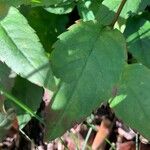
Eurybia schreberi
Schreber's aster · Schreber's Wood Aster · Nettle-leaved michaelmas daisy · Nettle-leaved Michaelmas-daisy
Description
Source: leafsnapEurybia schreberi, commonly called Schreber's aster or nettle-leaved Michaelmas-daisy, is a perennial herb in the family Asteraceae. It is native to eastern North America, where it is present in Canada and the United States. The flower heads emerge in the late summer or early fall to show white ray florets and yellow disc florets. It is listed as endangered in Indiana and Iowa, of special concern in Tennessee and possibly extirpated in Maine.
Care Guide
💧 Water
☀️ Light Partial sun
Schreber's aster occurs naturally in habitats like forest understories or rocky areas where it grows in natural shade. It prefers partial sun but can tolerate full sun or full shade, showing its versatile, hardy nature.
🌡️ Temperature 0–32.2°C
Schreber's aster kann sich an ein breites Spektrum von Temperaturbedingungen anpassen, dennoch kann ihre Verbreitung durch verschiedene Kombinationen von Wasser- und Wärmebedingungen eingeschränkt sein. Am besten gedeiht sie im Sommer in warmen Klimaten mit ausreichendem Niederschlag oder Bewässerung. Längere Phasen mit bewölktem, regnerischem Wetter sowie andauernd hohe Temperaturen erhöhen die Wahrscheinlichkeit, dass Schreber's aster abstirbt. Im Winter kann ein geeigneter Schutz vor Kälte die Überlebensrate der Pflanze verbessern.
💨 Humidity
🪴 Soil 6-7
🌱 Fertilizer
The best time to fertilize a Schreber's aster is in early spring, when it is coming out of dormancy and beginning active growth. Fertilization supplies important nutrients needed for healthy growth. Although Schreber's aster has relatively modest fertilizer requirements, an annual application can improve its survival and promote better, longer-lasting flowers.
🪴 Pot & Repot
✂️ Pruning
To enhance the growth of Schreber's aster, it's important to prune strategically from early to late spring. Begin by trimming any dead stems in early spring, and then thin out crowded areas later on to improve air circulation and light exposure. Regular pruning not only boosts the plant's beauty and health but also helps prevent disease and encourages vibrant blooms.
🌿 Propagating
🐛 Diseases & pets
☠️ Toxicity
Characteristics
- Plant Type
- Herb
- Life Cycle
- Perennial
- Genus
- Eurybia
- Family
- Asteraceae
- Hardiness Zone
- 3-8
- Mature Height
- 61 cm
- Mature Spread
- 40 cm
- Leaf Color
- Green
- Leaf Type
- Deciduous
- Flower Color
- White
- Flower Size
- 2.03 cm to 3.05 cm
- Bloom Time
- Late summer, Early fall
- Planting Time
- Spring, Summer
- Harvest Time
- Early fall, Mid fall