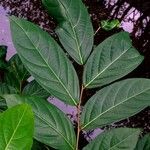
Eusideroxylon zwageri
Ulin · Borneo ironwood · Bornean ironwood · Billian · Borneo billian
Description
Source: leafsnapEusideroxylon zwageri is a rare timber tree native to the Brunei, Indonesia, Malaysia and Philippines region. It is known colloquially in English as Bornean ironwood, billian, or ulin.
Care Guide
💧 Water
Bornean ironwood flourishes in humid, rain-soaked environments and can tolerate moderate drought conditions. It should be watered every 2 to 3 weeks, allowing it to retain moisture effectively. As an outdoor species, its growth is synchronized with natural rainfall, which promotes its optimal vitality.
☀️ Light Full sun
Bornean ironwood is native to open habitats like sunny meadows and forest edges that offer abundant light. It thrives in full sun but will also tolerate partial sun, adapting well to various light conditions.
What are the sunlight requirements for Bornean Ironwood?
Bornean Ironwood, or Eusideroxylon zwageri, thrives in environments with ample light, such as sunny meadows and forest edges, making it suitable for full sun and partial sun conditions. Full sun refers to areas that receive above 6 hours of sunlight per day, while partial sun areas get about 3-6 hours of sunlight. It's essential to observe how sunlight moves through your garden to ensure you choose locations that provide the right balance of light and shade, as this is crucial for the plant's health.
What are the additional lighting recommendations for Bornean Ironwood grown indoors?
For Bornean Ironwood grown indoors where natural sunlight might be insufficient, especially during winter or in less sunny spaces, using artificial lights is recommended. LED lights are a popular choice as they can be customized to provide specific wavelengths needed by plants. For full sun plants, 30-50W/sq ft of artificial light is needed, partial sun plants require 20-30W/sq ft, and full shade plants need 10-20W/sq ft. The light source should be placed 12-36 inches above the plant, mimicking natural sunlight, and most plants will need 8-12 hours of light per day.
What symptoms indicate Bornean Ironwood is not getting enough light?
If Bornean Ironwood does not receive adequate sunlight, it may show various symptoms: new leaves growing smaller, leggy or sparse growth, faster leaf drop, slower or no new growth, and lighter-colored or yellowing leaves (chlorosis). Excessive sunlight exposure can lead to sunscald, leaf curling, wilting, and leaf scorching, where parts of the leaves appear dry, brown, and crispy.
How can I address light deficiency or excessive sunlight exposure for Bornean Ironwood?
To combat light deficiency, gradually move the plant to a sunnier location each week until it receives at least 6 hours of direct sunlight daily. Use a south-facing window and keep curtains open for maximum exposure. If the plant is large or not easily movable, consider artificial lighting, keeping it on for at least 8 hours daily. For outdoor plants, it's crucial to adapt them gradually to prevent sunburn. If sunlight is obstructed, prune branches or relocate the plant to a sunnier spot. Remember, parts of the plant affected by insufficient sunlight may not recover, but new growth will be healthy after increasing light exposure.
🌡️ Temperature 20–37.8°C
Bornean ironwood comes from tropical areas, where the climate is generally warm and humid. Because of this, it is well adapted to high heat and moisture. It does not tolerate sudden temperature shifts and prefers a consistent temperature, so avoiding indoor temperature fluctuations is important. It typically cannot withstand cold and needs higher temperatures to grow. If the environmental temperature falls too low, the plant may stop growing or even die.
💨 Humidity
🪴 Soil 6-6
🌱 Fertilizer
Fertilizing is essential for the care of Bornean ironwood. Routine feeding during the growing season preserves the energy for its showy foliage and encourages overall growth. Failing to fertilize can lead to unhealthy leaves, reduced ornamental value, and stunted or weak growth that is more prone to breakage.
🪴 Pot & Repot
✂️ Pruning
Bornean ironwood requires minimal pruning, primarily targeting dead or damaged branches. Prune from early to late winter to allow ample healing time before the growth season. Making clean cuts helps prevent disease, while regular light pruning improves the tree's structure and airflow, reducing the risk of pests. Proper timing and technique can significantly enhance the longevity and vigor of Bornean ironwood.
🌿 Propagating
🐛 Diseases & pets
☠️ Toxicity
Characteristics
- Plant Type
- Tree
- Life Cycle
- Perennial
- Genus
- Eusideroxylon
- Family
- Lauraceae
- Hardiness Zone
- 10-12
- Mature Height
- 29.87 m to 49.99 m
- Mature Spread
- 10.06 m to 14.94 m
- Leaf Color
- Dark Green
- Leaf Type
- Evergreen
- Flower Color
- Yellow, Green
- Flower Size
- 0.25 cm to 0.51 cm
- Bloom Time
- Late spring, Early summer, Mid summer
- Harvest Time
- Late summer, Early fall, Mid fall
- Native Area
- Indonesia, Philippines, Brunei