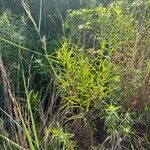
Euthamia gymnospermoides
Great Plains goldentop · Viscid euthamia · Texas Goldentop · Great Plains flat-top goldenrod · Viscid grass-leaved goldenrod
Description
Source: leafsnapEuthamia gymnospermoides, with the common names Great Plains goldentop and Texas goldentop, is a plant in the family Asteraceae. It is native primarily to the Great Plains and Great Lakes Region where it is found in prairies and sandy areas.Euthamia gymnospermoides is a perennial that produces heads of yellow flowers in late summer. It is distinguished from the similar Euthamia graminifolia by having only one vein per leaf and larger flower heads.
Care Guide
💧 Water
Texas goldentop thrives in environments with balanced moisture and prefers consistent hydration. For optimal health, it requires weekly watering. While it can tolerate brief dry spells, it generally flourishes outdoors when the growing season aligns with periods of adequate rainfall.
☀️ Light Full sun
Texas goldentop is a sun-loving herbaceous perennial native to open habitats, where it frequently thrives in meadows and grasslands. It prefers full sun but can also tolerate partial sun.
What are the sunlight requirements for Texas Goldentop (Euthamia gymnospermoides)?
Texas goldentop thrives in full sunlight and prefers to receive more than 6 hours of sunlight daily. It's essential to observe how sunlight moves through your garden to select the ideal location that offers a balance of light and shade, ensuring optimal growth for your plants. This perennial herbaceous plant is native to open habitats like meadows and grasslands, where it benefits from ample sunlight but can also tolerate partial sun conditions.
How can artificial lighting support the growth of Texas Goldentop indoors?
When natural sunlight is insufficient, especially during winter or in less sunny spaces, artificial lighting becomes crucial for the growth of indoor plants like Texas Goldentop. LED lights are often recommended because they can be customized to provide specific wavelengths needed by plants. For full sun plants, 30-50W/sq ft of artificial light is advisable, for partial sun plants, 20-30W/sq ft, and for full shade plants, 10-20W/sq ft. It's important to place the light source 12-36 inches above the plant to mimic natural sunlight and keep the light on for 8-12 hours daily to meet the plant's light requirements.
What are some symptoms of light deficiency in Texas Goldentop?
Symptoms indicating that Texas Goldentop is not receiving sufficient light include the growth of smaller new leaves compared to older ones, leggy or sparse growth, premature leaf drop, and a halt in new leaf production, indicating survival mode due to poor light conditions. Additionally, new leaves may appear lighter or developed irregular color patterns due to a lack of chlorophyll and essential nutrients. These symptoms suggest that the plant requires more sunlight to maintain healthy growth.
What are some symptoms of excessive sunlight exposure in Texas Goldentop?
Excessive sunlight exposure can lead to symptoms such as chlorosis, where leaves lose their green color and turn yellow, and sunscald, characterized by pale, bleached areas on the plant's tissue. Leaf curling, wilting, and leaf scorching, where edges or patches on leaves become brown and crispy, are additional signs that Texas Goldentop is receiving too much sunlight, harming its ability to photosynthesize properly and maintain overall health.
How can I mitigate issues related to sunlight exposure for Texas Goldentop?
To ensure Texas Goldentop receives optimal sunlight, gradually move plants to sunnier locations each week until they get at least 6 hours of direct sunlight daily. For indoor plants, consider using artificial light if the plant is large or not easily movable, keeping a desk or ceiling lamp on for at least 8 hours daily, or investing in professional plant grow lights. Outdoors, avoid sudden changes in light intensity to prevent sunburn. For plants with sunlight obstruction, consider pruning obstructions like branches, or transplant smaller plants during their dormant period to a sunnier location with good drainage. It's important to note that parts of the plant affected by insufficient sunlight may not recover, but new growth should be healthy with increased light exposure.
🌡️ Temperature 5–35°C
Texas goldentop can tolerate a wide range of temperatures, but its range may still be restricted by particular combinations of moisture and heat. It grows best in warm summer climates with sufficient rainfall or watering. Extended periods of cloudy, rainy weather, as well as extended high temperatures, can raise the chance of Texas goldentop dying. In winter, adequate protection from cold can increase the plant's survival rate.
💨 Humidity
🪴 Soil 6-8
🌱 Fertilizer
The best time to apply fertilizer to a Texas goldentop is in early spring, as it comes out of dormancy and begins active growth. Feeding supplies essential nutrients needed for healthy development. While Texas goldentop does not require much fertilization, giving it fertilizer once a year can improve its chances of survival and encourage stronger, longer-lasting blooms.
🪴 Pot & Repot
✂️ Pruning
Texas goldentop benefits from regular pruning, ideally done from early to late spring. By removing dead stems and shaping the plant, you can encourage optimal growth. This process improves airflow, reduces the risk of disease, and promotes dense foliage and abundant flowering. For the best results, prune the plant by one-third using clean, sharp tools.
🌿 Propagating
🐛 Diseases & pets
☠️ Toxicity
Characteristics
- Plant Type
- Herb
- Life Cycle
- Perennial
- Genus
- Euthamia
- Family
- Asteraceae
- Hardiness Zone
- 5-9
- Mature Height
- 46 cm to 91 cm
- Mature Spread
- 30 cm to 61 cm
- Leaf Color
- Green, Blue
- Leaf Type
- Deciduous
- Flower Color
- Yellow
- Flower Size
- 0.51 cm to 1.02 cm
- Bloom Time
- Late summer, Early fall, Mid fall
- Planting Time
- Spring, Summer, Autumn
- Harvest Time
- Mid fall, Late fall, Early winter