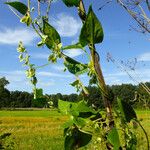
Fallopia dumetorum
Copse-bindweed · Desert knotgrass · Corpse Black-Bindweed · Climbing false buckwheat · Copse Buckwheat
Description
Source: leafsnapFallopia dumetorum, commonly known as copse bindweed or climbing false buckwheat, is a perennial plant in the Polygonaceae family. Native to Europe and Asia, it has also been introduced to North America and other regions globally. The plant can grow up to 2 meters in height and features a woody stem that can either climb or trail along the ground. The leaves of Fallopia dumetorum are alternate, simple, and ovate with pointed tips. They are dark green on the upper surface and lighter underneath. The plant produces small, white or pinkish-white flowers with five petals, arranged in clusters at the ends of branches. Fallopia dumetorum thrives in moist soils but can tolerate dry conditions as well. It grows well in both full sun and partial shade and is commonly found along roadsides, hedgerows, woodland edges, and disturbed areas. Historically, the plant has been used for its anti-inflammatory properties in medicinal applications. However, it should be noted that it contains oxalic acid, which can be harmful if ingested in large quantities. Overall, Fallopia dumetorum is an attractive ornamental plant that provides food for wildlife such as birds and offers medicinal benefits. Its unique properties make it an interesting addition to any garden or landscape design.
Care Guide
💧 Water Every 7 days
Copse Bindweed originates from temperate regions and thrives in moderate moisture. It prefers consistent watering, ideally once a week, but can tolerate short periods of dryness. Typically grown outdoors, Copse Bindweed has a strong root system that efficiently uses water during its active growing season.
How should I water my Copse Bindweed?
To properly water the Copse Bindweed, it is best to use filtered water at room temperature. This is because tap water might contain harmful particles. The water should be room temperature or slightly warmer because the plant is used to a warm environment, and cold water can be a shock to it. Additionally, it is advised not to water the plant from above as it could cause problems with the foliage. Instead, water the soil with filtered room temperature water until it is fully soaked. This helps to moisten the roots and support their spread through the soil for nutrient collection.
What should I do if I give my Copse Bindweed too much or too little water?
Overwatering is a more common problem for Copse Bindweed than underwatering. When the plant gets too much water, its stems and leaves may wilt and turn yellow. Over time, overwatering can lead to diseases like root rot, mold, and mildew, which can kill the plant. Underwatering is less likely, as the plant can tolerate some drought. However, if underwatering occurs, the leaves will become brittle and brown. It's important to notice signs of overwatering early and take action. Diseases like root rot may not be fixable if left too long. If you see signs of overwatering, reduce watering and check the soil drainage. If it drains poorly, replace it with a well-draining mix. If signs of underwatering appear, water more regularly until the signs improve.
How frequently should I give water to my Copse Bindweed?
If your Copse Bindweed is in a pot, you can check if it needs water by sticking your finger into the soil. If the top two to three inches of soil are dry, then it's time to water it. The same method can be used for outdoor Copse Bindweed planted in the ground. When the first few inches of soil have dried out, it's time to water. Typically, during spring and early fall, watering once a week is sufficient. However, during extremely hot weather, watering may need to be increased to twice or more per week. Nonetheless, mature and well-established Copse Bindweed can handle drought conditions quite well.
How much water does my Copse Bindweed require?
To properly water your Copse Bindweed, make sure to give it a generous amount of water. Check the soil by feeling the top two to three inches - if it's dry, it's time to water. When you do water, make sure to thoroughly soak the soil. You'll know you've added enough water when you see excess water flowing out of the drainage holes at the bottom of the pot. If you don't see any excess water draining, it means you haven't watered enough, and if the water accumulates, it can harm the plant. On the other hand, if you notice that water isn't draining through the pot, it could be a sign of poorly draining soil which can harm the plant. If you're growing the plant outdoors, it generally needs about 1 inch of rain per week.
How should I water my Copse Bindweed as it grows?
The water needs of the Copse Bindweed can vary depending on its growth stages. When the plant is young or has been recently transplanted, it will require more water than usual. During these stages, the plant focuses its energy on developing new roots that will support future growth. These roots need extra moisture to thrive. However, as the plant matures, its water requirements decrease. Another stage that may require increased watering is the bloom period, as the development of flowers consumes a significant amount of moisture. Therefore, during this time, it might be necessary to provide additional water to the Copse Bindweed.
☀️ Light Partial sun
Copse Bindweed naturally occurs in habitats such as forest understories or rocky areas, where it is exposed to natural shade. It prefers partial sun but can tolerate full sun or full shade, illustrating its versatile and hardy nature.
🌡️ Temperature 10–25°C
Copse Bindweed is a plant that naturally does best in temperatures of 50 to 77 °F (10 to 25 ℃). In colder seasons, measures should be taken to keep the temperature within this preferred range.
What is the ideal temperature range for Copse Bindweed?
Copse Bindweed, scientifically known as Fallopia dumetorum, flourishes in an environment where the temperature stays between 50 to 77 °F (10 to 25 °C). It's important to adjust conditions during colder seasons to keep the temperature within this range to support the plant's health and growth.
Is Copse Bindweed cold-tolerant?
Yes, Copse Bindweed is exceptionally cold-tolerant and requires no additional frost protection measures during the winter. However, before the onset of the first freeze in autumn, it's advised to water the plant thoroughly. This ensures the soil remains moist when it freezes, which helps prevent drought and water scarcity for the plant during the winter and into early spring.
What should I do if the winter temperature drops below -25°C?
Although Copse Bindweed can withstand very cold temperatures, if the winter temperature falls below -25°C, you might not see any immediate changes during winter, but there could be a noticeable decrease in sprouting or even no sprouting at all when spring arrives. In such cases, it is recommended to remove any parts of the plant that have failed to sprout come springtime.
How does Copse Bindweed react to high temperatures?
Copse Bindweed does not tolerate high temperatures well. When the temperature rises above 25°C, the plant's growth halts, and it becomes prone to rot. To mitigate damage, trim away any sunburned or dried-up parts of the plant. Relocate the plant to a shaded area during the midday and afternoon sun, or utilize a shade cloth. Also, ensure the plant is watered in the morning and evening to keep the soil moist.
💨 Humidity
🪴 Soil 6-7
🌱 Fertilizer
One fertilizer application in spring is generally sufficient for Copse Bindweed, although multiple feedings can maximize growth. Feed every one to one and a half months. Fertilization improves the leaves' appearance and function, helping maintain even color and a healthy texture. It also encourages root development and enhances nutrient uptake for long-term plant health.
🪴 Pot & Repot
✂️ Pruning
Copse Bindweed is a robust and fast-growing climbing plant. To keep its spread under control and maintain its health, prune it from early to late spring. During pruning, remove any dead stems and thin out crowded areas. Regular pruning not only prevents the plant from becoming invasive but also encourages more flowering. Always use clean and sharp tools to minimize the risk of disease.
🌿 Propagating
🐛 Diseases & pets
☠️ Toxicity
Characteristics
- Plant Type
- Herb, Vine
- Life Cycle
- Perennial
- Genus
- Fallopia
- Family
- Polygonaceae
- Hardiness Zone
- 6
- Mature Height
- 0.91 m to 3.05 m
- Mature Spread
- 0.91 m to 2.13 m
- Leaf Color
- Green, Dark Green
- Leaf Type
- Deciduous
- Flower Color
- White, Cream
- Flower Size
- 0.51 cm to 0.51 cm
- Bloom Time
- Summer
- Planting Time
- Spring, Summer, Autumn
- Harvest Time
- Late summer, Early fall, Mid fall
- Native Area
- India, Austria, Turkey, Sweden, Slovakia, Montenegro, Pakistan, Croatia, Slovenia, Belarus, Russia, Germany, Estonia, Koppen, South Korea, Latvia, Romania, Belgium, Portugal, Nepal, Netherlands, France, Tajikistan, Czech Republic, Bulgaria, Armenia, Poland, Greece, Ukraine, Serbia, China, Lithuania, Norway, Afghanistan, Kyrgyzstan, Kazakhstan, Italy, Spain, Switzerland, Denmark, Japan, Mongolia, Finland, Bhutan, Iran, Albania, Azerbaijan, United Kingdom, Hungary