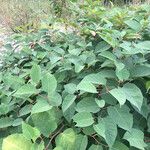
Fallopia japonica
Japanese knotweed · Japanese Bindweed · Asiatic knotweed · Japanese fleece flower · Mexican bamboo
Description
Source: leafsnapFallopia japonica, commonly known as Japanese knotweed, is a perennial plant native to East Asia. It belongs to the Polygonaceae family and can grow up to 3-4 meters tall. The plant features hollow stems with distinctive purple speckles and large, heart-shaped green leaves. Japanese knotweed is notorious for its invasive nature and rapid growth, often forming dense thickets that crowd out native vegetation. It spreads through underground rhizomes and seed dispersal. Despite its invasive characteristics, Japanese knotweed has been used in traditional East Asian medicine for centuries due to its anti-inflammatory properties. It contains resveratrol, a compound with potential health benefits such as reducing the risk of heart disease. Given its aggressive growth and impact on ecosystems, many countries have classified Japanese knotweed as an invasive species and have implemented measures to control or eradicate it from natural areas.
🌳 In Japan, where Japanese knotweed is native, locals enjoy its young shoots as a tangy substitute for rhubarb in various recipes. These shoots are edible while under a foot tall; once they exceed that height they become tough and less palatable. Besides its culinary uses, Japanese knotweed benefits beekeepers by supplying late-season nectar, so placing hives nearby is ideal. Moreover, extracts of Japanese knotweed, rich in resveratrol, are used to produce natural anti-aging cosmetics.
🎭 Bonding, well-being, stamina, optimism
Care Guide
💧 Water Every 7 days
☀️ Light Full sun
Despite its ability to survive in less light, Japanese knotweed prefers a habitat where sunlight is plentiful for optimal growth. This plant originated from regions with ample sunlight and flourishes more in those conditions. Both excessive and inadequate sunlight can hinder its development. The requirement for sunlight by this vegetation remains consistent throughout all stages of its growth.
🌡️ Temperature 5–35°C
Originating from Japan, where the yearly average temperature ranges from 59 to 64 ℉ (15 to 18 ℃), Japanese knotweed adjusts its growth and energy conservation according to the temperature. It thrives best in a temperature spectrum of 41 to 95 ℉ (5 to 35 ℃). During summer, the plant can adapt to temperatures that surpass its preferred range by slowing down its growth and preserving energy.
💨 Humidity
🪴 Soil 5-7
🌱 Fertilizer
For Japanese knotweed, one application of fertilizer in the spring is commonly adequate, though monthly or every one and a half month feedings could boost its growth. Fertilizing improves the look and performance of the leaves, fostering uniform color and ideal texture. Moreover, it encourages the development of roots and the absorption of nutrients, ensuring the plant's health in the long run.
🪴 Pot & Repot
✂️ Pruning
🌿 Propagating
🐛 Diseases & pets
☠️ Toxicity
Characteristics
- Plant Type
- Herb
- Life Cycle
- Perennial
- Genus
- Fallopia
- Family
- Polygonaceae
- Hardiness Zone
- 4-10
- Mature Height
- 0.91 m to 2.13 m
- Mature Spread
- 0.91 m to 6.1 m
- Leaf Color
- Green, Blue, Red
- Leaf Type
- Deciduous
- Flower Color
- White
- Flower Size
- 2.54 cm
- Bloom Time
- Mid spring, Late spring, Early summer, Mid summer
- Planting Time
- Spring, Autumn
- Harvest Time
- Mid summer
- Native Area
- Russia, Vietnam, Japan, Koppen, South Korea, China