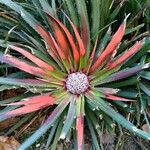
Fascicularia bicolor
Rhodostachys · Fascicularia andina · Billbergia bicolor (Ruiz & Pav.) Schult.f. · Fascicularia kirchhoffiana · Bromelia bicolor Ruiz & Pav.
Description
Source: leafsnapFascicularia bicolor is a distinctive and captivating plant in the Bromeliaceae family. Native to the Andes Mountains of Chile and Argentina, it thrives in rocky areas, cliffs, and forests. The plant forms a rosette of stiff, spiky leaves that are green on top and red underneath, arranged in a spiral pattern around the rosette's center. From this central rosette, Fascicularia bicolor produces beautiful flowers on long stalks. These bright blue or purple flowers, adorned with yellow stamens, bloom from late spring to early summer. This plant is easy to grow in well-draining soil with regular watering during its growing season, which spans from spring through fall. While it prefers partial shade, it can tolerate full sun as long as it receives adequate water. Fascicularia bicolor is an excellent choice for rock gardens or as an accent plant in containers or borders thanks to its unique appearance. Its vibrant flowers also attract hummingbirds. In summary, Fascicularia bicolor is a visually striking addition to any garden or landscape, offering both standout foliage and beautiful blooms.
Care Guide
💧 Water Every 7 days
☀️ Light Partial sun
Rhodostachys comes from habitats such as forest understories that provide natural shade. It prefers partial sun but can tolerate full sun when necessary.
🌡️ Temperature 15–37.8°C
Rhodostachys prefers warm conditions. If temperatures fall too low, growth may stop or the plant can incur frost damage. It tolerates high heat and humidity well and needs a consistent level of moisture in its surroundings. However, extremely high temperature and humidity can make it prone to fungal infections. In dry conditions, regular watering and misting are required to maintain sufficient air humidity. The plant is sensitive to sudden temperature changes, so keeping the temperature relatively stable is important.
💨 Humidity
🪴 Soil 6-7
🌱 Fertilizer
🪴 Pot & Repot
✂️ Pruning
To promote healthy growth and remove damaged leaves, prune rhodostachys in early spring. Trim spent flower stalks to encourage new blooms and maintain the plant's shape. Pruning improves airflow and helps prevent disease. However, be careful not to over-prune, as rhodostachys depends on its leaves for photosynthesis.
🌿 Propagating
🐛 Diseases & pets
☠️ Toxicity
Characteristics
- Plant Type
- Succulent
- Life Cycle
- Perennial
- Genus
- Fascicularia
- Family
- Bromeliaceae
- Hardiness Zone
- 8-11
- Mature Height
- 40 cm
- Mature Spread
- 40 cm
- Leaf Color
- Red, Green
- Leaf Type
- Evergreen
- Flower Color
- Blue
- Flower Size
- 2.03 cm to 3.05 cm
- Bloom Time
- Mid summer, Late summer
- Planting Time
- Spring, Summer
- Harvest Time
- Early fall, Mid fall