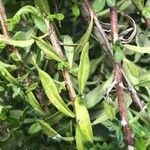
Felicia amelloides
Blue daisy · Blue marguerite · Garden felicia · నీలి గలగర · Seaside Daisy
Description
Source: leafsnapFelicia amelloides, the blue daisy bush or blue felicia, is a hairy, soft, usually perennial, evergreen plant, in the family Asteraceae. It can be found along the southern coast of South Africa. It grows as ground cover and produces many very regular branches. It mostly grows to about 50 cm (1.6 ft) high, rarely to 1 m. The leaves are oppositely arranged along the stems, dark green in colour and elliptic in shape. The flower heads sit individually on up to 18 cm (7 in) long, green to dark reddish stalks. They consist of about twelve heavenly blue ray florets that surround many yellow disc florets, together measuring about 3 cm (1+1⁄5 in) across. It is also cultivated as an ornamental, and was introduced in Europe in the middle of the 18th century.
🌳 The blue daisy is mainly valued for its ornamental qualities rather than for uses in fields like herbal medicine or culinary applications. Its vivid blue blooms and simple care requirements make it a common choice for gardeners and landscapers looking to add a burst of color to gardens. Even with its limited uses outside ornamental contexts, the plant’s visual appeal and low maintenance needs allow it to play a notable role in beautification and urban green spaces. In short, its primary practical potential is in enhancing the visual attractiveness of cultivated settings.
Care Guide
💧 Water Every 7 days
The blue daisy thrives in coastal habitats where consistent moisture is available, though it can tolerate short dry spells. To support its growth and blooming, watering it weekly is recommended. Typically grown outdoors, the blue daisy flourishes in abundant sunlight and prefers evenly moist soil, especially during its active growing season.
How should I water my Blue daisy?
To properly care for the Blue daisy, it's important to use filtered water that is at room temperature or slightly warmer. Tap water can potentially harm the plant due to particles it may contain. Since the Blue daisy thrives in warm environments, cold water can be a shock to its system. It's also best to avoid watering the plant from above, as this can lead to problems with the foliage. Instead, the recommended method is to apply filtered room temperature water directly to the soil until it is completely soaked. This helps to moisturize the roots and promote their growth and nutrient absorption.
What do I need to do if I give my Blue daisy too much or too little water?
Both overwatering and underwatering can harm your Blue daisy, but overwatering is more common. When the plant gets too much water, its stems and leaves wilt and turn yellow. Extended overwatering can also cause diseases like root rot, mold, and mildew, which can be fatal. While underwatering is less likely for the Blue daisy due to its drought tolerance, it can still happen, causing brittle and brown leaves. It's crucial to recognize the signs of overwatering early to prevent irreversible damage. If you notice these signs, reduce watering immediately and consider replacing poorly draining soil with a loose, well-draining potting mix. Conversely, if the plant shows signs of not getting enough water, simply increase the frequency of watering until the signs improve.
How frequently should I water my Blue daisy?
If your Blue daisy is in a pot, the best way to determine if it needs water is by sticking your finger into the soil. If the top two to three inches of soil feel dry, it's time to water it. If your Blue daisy is planted outdoors in the ground, you can use the same method to test the soil. Once the top few inches of soil are dry, it needs watering. Typically, during spring and early fall, watering once a week is sufficient. However, during hot weather, you may need to water twice a week or more. It's worth noting that mature, well-established Blue daisies have a good tolerance for drought.
How much water does my Blue daisy plant need?
When watering your Blue daisy, make sure to give it a generous amount of water. Wait until the top two to three inches of soil are dry, then thoroughly water the plant. Ensure that the water completely soaks the soil, allowing excess water to drain out through the pot's drainage holes. If you don't see any excess water draining, you may not have watered enough. Be careful not to let water accumulate in the soil, as this can harm the plant. Additionally, if water doesn't drain properly from the pot, it could be a sign of poorly draining soil, which is bad for the plant's health. If the plant is outside, one inch of rain per week should be enough.
How do I water my Blue daisy when it grows at different stages?
The water needs of the Blue daisy can vary depending on its growth stages. When the Blue daisy is young or has been recently transplanted, it requires more water than usual. During this time, the plant focuses on growing new roots, which need extra moisture. As the Blue daisy matures, its water needs decrease. Additionally, during the bloom period, the plant requires more water due to the energy used for flower development.
☀️ Light Full sun
Blue daisy flourishes in full sun, reflecting its native habitat's need for plentiful light. This supports the plant's healthy development. Certain growth stages may need different light intensities. Yet excessive light or insufficient light can adversely affect the plant's wellbeing.
What are the sunlight requirements for a Blue Daisy (Felicia amelloides)?
The Blue Daisy thrives under full sun exposure, mirroring its native environment's need for ample light, which is crucial for the plant's healthy growth. Full sun is defined as above 6 hours of sunlight per day, while partial sun refers to about 3-6 hours of sunlight daily. Observing how sunlight moves through your garden and selecting locations that provide a perfect balance of light and shade are essential for ensuring the plant's wellbeing. At certain growth stages, the light intensity required might vary, but overall, extreme light conditions should be avoided to prevent negative impacts on the plant.
How can artificial lighting support Blue Daisy's growth indoors?
Indoor Blue Daisies require adequate lighting for optimal growth, especially when natural sunlight is insufficient, such as in winter or less sunny spaces. Artificial lighting, such as LED lights, which can be customized to provide specific wavelengths needed by plants, offers a vital solution. The requirement for artificial light intensity varies by plant type: full sun plants need 30-50W per square foot, partial sun plants need 20-30W per square foot, and full shade plants need 10-20W per square foot. The light source should be placed 12-36 inches above the plant to mimic natural sunlight and should be kept on for 8-12 hours per day to replicate natural daylight hours, promoting faster, healthier growth.
What are the symptoms of inadequate lighting in a Blue Daisy?
When Blue Daisies are placed in rooms with inadequate lighting, several symptoms can manifest, including new leaves growing smaller than mature ones, leggy or sparse growth, faster leaf drop, slower or no new growth, and lighter-colored new leaves. Other symptoms include chlorosis, where leaves lose their green color and turn yellow due to a lack of chlorophyll and essential nutrients, sunscald, leaf curling, wilting, and leaf scorching. These symptoms indicate the plant's struggle with the light conditions and the need for better light exposure.
What solutions can alleviate the symptoms of light deficiency in Blue Daisies?
To counteract the symptoms of light deficiency in Blue Daisies, gradual exposure to more sunlight is key. For indoor plants, move them to a sunnier location each week, aiming for at least 6 hours of direct sunlight a day, using a south-facing window for natural light, or supplement with artificial light like desk lamps or grow lights for at least 8 hours daily. For outdoor plants, choose sunny spots and gradually acclimate them to avoid sunburn. Reducing obstructions such as pruning trees and transplanting smaller plants during dormant periods to sunnier locations can significantly improve sunlight reception. It's important to note that while parts of the plant affected by insufficient light may not recover, new growth should be healthy following these adjustments.
🌡️ Temperature 20–37.8°C
Blue daisy originates from areas where temperatures typically fall between 68 and 100 °F (20 to 38 ℃). It favors warmer conditions but can tolerate cooler ones when necessary. Modify its exposure in line with seasonal shifts.
What is the ideal temperature range for Blue daisy?
Blue daisy thrives in regions where temperatures generally range from 68 to 100 °F (20 to 38 °C). It prefers warmer climates but can adapt to cooler conditions if necessary. However, it is crucial to adjust its exposure considering the seasonal changes to protect it from extreme temperatures. During winter, maintaining temperatures above 20°C is beneficial for the plant's growth, as any temperatures approaching 0°C can be detrimental.
How does cold weather affect Blue daisy and what should I do?
Blue daisy is not tolerant of low temperatures and shows its best growth when the temperature remains above 20°C. In conditions where the temperature falls below 0°C, particularly to -5°C, the leaves may lighten in color. After frost damage, the plant's color can turn brown or black, and wilting or drooping may occur. To mitigate frost damage, trim off the frost-damaged parts and move the plant indoors to a warm environment, preferably near a south-facing window for adequate sunlight. It's also important to avoid placing the plant near heaters or air conditioning vents to prevent the air around it from becoming excessively dry.
How should I care for Blue daisy in high temperatures?
During the summer, it's essential to ensure that Blue daisy remains in temperatures below 38°C to avoid heat stress. If temperatures exceed 43°C, the plant may experience lighter leaf color and become more susceptible to sunburn. In such cases, trim away the sunburned and dried-up parts of the plant. Relocate the plant to a spot that offers shade during the midday and afternoon sun. Additionally, watering the plant in the morning and evening can help keep the soil moist and support the plant through extreme heat.
💨 Humidity
🪴 Soil 6-6
🌱 Fertilizer
Proper fertilization is vital to the health and appearance of the Blue daisy. Fertilize the Blue daisy in summer, repeating the treatment monthly throughout the season. Nutrients provide energy for growth and sustain the plant’s parts. Fertilization improves the Blue daisy’s floral display, ensuring the best blooms.
Why is it important to put fertilizer on my Blue daisy?
Fertilizer and soil nutrients are like fuel for your Blue daisy. They are essential for maintaining healthy growth. Plants use the nutrients found in the soil to develop new plant material and keep their existing parts in good condition. For the Blue daisy, fertilization is important for producing beautiful flowers. Since the flowers are the main attraction of this plant, most gardeners want to ensure they appear in their best form. Fertilization is an effective way to help your Blue daisy produce the most impressive blooms.
When should I fertilize my Blue daisy?
The Blue daisy goes through two main phases each year. Firstly, during the dormant phase in winter, the plant experiences minimal new growth. The second phase is the active growth phase, which occurs in spring and fall and requires more fertilization. It is advisable to begin fertilizing your Blue daisy in the spring and continue once a month throughout the rest of spring and most of summer. As fall approaches, you can gradually decrease the frequency of fertilization.
When is it a bad idea to fertilize my Blue daisy?
To promote Blue daisy growth, it's important to avoid root burn. During the active growth period in spring and summer, additional nutrients are needed. However, in the fall and winter when the plant goes into dormancy, fertilization should be discontinued.
What kind of fertilizer is best for my Blue daisy?
For the ideal fertilizer for a Blue daisy, you want a mix of the three main plant nutrients, with slightly more phosphorus. Another option is to add organic materials like compost, worm castings, and manure to improve the soil. Fertilizers can come in various forms and most will work for your Blue daisy. However, the best options are liquid or powdered. Regardless of the form, make sure to dilute the fertilizer and apply while watering the Blue daisy.
How can I feed my Blue daisy?
To apply fertilizer to your Blue daisy, start by finding a suitable fertilizer and understanding the recommended fertilization schedule. The most reliable method is to mix your liquid fertilizer with water before applying it to the soil. Follow the manufacturer's instructions for the specific fertilizer you are using, as they may have different feeding directions. These instructions will also explain how to properly dilute the fertilizer, preventing overfertilization. Once you have mixed the fertilizer with water, simply pour the mixture into the soil where your Blue daisy is planted.
🪴 Pot & Repot 2-3 years
The blue daisy flourishes in the spring and should be repotted every 2 to 3 years into a pot that is one size larger. After repotting, place it in a location with bright, indirect light and be careful not to overwater it. Light fertilization will encourage robust growth for this flowering plant.
✂️ Pruning
The Blue Daisy is known for its vibrant blue flowers and compact growth habit. To keep it looking its best, it's important to deadhead the flowers and prune in the spring. This care routine promotes growth, maintains the plant's shape, and prevents it from becoming leggy. As a result, the Blue Daisy will have a fuller, healthier appearance and become more aesthetically pleasing during the growing season.
🌿 Propagating
🐛 Diseases & pets
☠️ Toxicity
Characteristics
- Plant Type
- Herb
- Life Cycle
- Perennial, Annual
- Genus
- Felicia
- Family
- Asteraceae
- Hardiness Zone
- 9-11
- Mature Height
- 30 cm to 61 cm
- Mature Spread
- 30 cm to 61 cm
- Leaf Color
- Green, White, Variegated
- Leaf Type
- Deciduous
- Flower Color
- White
- Flower Size
- 3.81 cm
- Bloom Time
- All year round
- Planting Time
- Spring
- Harvest Time
- All year round
- Native Area
- South Africa