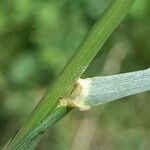
Festuca pratensis
Meadow fescue · English-bluegrass · Meadow False Rye Grass · Grass
Description
Source: leafsnapFestuca pratensis, the meadow fescue, is a perennial species of grass, which is often used as an ornamental grass in gardens, and is also an important forage crop. It grows in meadows, roadsides, old pastures, and riversides on moist, rich soils, especially on loamy and heavy soils. It is a tall, tufted grass similar to the tall fescue, Festuca arundinacea. Tall fescue differs by having minute hairs on the auricles. It can hybridise with Lolium perenne and Lolium multiflorum.
🌳 Although commonly known for its role in lawn and turf management, red fescue possesses characteristics that extend into less-explored areas. Research has shown it acts as a phytoremediator, capable of indicating the presence of certain heavy metals in soil—zinc, for instance—by accumulating these substances in its tissues. Additionally, because of its resilience and extensive root system, red fescue may contribute to soil stabilization projects and erosion control, offering potential as a natural engineering material for landscape restoration and rehabilitation efforts.
Care Guide
💧 Water
☀️ Light Full sun
Red fescue maintains peak health when given plentiful sunlight, reflecting its origin in open habitats. It can tolerate lower light levels, but this may limit optimal growth. Excessive or insufficient sunlight can reduce its vigor or fade its color.
🌡️ Temperature 5–35°C
Red Fescue is a temperate woody species that requires temperatures of 41 to 95 ℉ (5 to 35 ℃). It is native to cooler, moist habitats and can withstand light frosts. In the colder months, Red Fescue should be maintained at 41 to 50 ℉ (5 to 10 ℃) to promote dormancy and prevent frost damage.
💨 Humidity
🪴 Soil 5-7
🌱 Fertilizer
Red Fescue is a cool-season grass that primarily grows in spring and fall. It becomes dormant in winter and its growth slows in summer. Applying suitable fertilizers in spring can replenish nutrients and encourage vigorous, dense growth. Well-fed lawns are greener, resilient, and resist pests and weeds.
🪴 Pot & Repot
✂️ Pruning
🌿 Propagating
🐛 Diseases & pets
☠️ Toxicity
Characteristics
- Plant Type
- Grass
- Life Cycle
- Perennial
- Genus
- Festuca
- Family
- Poaceae
- Hardiness Zone
- 4-10
- Mature Height
- 30 cm to 61 cm
- Mature Spread
- 10 cm
- Leaf Color
- Green, Blue, Gray, Silver
- Leaf Type
- Evergreen
- Flower Color
- Yellow, Brown, Purple, Gold
- Flower Size
- 5.08 cm to 20.32 cm
- Bloom Time
- Late spring, Early summer
- Planting Time
- Spring, Winter
- Harvest Time
- Mid summer