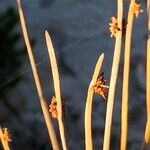
Ficinia nodosa
Description
Source: leafsnapFicinia nodosa, the knotted club-rush or knobby club-rush, is a rhizomatous perennial in the family Cyperaceae, native to South Africa, Australia, and New Zealand. Widespread in the Southern Hemisphere, Ficinia nodosa grows to between 15 and 220 cm in height. Although it grows best in sandy, salty soil, the plant grows in a wide variety of environments from coastal sand dunes to alpine regions. F. nodosa’s appearance is characterised by dense clusters of long green stems topped with small, rounded flowers often remaining throughout the year.
Care Guide
💧 Water
Knobby club-rush thrives in coastal dunes and sandy soils, requiring a careful balance of dry periods and moisture. While it can withstand moderate drought, it needs weekly watering when cultivated. Well-draining soil is crucial to prevent waterlogging, particularly in areas with frequent rain or high precipitation.
☀️ Light Full sun
Knobby club-rush flourishes in abundant sunlight, which promotes healthy growth and vigour. The plant does not require any shade, as it has a strong tolerance for light exposure without harm. Excessive shading or a marked lack of light can inhibit its growth; it originates from a natural habitat with ample solar exposure.
What are the sunlight requirements for Knobby club-rush?
Knobby club-rush (Ficinia nodosa) thrives in conditions where it receives more than 6 hours of sunlight daily, categorizing it as a full sun plant. Sunlight plays a crucial role in its growth and vigor, making it essential to choose locations that provide ample sunlight without excessive shade. It's important to observe the movement of sunlight through your garden to find the perfect balance for your plants, ensuring their health and happiness.
What role does sunlight play in the growth of Knobby club-rush, and how can artificial lighting be used?
Sunlight is paramount for the healthy growth and vigor of Knobby club-rush, enabling it to thrive in its natural habitat characterized by abundant solar exposure. In cases where natural sunlight is insufficient, especially during winter or in less sunny spaces, artificial lighting becomes essential. LED lights, favored for their ability to mimic the specific wavelengths needed by plants, are recommended. For full sun plants like Knobby club-rush, 30-50W/sq ft of artificial light is needed. To mimic natural sunlight, the light source should be placed 12-36 inches above the plant for 8-12 hours per day, ensuring optimal growth.
What are the signs of light deficiency in Knobby club-rush?
Knobby club-rush shows several symptoms when it experiences light deficiency, including small leaves, leggy or sparse growth, faster leaf drop, slower or no new growth, lighter-colored new leaves, chlorosis, sunscald, leaf curling, wilting, and leaf scorching. These signs indicate the plant's struggle under inadequate lighting conditions, reflecting the need for better light exposure to maintain health and vigor.
How can you address light deficiency issues in Knobby club-rush?
To combat light deficiency in Knobby club-rush, gradually increase sunlight exposure by moving the plant to sunnier locations, ensuring at least 6 hours of direct sunlight daily. For indoor plants that are large or difficult to move, consider supplemental artificial lighting, keeping lamps on for at least 8 hours a day or using professional plant grow lights. Outdoors, avoid sudden changes in light intensity and prune any obstructions like trees to allow more sunlight. For plants in the ground, transplanting to a sunnier location during the dormant period can also help. Remember, while parts of the plant that have already been damaged may not recover, new growth should be healthy with improved light conditions.
🌡️ Temperature 15–37.8°C
Knobby club-rush is fairly adaptable to temperature, tolerating high heat and considerable temperature swings. In hot weather, care should be taken to water appropriately and provide some shade to prevent sunburn. Conversely, it has limited cold tolerance; while it can endure mild cold, very low temperatures may cause frost damage.
💨 Humidity
🪴 Soil 6-7
🌱 Fertilizer
Knobby club-rush benefits from extra nutrients to encourage healthy new growth. In spring, adding a layer of compost around the plant's base will effectively supply the nutrition it requires. Fertilizing supports vigorous development and helps the plant defend against diseases and pests.
🪴 Pot & Repot 2-3 years
When repotting Knobby club-rush, select a pot 1-2 inches (2.5–5.1 cm) larger with good drainage. Use a well-draining potting mix. Repot in spring or fall, making sure the root ball sits slightly below the rim of the flower pot. Water thoroughly after repotting and keep it in a warm spot with indirect sunlight.
✂️ Pruning
Knobby club-rush has tufted, grass-like leaves and distinctive knobby stems. To encourage new growth and improve air circulation, which reduces the risk of disease, prune the plant in early spring by cutting back any dead stems. Use sharp, clean tools to ensure effective pruning that boosts the plant's health and visual appeal.
🌿 Propagating
🐛 Diseases & pets
☠️ Toxicity
Characteristics
- Plant Type
- Grass
- Life Cycle
- Perennial
- Genus
- Ficinia
- Family
- Cyperaceae
- Hardiness Zone
- 8-11
- Mature Height
- 0.15 m to 2.13 m
- Mature Spread
- 46 cm
- Leaf Color
- Green
- Leaf Type
- Evergreen
- Flower Color
- Brown, White, Yellow
- Flower Size
- 0.25 cm to 0.51 cm
- Bloom Time
- Summer, Early fall, Mid fall
- Planting Time
- Spring, Summer, Autumn
- Harvest Time
- Late summer, Fall, Early winter
- Native Area
- South Africa, New Zealand