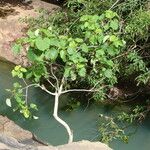
Ficus abutilifolia
Large-leaved Rock Fig
Description
Source: leafsnapFicus abutilifolia, commonly known as the Indian laurel fig, is a species of fig tree native to India and Sri Lanka. It is a small- to medium-sized evergreen tree that can reach up to 15 meters in height. The leaves are glossy, leathery, oval-shaped, and have pointed tips. The bark is smooth and grayish-brown. The Indian laurel fig produces small, greenish-yellow flowers that may not be showy but attract pollinators such as wasps. The fruit is a small, round fig that changes from green to purple when ripe. Ficus abutilifolia has numerous uses in traditional medicine for treating ailments such as diarrhea, dysentery, fever, and skin diseases. It also holds cultural significance in Hinduism, where it is considered sacred due to its association with Lord Vishnu. In landscaping and gardening, it is valued for its attractive foliage that provides shade during hot summers. It is also suitable for bonsai cultivation due to its adaptability to pruning techniques. Overall, Ficus abutilifolia serves multiple purposes, from medicinal uses to ornamental value, making it an important species in the tropical regions where it is native.
Care Guide
💧 Water Every 7 days
The large-leaved rock fig needs minimal watering, except during drought conditions. For potted large-leaved rock figs, water them weekly during the spring, summer, and fall. In winter, reduce watering to every other week. Adjust the watering frequency based on temperature changes, and increase humidity in dry air to promote optimal growth.
☀️ Light Full sun
Large-leaved rock fig is native to open habitats, such as sunny meadows and forest margins, which provide plenty of light. It does best in full sun but can also tolerate partial sun, adapting well to a range of light conditions.
🌡️ Temperature 15–37.8°C
The large-leaved rock fig is naturally adapted to moderate to warm temperatures year-round in its native habitat, favoring a range of 59 to 100 °F (15 to 38 ℃). For best growth, maintain these conditions. Seasonal adjustments may be necessary, particularly in cooler climates.
💨 Humidity
🪴 Soil 6-7
🌱 Fertilizer
The best time to fertilize a Large-leaved rock fig is in early spring as it breaks dormancy. This encourages overall growth and flower formation. Fertilization improves the foliage, stems, and branches, while encouraging flowers that are large, bright, and long-lasting. It assists in moving nutrients from the roots to the flowers and enhances the plant's health and resistance to disease.
🪴 Pot & Repot
✂️ Pruning
Pruning the large-leaved rock fig on a regular schedule is crucial for encouraging the growth of side branches and increasing its ornamental value. Begin by pinching the terminal buds when the plant reaches a height of 60 cm, and prune again when it grows to 80 cm. Consistent pruning not only improves air circulation but also stimulates the growth of new leaves. Be sure to wear gloves during this process, as the plant releases a milky sap from cuts.
🌿 Propagating
🐛 Diseases & pets
☠️ Toxicity
Characteristics
- Plant Type
- Tree
- Life Cycle
- Perennial
- Genus
- Ficus
- Family
- Moraceae
- Hardiness Zone
- 8-11
- Mature Height
- 4.88 m to 10.06 m
- Mature Spread
- 3.96 m to 7.92 m
- Leaf Color
- Green, Dark Green
- Leaf Type
- Evergreen
- Bloom Time
- Late spring, Summer, Early fall
- Planting Time
- Spring, Summer, Autumn
- Harvest Time
- Late summer, Fall, Early winter
- Native Area
- Burkina Faso, South Africa, Zambia, Sudan, Mauritania, Nigeria, Guinea, Tanzania, Zimbabwe, Benin, Mali, Chad, Cameroon, Mozambique, Togo, Ghana, Senegal, Eswatini, Côte d'Ivoire, Botswana, Central African Republic