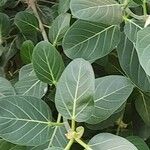
Ficus benghalensis
لور · انجیر معابد · فیکوس بنگال · Indian banyan · Ficus Audrey
Description
Source: leafsnapFicus benghalensis, commonly known as the banyan tree, is an impressive species of fig native to India and Pakistan. A member of the Moraceae family, it can grow up to 30 meters tall and spread over 100 meters wide. The banyan tree is iconic for its aerial roots that extend from its branches, eventually forming new trunks. The leaves of Ficus benghalensis are large, leathery, and glossy green. It produces small figs that ripen to a purple or red color. In India, the banyan tree holds significant cultural importance, being considered sacred by Hindus. They believe it represents eternal life because of its ability to regenerate from aerial roots. Additionally, it provides much-needed shade for travelers and animals during the hot summer months. Ficus benghalensis can also be cultivated as an ornamental plant in tropical regions around the world due to its impressive size and unique appearance. However, it's important to note that it requires ample space for growth because its extensive root system can cause damage if planted too close to buildings or other structures. Overall, Ficus benghalensis is an iconic plant with deep cultural significance in India and is also appreciated worldwide for its ornamental appeal.
🌳 Besides offering shade and shelter, the banyan tree has an exceptional ability to absorb a range of pollutants, including heavy metals from contaminated soil, making it a valuable environmental sentinel. Its widespread root system helps curb soil erosion, and the tree serves an important role in urban landscaping for air purification, thereby effectively improving air quality.
🎭 Contemplation
Care Guide
💧 Water Every 7 days
The banyan tree, native to the Indian subcontinent, thrives in humid climates characterized by monsoons. Although it can withstand short periods of drought, it prefers consistent moisture. Water the banyan tree every 1-2 weeks, ensuring the soil remains lightly moist. Thanks to its extensive root system, the tree does not require frequent watering.
How should I water my Banyan tree?
You can water your Banyan tree with any common watering tool, like cans, hoses, or cups. Just make sure to directly water the soil and evenly moisten all areas to provide enough water to the root system. Filtered water is recommended to avoid harmful particles from tap water, and it's best to use water that is at or slightly above room temperature to avoid shocking the tree. However, the Banyan tree usually adapts well to any type of water.
What should I do if I give my Banyan tree too much or too little water?
Outdoor plants, especially newly planted ones or seedlings, can suffer from lack of watering. It is essential to ensure sufficient watering for the first few months, especially when the tree is small or newly planted. Once the roots are established, Banyan trees can rely on rain most of the time. When your Banyan tree is in a pot, overwatering is more likely to happen. If you accidentally overwater your Banyan tree, take immediate action to fix the situation. First, stop watering the plant to minimize the effects of overwatering. Then, remove the Banyan tree from its pot to check the roots. If you find no signs of root rot, you can return the plant to its container. However, if you notice root rot, trim the affected roots and consider applying a fungicide to prevent further damage. Lastly, repot the Banyan tree in well-draining soil. In the case of underwatering, simply water the Banyan tree more frequently. Underwatering is usually easy to remedy, as the plant's leaves will droop, dry out, and fall off. With sufficient watering, the leaves will soon regain their fullness. Correct your watering frequency once you notice underwatering.
How frequently do I need to water my Banyan tree?
Most outdoor plants can rely on rainfall for their water needs. However, if you live in an area with little rainfall, you should water your plants adequately every two weeks in the spring and fall. In the summer, you'll need to water them more often. In the winter, when plants grow slower and need less water, you can water them sparingly or not at all. If you have a young or newly planted Banyan tree, it needs more frequent watering to help it establish and grow. Mature Banyan trees are more adaptable and drought tolerant. For potted Banyan trees, there are two ways to determine watering frequency. One is to set a schedule, such as once a week or every other week. However, this method may not be suitable for your specific growing environment. The other approach is to check the soil moisture. Wait until the top two to four inches of soil have completely dried out before watering again. This guideline may vary depending on the season, as water needs are higher in the summer.
How much water does my Banyan tree require?
Watering your Banyan tree may be different than you expect. Instead of needing a lot of water, it only requires about five to ten ounces per watering if only a few inches of soil have dried. You can also gauge how much to water based on how much soil has dried out between waterings. To ensure the tree receives enough moisture, water until all the layers of dry soil are moistened. If over half of the soil is dry, provide more water until it starts to drain from the pot's holes. If the tree is planted in a rainy area, it may not need additional watering. For young or newly established trees, make sure they receive 1-2 inches of rain per week. As they grow, they can rely on rainwater, but during hot, dry periods without rainfall for a few weeks, a full watering is necessary to prevent stress.
How can I know if I'm giving my Banyan tree enough water?
The Banyan tree is commonly affected by overwatering, which can be identified through signs such as yellowing leaves and leaf drop. Overwatering can also cause the plant to shrink and lead to root rot. Conversely, an underwatered Banyan tree will start to droop and may have brown or brittle leaves. Regardless of whether you notice signs of overwatering or underwatering, it is important to take action and restore the tree's health.
☀️ Light Partial sun
The banyan tree prefers intermediate sun exposure, yet it can tolerate a full day of sunlight or a completely shaded day. Originating from environments with fluctuating sunlight, its growth may be affected by excessive or insufficient light, which could potentially result in lagging growth or wilting.
What are the sunlight requirements for plants in general?
Plants have varied sunlight requirements depending on their type. Partial sun plants need about 3-6 hours of sunlight a day, whereas plants that require full sun or full shade need more than 6 hours of sunlight daily. It's important to watch how sunlight moves through your garden, selecting spots that offer the right balance of light and shade, ensuring your plants thrive in their environment.
What are the sunlight and artificial light needs of a Banyan tree?
The Banyan tree enjoys moderate exposure to sunlight and can endure both a whole day of sunshine or a day in complete shade, thanks to its adaptability originating from habitats with variable sunlight. However, too much or too little light can affect its growth, possibly leading to stunted growth or withering. For indoor Banyan trees, adequate lighting is crucial for optimal growth, especially when natural sunlight is scarce. Artificial lighting, like LED lights, can offer a viable solution by providing essential wavelengths. The intensity of artificial light varies based on the plant's requirements (e.g., full sun plants need 30-50W/sq ft, partial sun 20-30W/sq ft, and full shade 10-20W/sq ft). It's recommended to place the artificial light source 12-36 inches above the plant, ensuring it receives 8-12 hours of light per day to mimic natural daylight hours.
What are the potential symptoms of light deficiency in a Banyan tree?
When a Banyan tree experiences light deficiency, it may show several symptoms. These include faster leaf drop as the plant sheds older leaves to conserve resources, development of lighter-colored or pale new leaves indicating a lack of chlorophyll, leggy or sparse growth due to longer spaces between leaves or stems, slower or halted new growth as the plant enters survival mode, and a loss of variegation in some varieties. Excessive sunlight can cause chlorosis, leading to yellowing leaves, sunscald with pale or necrotic areas on the plant, leaf curling as a defense against water loss, wilting due to increased transpiration, and leaf scorching characterized by brown, dry edges or patches on leaves.
How can I address symptoms of light deficiency or excess in my Banyan tree?
To optimally nurture your Banyan tree in response to light-related issues, consider gradual adaptation to light conditions. For indoor plants, shift them to sunnier spots weekly until they receive 3-6 hours of direct sunlight daily or use artificial light for plants that are large or immovable, keeping it on for at least 8 hours a day. For outdoor plants, moving them gradually to sunnier locations helps avoid sunburn. Additionally, reducing obstructions like pruning trees or transplanting smaller plants to sunnier spots can improve sunlight access. Note that parts of the plant affected by insufficient sunlight may not recover, but new growth following increased light exposure will be healthy.
🌡️ Temperature 20–37.8°C
The banyan tree typically grows in humid subtropical and tropical regions where temperatures range from 20 to 38 ℃ (68 to 100.4 ℉). It prefers warm conditions and can tolerate some cold, but temperatures below 10 ℃ (50 ℉) may harm the plant. During hot summer months, providing partial shade is recommended to prevent heat stress.
What are the ideal temperature conditions for a Banyan tree?
The Banyan tree, or Ficus benghalensis, thrives in humid subtropical and tropical climates, favoring warm temperatures ranging from 20°C to 38°C (68°F to 100.4°F). It requires warm environments and can withstand minor cold spells, but exposure to temperatures below 10°C (50°F) could damage the plant. During hot summer periods, partial shading is advised to alleviate heat stress. The tree is notably sensitive to cold, and during autumn, it is preferable to move it indoors by placing it near a bright window, albeit away from direct heat sources. Keeping the temperature above 20°C in winter months promotes healthy growth, whereas temperatures nearing 5°C are harmful.
How should I care for my Banyan tree in low temperature conditions?
Banyan trees prefer warm temperatures and do not tolerate cold well, thriving optimally when temperatures are above 20°C. It's vital to keep the environment above 5°C during the winter. Should the temperature fall below 1°C, the leaves might discolor, becoming lighter and, following frost damage, turning brown or black, with the tree exhibiting signs of wilting and drooping. In such situations, it's advisable to trim off frost-damaged parts and move the tree indoors to a warmer environment. Positioning the plant near a south-facing window ensures ample sunlight, and it's essential to avoid placing it near heaters or air conditioning vents to prevent the air from becoming excessively dry.
What steps should I take if my Banyan tree experiences high temperature stress?
During the summer, it's crucial to ensure that the Banyan tree's temperature does not exceed 38°C. At temperatures above 43°C, the leaves may start to lighten in color, indicating an increased risk of sunburn. To manage this, trim away any sunburned or dried parts. Relocate the plant to an area that offers protection from the intense midday and afternoon sun. Watering the plant in the morning and evening helps maintain soil moisture, which is vital for the tree's health during periods of extreme heat.
💨 Humidity high (>60%)
This plant needs special care because it loves high humidity levels of 60-80% or more. The best way to achieve this is by placing a humidifier near the plant. Daily misting is also essential! Make sure the room has good ventilation.
🪴 Soil 6-7
🌱 Fertilizer
Banyan tree care is fundamentally dependent on fertilization. Routine nourishment throughout the growth period facilitates energy needs for attractive foliage and promotes general development. If fertilization is overlooked, it could lead to unhealthy foliage, reduced aesthetic value, and growth that is underdeveloped or frail, making it susceptible to snapping.
Why should I put fertilizer on my Banyan tree?
Banyan trees need regular fertilization because their showy leaves require a lot of energy to produce and maintain. The challenge is that the tree needs enough energy not only for its leaves, but also to support the growth of its stems, branches, roots, and other vital structures. Neglecting fertilization can lead to two likely outcomes. First, the leaves may lose their natural color and texture, making the tree look unhealthy and less attractive. Second, the overall growth of the tree may slow down or result in weak growth that could easily break.
When should I fertilize my Banyan tree?
To ensure the health of your Banyan tree, occasional feedings are beneficial. Therefore, it is not necessary to establish a specific feeding schedule when planting one of these trees. A simple and effective method to fertilize your Banyan tree is to apply the fertilizer while watering it on certain occasions. Additionally, during the growing season, it is important to provide an adequate amount of water for your tree. You can feed the plant every two to three weeks, consistently throughout the period of new growth.
When is it not a good idea to put fertilizer on my Banyan tree?
For most of the year, you can fertilize your Banyan tree on a regular schedule. This includes the active growing season of spring, summer, and early fall. However, during the winter when the tree enters a dormant phase, no fertilizer should be given. During this time, the tree doesn't show much or any new growth and uses less energy overall. Hence, fertilization is unnecessary in winter.
What kind of fertilizer should I use for my Banyan tree?
The fertilizer for a Banyan tree has a specific blend of nutrients, each in relatively low amounts. An ideal fertilizer has an N-P-K ratio of 3-1-2. However, a general-purpose fertilizer with an even blend can also work well. When using a balanced fertilizer, the ratio number for each nutrient should be 3 or lower. You can choose between granular or liquid-based fertilizer. If using a liquid one, it's best to dilute it by half. Granular fertilizer has few drawbacks, but it's generally more convenient to use liquid fertilizer, especially when watering the Banyan tree.
How do I make my Banyan tree grow better?
One easy way to fertilize a Banyan tree is to feed it whenever you water it. To do this, grab some fertilizer and a water container, like a watering can. Dilute the fertilizer by mixing it with water. Then, just pour the water and fertilizer mixture onto the soil, making sure it reaches the roots. Another option is to use granular fertilizer. Simply sprinkle some onto the soil where your Banyan tree is planted. Granular fertilizers are usually slow-release, so you won't need to fertilize as frequently as with liquid fertilizers. Regardless of the method you choose, it's helpful to water the tree while you're fertilizing it.
🪴 Pot & Repot 2-3 years
When repotting a Banyan tree, select a pot 1-2 inches (2.5–5.1 cm) larger with ample drainage. Use a well-draining potting mix. Repot in spring or fall, making sure the root ball is slightly lower than the rim of the flower pot. Water thoroughly after repotting and place it in a warm spot with indirect sunlight.
✂️ Pruning
The banyan tree is characterized by its extensive aerial roots and broad canopy. To maintain its health and manage its growth, pruning should be done from early to late winter, with a focus on removing dead branches and reducing overcrowding. This process improves air circulation and light penetration. Regular maintenance is crucial and should be performed using sterile tools to promote vigorous regrowth.
🌿 Propagating
🐛 Diseases & pets
☠️ Toxicity
Characteristics
- Plant Type
- Tree
- Life Cycle
- Perennial
- Genus
- Ficus
- Family
- Moraceae
- Hardiness Zone
- 10-12
- Mature Height
- 20.12 m to 29.87 m
- Mature Spread
- 35.05 m
- Leaf Color
- Green, Blue
- Leaf Type
- Evergreen
- Flower Color
- Yellow
- Flower Size
- 2.54 cm
- Bloom Time
- All year round
- Planting Time
- Spring, Autumn
- Harvest Time
- All year round
- Native Area
- Nepal, India, Malaysia, Indonesia, Vietnam, Myanmar, Bhutan, Bangladesh, Pakistan, Thailand