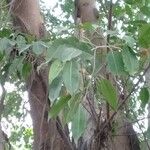
Ficus caulocarpa
Stem-fruited fig
Description
Source: wikipedia (CC BY-SA)Ficus caulocarpa is a flowering plant in the genus Ficus in the family Moraceae. It is native to southeastern Asia, from India and Sri Lanka easy to Taiwan and the Philippines, and also New Guinea. It is an often shrubby, multistemmed tree growing to 20 m tall. The leaves, of which three complete sets are produced each year, are entire and glabrous, and up to 22 cm long by 8.5 cm broad.
Care Guide
💧 Water
The shortleaf fig thrives in humid environments and is moderately tolerant of drought. Originating from tropical rainforests, it is well-suited to high humidity. Water it every two weeks. As an evergreen plant, the shortleaf fig keeps its leaves throughout the year, which enhances its ability to retain water compared to deciduous plants.
☀️ Light Full sun
The shortleaf fig prefers spots with unblocked, strong, and steady sunlight, which encourages healthy growth. While adapted to conditions of abundant sun, it can also tolerate locations with less intense light. It fares poorly with either too little or too much exposure, resulting in stress or inhibited growth, respectively.
What are the sunlight requirements for a Shortleaf fig?
The Shortleaf fig requires full sun, which means it needs above 6 hours of sunlight daily, but it can also thrive in partial sun, receiving about 3-6 hours of sunlight. It's important to observe the movement of sunlight through your garden to find spots that offer a good balance of light and shade. This ensures your plants grow happily without being stressed by too much or too little light. Additionally, the Shortleaf fig, while preferring robust and continuous sunlight, can also adapt to less intense sun exposure. However, insufficient or excessive exposure could lead to stress or hindered growth.
How should I use artificial lighting for Shortleaf fig indoor plants?
For Shortleaf fig indoor plants requiring additional lighting, particularly in less sunny spaces or during winter, artificial lights can be a crucial solution. Opt for LED lights, which can provide the specific wavelengths your plants need. Full sun plants require 30-50W/sq ft, partial sun plants 20-30W/sq ft, and full shade plants 10-20W/sq ft of artificial light. The light source should be placed 12-36 inches above the plant to mimic natural sunlight. Also, ensure the artificial light mimics the natural daylight duration, typically 8-12 hours per day, depending on the plant species.
What symptoms indicate a Shortleaf fig is getting too much or too little sunlight?
Symptoms of improper light exposure in Shortleaf figs include small or lighter-colored new leaves, leggy or sparse growth, faster leaf drop, slowed or halted growth, and specific signs of distress like chlorosis (yellowing leaves), sunscald, leaf curling, wilting, and leaf scorching. These symptoms suggest the plant is either not getting enough light or is being harmed by excessive sunlight. Observing these signs early can help in adjusting the plant's light exposure to mitigate stress and promote healthy growth.
How can I correct the light exposure for my Shortleaf fig?
To optimize your Shortleaf fig's light exposure, gradually increase natural sunlight by moving the plant to a sunnier location each week until it gets at least 6 hours daily, especially using a south-facing window for indoors. If moving the plant isn't feasible, or for additional lighting, consider artificial lights, keeping them on for about 8 hours a day. For outdoor plants, ensure a gradual transition to sunnier spots to prevent sunburn. In case of light obstructions, for ground-planted figs, consider pruning or transplanting during the dormant period to areas with better sunlight and drainage. It's crucial to remember that parts of the plant damaged by previous inadequate light might not recover, but new growth should be healthy with improved light conditions.
🌡️ Temperature 20–37.8°C
The shortleaf fig comes from tropical areas, which are typically warm and humid. Consequently, it is adapted to high temperatures and humidity. It does not tolerate sudden temperature changes and prefers a steady temperature, so indoor temperature fluctuations should be avoided. It generally cannot withstand cold and needs warmer conditions for growth. If the surrounding temperature falls too low, the plant may stop growing or even die.
💨 Humidity
🪴 Soil 6-7
🌱 Fertilizer
Early spring, when the Shortleaf fig breaks dormancy, is the best time to fertilize. Doing so stimulates overall growth and flower formation. Fertilization improves the foliage, stems, and branches, and encourages flowers that are large, bright, and long-lasting. It also helps transport nutrients from the roots to the flowers and boosts the plant's health and resistance to disease.
🪴 Pot & Repot
✂️ Pruning
The shortleaf fig, with its small, leathery leaves, can thrive both indoors and outdoors. To encourage optimal growth in the spring, it is best to prune the plant from early to late winter. This helps improve air circulation and light penetration. Make sure to use clean, sharp tools during maintenance to minimize damage and prevent infections.
🌿 Propagating
🐛 Diseases & pets
☠️ Toxicity
Characteristics
- Plant Type
- Tree
- Life Cycle
- Perennial
- Genus
- Ficus
- Family
- Moraceae
- Hardiness Zone
- 10-11
- Mature Height
- 20.12 m to 35.05 m
- Mature Spread
- 10.06 m to 20.12 m
- Leaf Color
- Dark Green, Forest Green
- Leaf Type
- Evergreen
- Bloom Time
- All year round
- Planting Time
- Spring, Summer, Autumn
- Harvest Time
- All year round
- Native Area
- Sri Lanka, Malaysia, Indonesia, Japan, Myanmar, Philippines, Singapore, Thailand, China