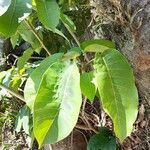
Ficus citrifolia
Shortleaf Fig · Wild banyantree · Strangler Fig · Ficus · Fig Tree
Description
Source: leafsnapFicus citrifolia, commonly known as the Shortleaf Fig or the Wild Banyan Tree, is a species of flowering plant in the fig family. It is native to Florida, the Caribbean, and Central and South America. This plant can grow up to 30 meters tall with a trunk diameter reaching up to 1 meter. Its leaves are dark green, glossy, and have a leathery texture, growing up to 30 cm in length. The Shortleaf Fig produces small figs that are green when unripe but turn yellow or red when mature. Although these fruits are edible, they are not commonly consumed by humans due to their small size. Ficus citrifolia is often used for ornamental purposes because of its attractive foliage and unique growth habit. Additionally, it provides habitat for various wildlife species, including birds and insects. In traditional medicine, different parts of this plant have been used to treat various ailments such as respiratory problems, skin diseases, and fevers, among other conditions. Overall, Ficus citrifolia is a fascinating tree with multiple uses, both in traditional medicine and ornamental applications. It plays a significant role in many ecosystems where it naturally grows.
Care Guide
💧 Water Every 7 days
☀️ Light Partial sun
Brown woolly fig occurs naturally in habitats like forest understories and rocky areas, where it grows in shaded conditions. It favors partial sun but can tolerate both full sun and full shade, showing its hardy, adaptable nature.
🌡️ Temperature 20–37.8°C
The brown woolly fig comes from tropical regions, where the climate is usually warm and humid. As a result, it is well adapted to high temperatures and humidity. It does not tolerate sudden temperature changes and prefers a stable thermal environment, so avoiding temperature fluctuations indoors is important. It generally cannot endure cold temperatures and needs warmer conditions for growth. If the surrounding temperature falls too low, the plant may stop growing or even die.
💨 Humidity
🪴 Soil 6-8
🌱 Fertilizer
The best time to fertilize a Brown woolly fig is in early spring, as it comes out of dormancy. This supports overall growth and flower development. Fertilizing improves the foliage, stems, and branches, and encourages flowers that are larger, more vibrant, and longer-lasting. It also helps transport nutrients from the roots to the flowers and enhances the plant's health and disease resistance.
🪴 Pot & Repot
✂️ Pruning
🌿 Propagating
🐛 Diseases & pets
☠️ Toxicity
Characteristics
- Plant Type
- Tree
- Life Cycle
- Perennial
- Genus
- Ficus
- Family
- Moraceae
- Hardiness Zone
- 10-12
- Mature Height
- 20.12 m to 29.87 m
- Mature Spread
- 14.94 m to 24.99 m
- Leaf Color
- Dark Green, Forest Green
- Leaf Type
- Evergreen
- Bloom Time
- All year round
- Planting Time
- Spring, Summer, Autumn
- Harvest Time
- All year round
- Native Area
- Nepal, Sri Lanka, India, Malaysia, Indonesia, Cambodia, Vietnam, Myanmar, Philippines, Bhutan, Bangladesh, Laos, Thailand, China