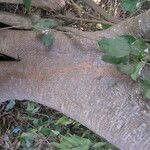
Ficus lutea
Dahomey rubbertree · West African rubbertree · Lagos rubbertree · Vogel's fig · Giant-leaved Fig
Description
Source: leafsnapFicus lutea, commonly known as the yellow fig or giant-leaved fig, is a species of tree belonging to the Moraceae family. Native to the tropical regions of Africa and Madagascar, this tree can reach heights of up to 30 meters. Its large, glossy leaves can grow up to 50 centimeters in length and are a vibrant green color. The tree produces small, yellowish-green fruit. In local communities where Ficus lutea grows, it holds significant traditional value. The leaves are used for medicinal purposes, such as treating skin conditions, and the fruit is consumed by both humans and animals. Ecologically, Ficus lutea is crucial as it provides food for many species of birds and mammals, which feed on its fruit or seek shelter in its branches. In summary, Ficus lutea is an important plant species with both cultural significance to local communities and ecological importance within its natural habitat.
Care Guide
💧 Water Every 7 days
☀️ Light Partial sun
The Lagos rubbertree occurs naturally in habitats such as forest understories or rocky sites, where it gets natural shade. It favors partial sun but can tolerate full sun or full shade, showing its adaptable and hardy character.
🌡️ Temperature 20–37.8°C
Lagos rubbertree comes from tropical regions, where the climate is usually warm and humid. Consequently, it is well adapted to high temperatures and humidity. It does not tolerate sudden temperature changes and prefers a stable temperature, so avoiding indoor temperature fluctuations is important. It generally cannot withstand cold and requires warmer conditions to grow. If the environmental temperature falls too low, the plant may stop growing or even die.
💨 Humidity
🪴 Soil 6-8
🌱 Fertilizer
The optimal period for fertilizing a Lagos rubbertree is at the beginning of spring when it is waking from dormancy. This enhances its overall growth and contributes to the development of its flowers. Fertilization aids in the improvement of the plant's foliage, stems, and branches, as well as the production of large, lively, and enduring flowers. Additionally, it helps in moving nutrients from the roots to the flowers, and boosts the plant's health and resilience to diseases.
🪴 Pot & Repot
✂️ Pruning
🌿 Propagating
🐛 Diseases & pets
☠️ Toxicity
Characteristics
- Plant Type
- Tree
- Life Cycle
- Perennial
- Genus
- Ficus
- Family
- Moraceae
- Hardiness Zone
- 10-12
- Mature Height
- 14.94 m to 29.87 m
- Mature Spread
- 10.06 m to 20.12 m
- Leaf Color
- Dark Green, Forest Green
- Leaf Type
- Evergreen
- Bloom Time
- All year round
- Planting Time
- Spring, Summer, Autumn
- Harvest Time
- All year round
- Native Area
- Burkina Faso, Angola, Namibia, Madagascar, Nigeria, Yemen, Kenya, Uganda, Tanzania, Zimbabwe, Guinea-Bissau, Mali, Benin, Sierra Leone, Equatorial Guinea, Cameroon, Liberia, Mozambique, Ghana, Ethiopia, Congo, Central African Republic, Malawi, South Africa, Zambia, Sudan, Guinea, Chad, Togo, Senegal, Eswatini, Côte d'Ivoire, Gambia, Congo (DRC), Gabon