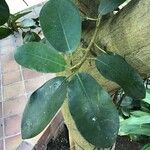
Ficus rubiginosa
انجیر روبیجینا، فیکوس روبیجینا · Illawarra fig · Rusty fig · Port Jackson fig · Larger small-leaf fig
Description
Source: leafsnapFicus rubiginosa, commonly known as the rusty fig or Port Jackson fig, is an evergreen tree species native to Australia. A member of the Moraceae family, this tree can reach heights of up to 30 meters. It boasts a dense canopy of glossy, oval-shaped green leaves that can grow up to 15 centimeters in length. The bark of the tree is smooth and grayish-brown, adorned with small bumps or lenticels. The tree produces small, round fruits that transition from green when unripe to purple when mature. While these fruits are edible, they are not commonly consumed by humans due to their sour taste. Ficus rubiginosa is often favored for landscaping due to its attractive foliage and its ability to provide ample shade. It can also be cultivated indoors as a houseplant with proper care. This tree holds cultural significance for Indigenous Australians, who use its bark to make baskets, fishing nets, and other traditional items. Additionally, the leaves of Ficus rubiginosa have been utilized in traditional medicine to treat various ailments such as skin infections and respiratory problems. Overall, Ficus rubiginosa is an important plant species both ecologically and culturally in Australia, valued for its unique characteristics and historical uses by humans.
Care Guide
💧 Water Every 7 days
The Port Jackson fig thrives in coastal, humid environments and prefers consistently moist soil, requiring weekly watering. Once established, it displays moderate drought tolerance. As an evergreen plant, it needs stable moisture levels to maintain its foliage. Using mulch can help retain soil moisture, thereby reducing the frequency of watering.
☀️ Light Partial sun
The Port Jackson fig is native to habitats like forest understories or rocky sites, where it occurs in natural shade. It prefers partial sun but can adapt to full sun or complete shade, showing its hardy, versatile nature.
🌡️ Temperature 20–37.8°C
Port jackson fig has strong temperature adaptability, tolerating higher heat and wide temperature swings. During hot weather, attention should be given to watering and suitable shading to avoid sunburn. Conversely, Port jackson fig is fairly sensitive to low temperatures; it can handle some cold, but excessively low temperatures may cause frost damage.
What is the botanical name of the Port Jackson fig?
The botanical name of the Port Jackson fig is Ficus rubiginosa.
💨 Humidity high (>60%)
This plant needs special care because it loves high humidity levels of 60-80% or more. The best way to achieve this is by placing a humidifier near the plant. Daily misting is also essential! Make sure the room has good ventilation.
🪴 Soil 6-8
🌱 Fertilizer
Timing is essential for fertilizing Port jackson fig. Apply fertilizer in early spring and continue monthly until early summer. Fertilizer promotes attractive blooms and supplies energy during both dormant periods and active growth phases.
🪴 Pot & Repot 2-3 years
Repot your Port Jackson fig every 2 to 3 years in early spring. Use a larger pot to accommodate its vigorous root system. After repotting, water the plant moderately and reduce fertilization until you see new growth. Consistent care after repotting is essential for maintaining the optimal health of your Port Jackson fig.
✂️ Pruning
The Port Jackson fig is an evergreen tree that thrives with regular pruning to maintain its shape. Key techniques include removing dead branches and thinning the canopy to enhance air circulation. Pruning during its dormant period, from early to late winter, encourages healthy growth and increases resilience against pests and diseases.
🌿 Propagating
🐛 Diseases & pets
☠️ Toxicity
Characteristics
- Plant Type
- Tree
- Life Cycle
- Perennial
- Genus
- Ficus
- Family
- Moraceae
- Hardiness Zone
- 9-11
- Mature Height
- 40 cm
- Mature Spread
- 40 cm
- Leaf Color
- Green
- Leaf Type
- Evergreen
- Flower Color
- Green
- Bloom Time
- All year round
- Planting Time
- Spring, Summer
- Harvest Time
- All year round