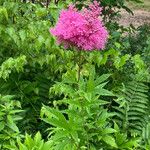
Filipendula rubra
Queen of the prairie · Queen-of-the-Prairie · Prairie dropwort · Red Queen-of-the-meadow
Description
Source: leafsnapFilipendula rubra, also known as queen-of-the-prairie, is a species of flowering plant in the family Rosaceae native to the northeastern and central United States and southeastern Canada. It prefers full sun or partial shade and moist soil, but tolerates drier soil in a shadier location. It grows tall and firm, and produces blooms that are tiny and pink above its ferny, pointy leaves.Of the numerous garden cultivars, 'Venusta' has gained the Royal Horticultural Society's Award of Garden Merit.
🌳 With its beautiful, lush pink flowers and decorative foliage, the Queen of the Prairie is a versatile and valuable addition to a variety of garden types. Its attractive appearance makes it an excellent accent plant, but it can also be effectively planted alongside other perennials at the back of borders or within mixed shrub borders. It is perfect for wildlife gardens and naturalistic or prairie plantings. The Queen of the Prairie thrives in moist conditions, making it an ideal choice for rain gardens, bog gardens, and areas around streams and ponds.
🎭 Wooing
Care Guide
💧 Water Every week
Native to the moist meadows of North America, the queen of the prairie thrives with consistent moisture and benefits from weekly watering. This perennial herb flourishes outdoors in well-draining soil, which provides the necessary hydration during its active growing season.
How should I water my Queen of the prairie plant?
To properly water the Queen of the prairie, it is important to follow a few guidelines. First, use filtered water at room temperature. This is because tap water can have harmful particles for the plant. Additionally, the Queen of the prairie prefers warm environments, so using cold water can be a shock to its system. Secondly, avoid overhead watering as it may cause issues with the foliage. Instead, apply the filtered room temperature water directly to the soil until it is fully soaked. This will benefit the plant by moisturizing the roots and aiding in their spread for nutrient collection.
What should I do if I give my Queen of the prairie plant too much or too little water?
Both overwatering and underwatering can harm the health of your Queen of the prairie, but overwatering is more common. If your plant receives too much water, the stems and leaves may wilt and turn yellow. Overwatering for a long time can lead to diseases like root rot, mold, and mildew, which can kill the plant. The Queen of the prairie is more tolerant of drought, so underwatering is less common. However, if it happens, the leaves may become brown and brittle. It's important to notice signs of overwatering early and take action. Some diseases caused by overwatering, like root rot, are difficult to fix if left unattended. If you see early signs, reduce your watering schedule and check the soil drainage. Replace poorly draining soil with a loose, well-draining potting mix. If you see signs of underwatering, water more regularly until the signs go away.
How often do I need to water my Queen of the prairie plant?
To determine if your Queen of the prairie plant needs water, there are different methods depending on whether it's in a pot or in the ground. For potted plants, simply stick your finger into the soil. If the top two to three inches are dry, then it's time to water. The same applies for plants in the ground - if the first few inches of soil are dry, it's time to water. During the spring and early fall, watering once a week is usually sufficient. However, in very hot weather, you may need to water them twice a week or more. It's important to note that mature Queen of the prairie plants that are well-established have a remarkable ability to withstand drought.
How much water does my Queen of the prairie plant need?
To properly water your Queen of the prairie, don't be afraid to give it a generous amount of water. Make sure the top two to three inches of soil are dry before watering. It's best to thoroughly water the plant, ensuring that the soil is completely soaked. You should add enough water for it to flow out of the drainage holes at the bottom of the pot. If you don't see any excess water draining, it means you haven't given enough water. However, be cautious not to let water accumulate inside the soil, as this can harm the plant. If there is no water draining from the pot, it could indicate that the soil doesn't drain well, which is harmful to the plant's health. If the plant is outdoors, one inch of rain per week is sufficient.
How do I water my Queen of the prairie as it grows?
The water requirements of the Queen of the Prairie vary depending on its growth stages. In the early years and after transplanting, it needs more water as it focuses on establishing new roots for future growth. These roots perform best with slightly higher moisture levels. As the plant matures, it requires less water. Additionally, during the bloom period, the plant may need more water to support flower development.
☀️ Light Full sun
The queen of the prairie does best in locations that get sunlight all day, although it can also tolerate areas with moderate light. Enough light is necessary for vigorous growth, and its native habitat is typically bright. Both too much and too little light can interfere with its development.
What are the sunlight requirements for Queen of the Prairie?
The Queen of the Prairie ('Filipendula rubra') requires full sun, which is defined as above 6 hours of sunlight daily, for optimal growth. It can also tolerate partial sun, about 3-6 hours of sunlight. Ensuring the plant receives the right amount of light is crucial for its development. Observing the movement of sunlight through your garden will help in choosing spots that offer a perfect balance of light and shade, crucial for the plants' growth and happiness.
Can the Queen of the Prairie grow with artificial lighting?
Yes, the Queen of the Prairie can grow with artificial lighting, especially in conditions where natural sunlight is insufficient, such as during winter or in less sunny spaces. Indoor plants require adequate lighting for optimal growth, with LED lights being a popular choice due to their customizability to provide specific wavelengths needed by plants. Full sun plants need 30-50W/sq ft, partial sun plants 20-30W/sq ft, and full shade plants 10-20W/sq ft of artificial light. It's important to place the light source 12-36 inches above the plant and mimic natural daylight hours, providing most plants with 8-12 hours of light per day.
What are the symptoms of inadequate lighting for Queen of the Prairie?
Symptoms of inadequate lighting for the Queen of the Prairie include smaller new leaves, leggy or sparse growth, faster leaf drop, slower or no new growth, and lighter-colored new leaves. Additional symptoms can be chlorosis, where leaves turn yellow due to loss of chlorophyll; sunscald, which presents as pale, bleached areas on leaves or stems; leaf curling as a defense mechanism against excessive sun; wilting due to water loss; and leaf scorching, characterized by brown, dry edges on leaves. These symptoms indicate either too little or too much sunlight, affecting the plant's health.
How can I address sunlight-related issues for Queen of the Prairie?
To address sunlight-related issues for the Queen of the Prairie, gradually introducing plants to a sunnier location can be effective. For indoor plants, utilize a south-facing window or artificial light sources to ensure they receive at least 6 hours of direct sunlight daily. For outdoor plants, moving them gradually to better lit areas helps prevent sunburn. Minimizing obstructions such as branches that block sunlight or transplanting smaller plants to sunnier locations with good drainage are also beneficial strategies. Note that parts of the plant affected by poor light may not recover, but new growth should be healthy following these adjustments.
🌡️ Temperature 0–35°C
The natural temperature range for queen of the prairie is 0 to 35°F (-17.8 to 1.7°C). To do well, it prefers temperatures within that span along with consistent moisture during the growing season. In winter, adjusting temperature is unnecessary because the plant is adapted to cold, but frost protection should be used if required.
What are the temperature requirements for Queen of the Prairie to thrive?
Queen of the Prairie (Filipendula rubra) thrives best in environments where the temperatures range between 0 to 35℉ (-17.8 to 1.7℃). To ensure optimal growth, maintaining consistent moisture throughout the growing season is crucial. Although Queen of the Prairie possesses strong cold resistance, it is important to protect it from temperatures dropping below -35°C by covering the plant with soil or straw. Additionally, watering the plant abundantly before the first freeze in autumn can help keep the soil moist and prevent drought and water scarcity during winter and early spring.
How should I care for Queen of the Prairie during low temperatures?
Queen of the Prairie is cold-tolerant and best supported when temperatures remain above 0°C. However, during winter, it is essential to ensure that temperatures do not fall below -30°C. In the event that temperatures plunge below -35°C, the plant might not show immediate adverse effects, but there could be a noticeable decrease in sprouting or even a failure to sprout in the spring. If this occurs, removing the parts that failed to sprout in the spring is advisable for the health of your plant.
What should I do if my Queen of the Prairie experiences high temperatures?
To protect Queen of the Prairie during periods of high temperatures, specifically above 35°C, attentive care is needed to prevent heat stress. If temperatures exceed 38°C, the plant's leaves might become lighter in color, curl, or even suffer from sunburn, leading in extreme cases to wilting and drying of the plant. To mitigate these effects, trim away the sunburned and dried parts. Moreover, relocating the plant to a shaded area or utilizing a shade cloth to protect it from the midday and afternoon sun can be beneficial. Ensure to water the plant during the cooler morning and evening hours to keep the soil adequately moist.
💨 Humidity
🪴 Soil 6-7
🌱 Fertilizer
The best time to fertilize a Queen of the Prairie is in early spring, when it is coming out of dormancy and starting active growth. Fertilization supplies essential nutrients for healthy development. Although Queen of the Prairie has fairly low fertilizer requirements, feeding it annually can improve its survival and encourage better, longer-lasting blooms.
Why should I put fertilizer on my Queen of the prairie?
Fertilization is important for the Queen of the prairie and other plants because it provides essential nutrients for growth. Although the Queen of the prairie has relatively low fertilization needs, annual fertilization can greatly benefit the plant by promoting its survival and improving the quality and longevity of its flowers. Therefore, it is recommended to regularly fertilize the Queen of the prairie if you want it to thrive and look its best.
When should I fertilize my Queen of the prairie plant?
The best time to fertilize a Queen of the prairie is late winter to early spring. This is when the plant is coming out of its dormant phase and beginning to grow. Fertilizing at this time helps the plant start the season off well. It is also okay to fertilize in the fall, but not recommended in summer or winter.
When is the time I should not fertilize my Queen of the prairie?
To ensure the proper care of your Queen of the prairie, it is best to fertilize it only during late winter and early spring. This plant requires minimal fertilization, so a single feeding during this time is enough. Fertilizing during spring, summer, and fall can cause overfertilization, which can lead to problems. The only exception is if you didn't fertilize in spring, then it's okay to feed it in the fall. Additionally, there is no need to fertilize during winter since the plant is in a dormant phase and doesn't produce new growth.
What kind of fertilizer does my Queen of the prairie need?
To give your Queen of the Prairie plant the necessary nutrients, any general-purpose fertilizer with a balanced amount of the three main plant nutrients will work well. However, there are specific nutrient blends that are even more beneficial. Many gardeners believe that higher levels of phosphorus help develop stronger roots and better flowers, making it a good approach for a flowering plant like the Queen of the Prairie. Whether in granular or liquid form, as long as there are ample nutrients, the fertilizer will be effective. In addition to manufactured fertilizers, organic methods like compost and manure can also help improve the soil and create a healthy growing environment for your Queen of the Prairie.
How do I give my Queen of the prairie plant the nutrients it needs to grow well?
To fertilize a Queen of the prairie, the most common method is to use a granular or pellet fertilizer around the plant. It is important to do this when the plant is transitioning from its dormant phase to active growth, typically in early spring when shoots start emerging from the soil. Alternatively, some people may opt for a liquid fertilizer, but it should be diluted with water before application. Regardless of the type of fertilizer used, it is advisable to moisten the soil before, during, and after fertilization.
🪴 Pot & Repot 2-3 years
When repotting Queen of the prairie, select a pot 1-2 inches (2.5–5.1 cm) larger with good drainage. Use a well-draining potting mix. Repot in spring or fall, making sure the root ball sits slightly below the rim of the flower pot. Water thoroughly after repotting and place in a warm spot with indirect sunlight.
✂️ Pruning
The Queen of the Prairie is a perennial plant characterized by tall clusters of pink flowers and fern-like leaves. To manage its height and encourage blooming, prune the plant in early to late spring. Be sure to remove dead flowers, eliminate weak growth, and use clean tools to improve air circulation and minimize pests.
🌿 Propagating
🐛 Diseases & pets
☠️ Toxicity
Characteristics
- Plant Type
- Herb
- Life Cycle
- Perennial
- Genus
- Filipendula
- Family
- Rosaceae
- Hardiness Zone
- 3-9
- Mature Height
- 1.83 m to 2.44 m
- Mature Spread
- 1.22 m
- Leaf Color
- Green
- Leaf Type
- Deciduous
- Flower Color
- Pink
- Flower Size
- 0.25 cm to 0.76 cm
- Bloom Time
- Early summer, Mid summer
- Planting Time
- Spring, Autumn
- Harvest Time
- Mid summer