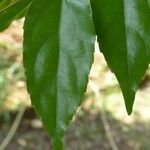
Flacourtia jangomas
Indian-plum · Greater krekup · Runeala-plum · Governor's plum · Paniala
Description
Source: leafsnapFlacourtia jangomas, commonly known as Indian plum or Chalta, is a small to medium-sized tree that belongs to the Salicaceae family. Native to the Indian subcontinent and Southeast Asia, it can be found in countries such as India, Bangladesh, Myanmar, Thailand, and Malaysia. The tree grows up to 10 meters in height and has a trunk diameter of up to 50 cm. It features a dense crown of branches with dark green, oval-shaped leaves that have serrated edges. The flowers are small and can be either white or pinkish. The fruit of Flacourtia jangomas is edible but has an acidic taste, making it more suitable for use in jams or pickles rather than for eating raw. The fruit is round, measures about 2-3 cm in diameter, and contains numerous seeds within its flesh. In traditional medicine, various parts of the Flacourtia jangomas plant have been used for their medicinal properties, such as treating fever, diarrhea, and dysentery, among other ailments. Overall, the Flacourtia jangomas plant serves both culinary and medicinal purposes, making it an important species within its native range.
Care Guide
💧 Water Every 7 days
The Indian coffee plum thrives in tropical environments, where it can adapt to both heavy rains and dry spells. This plant is drought-tolerant and, when cultivated, needs watering every two weeks. It grows best outdoors and benefits from mulching, which helps retain soil moisture and mimics the natural leaf litter found in its native habitat.
How should I properly water my Indian coffee plum plant?
When watering your Indian coffee plum, you have flexibility in choosing the watering tool. Whether it's a watering can, hose, or even a cup, any common tool will do the job. It's important to apply the water directly to the soil. This ensures equal moisture distribution to all areas, providing the necessary hydration to the entire root system. Using filtered water is preferable to tap water, as tap water may contain harmful particles. Additionally, it's best to use water at or slightly above room temperature, avoiding excessively cold or hot water, which can shock the Indian coffee plum. Nevertheless, the plant generally responds well to any type of water.
What should I do if I give my Indian coffee plum too much water or not enough water?
Outdoor plants, especially newly planted ones or seedlings, are often prone to lack of watering. It is important to remember to consistently water them for a few months, especially when they are small or recently planted. Once the roots are established, Indian coffee plum trees can rely on rain most of the time. When Indian coffee plum trees are planted in pots, overwatering is more likely to happen. If you accidentally overwater your Indian coffee plum, it is important to address the situation immediately. First, stop watering the plant right away to minimize the effects of overwatering. Then, remove the Indian coffee plum from its pot to inspect its roots. If no root rot is found, you can put the plant back in its container. If root rot is present, you should trim any affected roots and consider applying a fungicide to prevent further damage. Lastly, repot the Indian coffee plum in well-draining soil. On the other hand, underwatering an Indian coffee plum plant is usually an easier problem to fix. If the plant is underwatered, its leaves may droop, dry out, and fall off. However, once sufficient watering is provided, the leaves will quickly regain their fullness. It is important to correct your watering frequency as soon as you notice signs of underwatering.
How many times should I give water to my Indian coffee plum plant?
If your area receives enough rainfall, most outdoor plants can grow naturally without needing extra watering. However, if there is a lack of rainfall, it is important to water your plants adequately. During the spring and fall, watering every two weeks should be sufficient. In the summer, more frequent watering is necessary. In the winter, when plants grow slower and require less water, it is best to water sparingly or not at all. If you have a young or newly planted Indian coffee plum, it is advisable to water it more frequently to help it establish and grow into a more adaptable and drought-tolerant plant. For potted plants, there are two main methods to determine how often to water your Indian coffee plum. The first approach is to follow a predetermined watering schedule, such as watering once every week or every other week. However, this method may not be effective in considering the specific growing environment of your Indian coffee plum. Your watering frequency should also be adjusted based on the season. During summer, when the plant's water needs are highest, a predetermined watering schedule may not be sufficient. Instead, you can base your watering frequency on the moisture level of the soil. Generally, it is best to wait until the top two to four inches of soil, which is usually about ⅓ to ½ the depth of the pots, have dried out completely before watering again.
How much water does my Indian coffee plum require?
When watering your Indian coffee plum, remember that it doesn't always require a lot of water. If only a few inches of soil have dried since the last watering, you can maintain healthy growth by giving it around five to ten ounces of water each time. You can also determine the amount of water needed based on the moisture levels in the soil. Take note of how many inches of soil have dried between waterings. To ensure your Indian coffee plum receives enough moisture, water it enough to dampen all the layers of soil that have dried out since the last watering. If over half of the soil has dried, consider giving more water than usual. In such cases, continue watering until you see excess water draining from the pot's drainage holes. If your Indian coffee plum is planted in an area that receives sufficient outdoor rain, additional watering may not be necessary. When the plant is young or still establishing itself, ensure it receives 1-2 inches of rain per week. As it grows and becomes established, it can rely solely on rainwater, unless there is a hot spell without rainfall for 2-3 weeks. In that case, consider giving the plant a thorough watering to prevent stress.
How can I know if I'm giving enough water to my Indian coffee plum?
The Indian coffee plum is often overwatered, which can cause a variety of issues. Signs of overwatering include yellowing leaves, leaf dropping, shriveling of the plant structure, and potential root rot. Alternatively, an underwatered Indian coffee plum will start to wilt and may have brown or brittle leaves. If you notice any signs of overwatering or underwatering, it is important to take action and restore the plant's health.
☀️ Light Full sun
The Indian coffee plum performs best in places with plentiful direct sunlight, but it can tolerate locations that receive only moderate light. In its natural habitat the plant is used to ambient illumination. Too little sunlight can hinder its growth, while too much exposure can be damaging.
What are the sunlight requirements for Indian coffee plum?
The Indian coffee plum requires an environment that is fully exposed to generous amounts of sunlight to thrive optimally, necessitating more than 6 hours of sunlight a day (full sun). However, it can also adapt to moderate amounts of sunlight, about 3-6 hours daily (partial sun). In its natural habitat, this plant is used to ambient light, thus, both insufficient and excessive sunlight can negatively impact its growth. Watching how sunlight moves through your garden to choose spots that offer a balance of light and shade will help ensure the plant's success.
How does artificial lighting support the growth of Indian coffee plum when natural sunlight is insufficient?
When natural sunlight is insufficient, particularly during winter or in less sunny spaces, artificial lighting becomes crucial for the growth of indoor Indian coffee plum plants. Adequate lighting is vital for optimal growth, with LED lights being a popular choice because they can be customized to provide specific wavelengths needed by the plants. For full sun plants, 30-50W per square foot of artificial light is needed, while partial sun plants require 20-30W, and full shade plants need 10-20W. Placing the light source 12-36 inches above the plant can mimic natural sunlight, and providing 8-12 hours of light per day matches the natural daylight hours needed by most plant species.
What are the common symptoms of light deficiency or excessive exposure in Indian coffee plum?
Common symptoms of light deficiency in Indian coffee plum include smaller new leaves compared to mature ones, leggy or sparse growth, faster leaf drop, slower or no new growth, and lighter-colored new leaves. These indicate that the plant is not receiving adequate sunlight, leading to stunted growth and weaker structure. On the other hand, excessive sunlight can cause chlorosis, sunscald, leaf curling, wilting, and leaf scorching. These symptoms show damage due to overexposure to sunlight, affecting the plant's ability to photosynthesize and maintain overall health.
What solutions can be implemented for Indian coffee plum facing light-related issues?
To address light-related issues in Indian coffee plum, several solutions can be implemented. Indoors, gradually moving the plant to a sunnier location each week until it receives at least 6 hours of direct sunlight daily can be beneficial. Using a south-facing window or artificial light, such as desk lamps or professional plant grow lights for at least 8 hours a day, can also help. Outdoors, gradually relocating the plant to ensure a transition to a sunnier spot without sudden changes is advised. Additionally, reducing obstructions by pruning trees or moving the plant to areas with more sunlight and transplanting smaller plants to sunnier locations during their dormant period can greatly improve light exposure.
🌡️ Temperature 20–37.8°C
Indian coffee plum comes from tropical areas, where the climate is generally warm and humid. As a result, it is well suited to high temperatures and humidity. It does not tolerate sudden temperature changes and prefers a stable temperature, so it is important to avoid temperature fluctuations indoors. It usually cannot withstand cold temperatures and requires warmer conditions for growth. If the environmental temperature falls too low, the plant may stop growing or even die.
💨 Humidity
🪴 Soil 6-7
🌱 Fertilizer
Prefer organic fertilizers (e.g., fish emulsion, compost) instead of chemical ones for Indian coffee plum. Supply higher levels of nitrogen and phosphorus to young plants during spring. Incorporate compost or fertilizer before or after planting. For mature plants, supplement in spring with a balanced fertilizer or one targeted to specific deficiencies. Nutrient deficiency causes small leaves, short branches, yellow/bronze leaves, acidic fruits, premature fruit fall, and splitting.
Why do I have to add fertilizer to my Indian coffee plum tree?
If you have an Indian coffee plum, it is important to fertilize it regularly in order to maintain its overall health. Providing the proper nutrients will promote strong growth and make the plant more resistant to challenging conditions, as well as better able to fight off diseases and pests. One of the most appealing aspects of an Indian coffee plum is its foliage, so it is crucial to keep it in good condition. This can be achieved by following a consistent fertilization schedule tailored to your specific Indian coffee plum. By doing so, you will encourage the development of vibrant, lush leaves.
When should I fertilize my Indian coffee plum for the best results?
To properly care for your Indian coffee plum, it is recommended to fertilize it in late winter or early spring. This will provide the necessary nutrients for healthy growth once the weather warms up. If you live in a warm climate region, it can also be beneficial to fertilize again in early fall. This will give your Indian coffee plum extra nutrients for the next growing season and help it withstand the winter cold without leaf damage. Fertilizing earlier in the fall will ensure that the new branches have enough time to grow strong before winter arrives.
When is it not a good idea to fertilize my Indian coffee plum?
There are specific times of the year when you should avoid fertilizing your Indian coffee plum. Firstly, during the winter months, when the plant is dormant and does not need any feeding. Additionally, it is not advisable to fertilize the plant in late spring and summer, as the weather tends to be hotter and drier. These conditions can have a negative impact on the plant's response to fertilization. To avoid any issues, it is recommended to follow a fertilization schedule that involves feeding only in early spring and early fall.
What kind of fertilizer does my Indian coffee plum plant require?
For an Indian coffee plum, nitrogen is usually the most crucial nutrient, although phosphorus and potassium are also important. Therefore, a balanced fertilizer like 10-10-10 is recommended as it provides a decent amount of all three nutrients. However, using a fertilizer with a slightly higher nitrogen content, such as a ratio of 10-6-4, often leads to optimal growth. Both granular and liquid-based fertilizers can be used for this purpose.
How can I make my Indian coffee plum plant grow better?
To fertilize your Indian coffee plum, you have two options: granular fertilizer or liquid fertilizer. With granular fertilizer, simply sprinkle it on the soil at the correct time. The slow-release nature of granular fertilizer will release nutrients slowly over time. Before applying the fertilizer, it's best to lightly water your plum. On the other hand, if you choose to use liquid fertilizer, mix it with water and pour it onto the soil around the base of the plum. However, this method is less common. Additionally, it may be beneficial to do a soil test beforehand to see if any pH adjustments are needed.
🪴 Pot & Repot
✂️ Pruning
The Indian coffee plum, known for its spiny branches and edible fruits, benefits from structured pruning during its dormant season, which occurs from early to late winter. Important pruning activities include removing dead wood and crossing branches to enhance air circulation, promote new growth, and maintain the plant's ideal size. These steps help improve fruit yield and support overall plant health.
🌿 Propagating
🐛 Diseases & pets
☠️ Toxicity
Characteristics
- Plant Type
- Tree, Shrub
- Life Cycle
- Perennial
- Genus
- Flacourtia
- Family
- Salicaceae
- Hardiness Zone
- 9-11
- Mature Height
- 6.1 m to 10.06 m
- Mature Spread
- 3.96 m to 6.1 m
- Leaf Color
- Dark Green, Forest Green
- Leaf Type
- Evergreen
- Flower Color
- White, Cream
- Flower Size
- 0.51 cm to 1.02 cm
- Bloom Time
- Mid spring, Late spring
- Planting Time
- Spring, Summer
- Harvest Time
- Mid summer, Late summer, Early fall