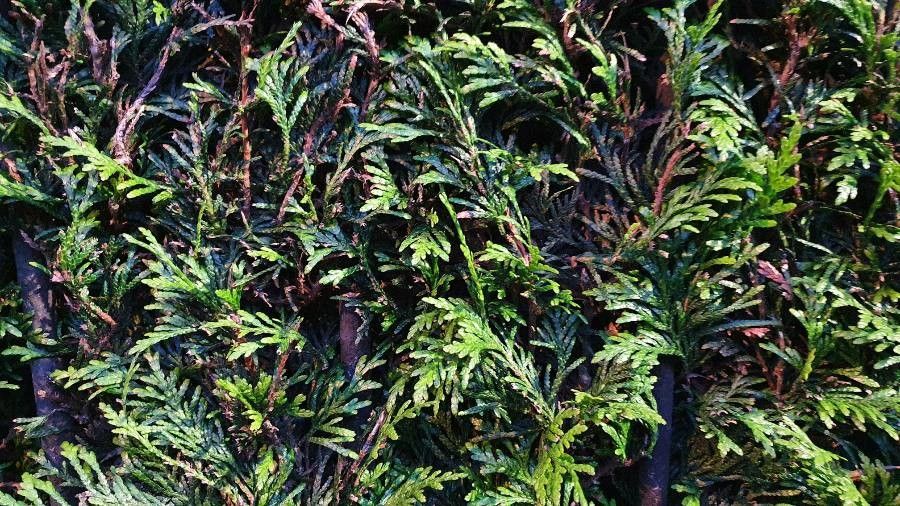
Fokienia is a genus of conifer tree belonging to the cypress family. In its characteristics, Fokienia is intermediate between the genera of Chamaecyparis and Calocedrus. Genetically Fokienia is much closer to Chamaecyparis, and not all researchers recognize Fokienia as a separate genus. The genus comprises only one living species, Fokienia hodginsii or Fujian cypress (Chinese: 福建柏; pinyin: Fújiànbǎi; Vietnamese: Pơmu), and one fossil species (Fokienia ravenscragensis).Fokienia hodginsii is native from southeastern China (provinces of Zhejiang, Guizhou, Yunnan and Fujian) to Northern Vietnam (provinces of Ha Bac, Hà Giang, Hà Tĩnh, Hòa Bình, Sơn La, Nghệ An, Lào Cai, Lai Châu, Thanh Hóa, Tuyên Quang, Yên Bái and Vĩnh Phú), west central Vietnam (provinces of Đắk Lắk, Gia Lai, Lâm Đồng), and west to northern Laos. The name derives from the old Romanised name of Fujian province, China, from where the first specimen was introduced to Europe, collected by Captain Hodgins in 1908. Fokienia is an evergreen tree, 25–30 m tall. It has greyish-brownish bark that peels off when the tree is young. On older trees, the bark presents longitudinal fissures and becomes aromatic. The leaves are arranged in flattened branchlet systems, with the branchlets in one plane. The leaves on adult trees are in opposite decussate pairs, the alternating pairs not evenly spaced so appearing as whorls of 4 at the same level; they are sub-acute, about 2–5 mm long, glossy green above, and with white stomatal bands below. The lateral leaves are ovate and compressed, and facial leaves are oblanceolate with a triangular apex. On young trees, the leaves are larger, up to 8–10 mm long and 6 mm broad.The male cones are oval or cylindrical, around 2.5 mm long, terminal on the shoots. They have from 3 to 5 pairs of scales. The female cones are much larger, 15–25 mm long and 14–22 mm broad, globose or sub-globose, and ripen in the second year. They have 5-8 pairs of scales. There are two winged seeds on each scale. They are around 4 mm long, angular and pointed. On the upper and lower surfaces there are 2 large resin blisters. The wings are lateral and very unequal.The tree does not tolerate shade, and requires mild climate and abundant rainfall to grow best. It occurs mainly on humid soil in montane habitats. In Vietnam, it grows on limestone or granite terrain above 900 m altitude. The fossil species Fokienia ravenscragensis was described from the early Paleocene (66-60 m.a. before present) Ravenscrag formation of southwest Saskatchewan and adjacent Alberta, Canada.
Fujian cypress is resistant to disease and is generally not susceptible to illnesses. In terms of care, this plant is fairly low-maintenance. When grown outdoors it needs little watering, and larger specimens typically do not require pruning. Smaller plants, however, should be pruned after they finish blooming. Fujian cypress is suitable for anyone with an outdoor area, such as a garden or deck, and does not demand much care experience.
How to keep Fokienia Hodginsii.
Light
Fujian cypress prefers locations that receive light for most of the day. It can also tolerate places with dappled light. However, both too little and too much light can be harmful. It originally thrived in environments with abundant light, and its health and growth are closely tied to those conditions.
Water
The Fujian cypress, native to the subtropical highlands, prefers moderate humidity and can withstand short periods of dryness. It thrives in consistently moist soil and requires watering every 1-2 weeks. As an evergreen tree grown outdoors, the Fujian cypress retains moisture in its foliage, which is crucial for coping with temperature fluctuations.
Temperature
Fujian cypress thrives in mild climates with temperatures from 59 to 95°F (15 to 35°C). To recreate its natural setting, keep temperatures within that range, particularly during growth periods. In extreme seasons, adjust temperatures as needed to maintain the plant's health.
Fertilizer
Fujian cypress has specific nutrient needs and does not require heavy fertilization. Spring is the best season to apply fertilizer for optimal growth. Supplying nutrients improves its health, increases its resistance to pests and diseases, and supports its long lifespan.
Pruning
To care for Fujian cypress, it's best to prune the tree between early and late winter. Focus on removing dead or diseased branches, thinning the tree for better airflow, and maintaining its shape. Make sure to make clean, angled cuts to prevent water from accumulating, which promotes healthy growth and enhances the tree's appearance while reducing the risk of fungal infections. For more detailed techniques, consult horticultural guides.
Botanical profile.
- Plant Type
- Tree
- Life Cycle
- Perennial
- Genus
- Fokienia
- Family
- Cupressaceae
- Hardiness Zone
- 8-9
- Mature Height
- 7.62 m to 10.67 m
- Mature Spread
- 0.61 m to 3.05 m
- Leaf Color
- Green
- Leaf Type
- Evergreen
- Flower Color
- Yellow, Green, Brown
- Flower Size
- 0.51 cm
- Bloom Time
- Early spring, Mid spring
- Planting Time
- Spring
- Harvest Time
- Late summer, Early fall, Mid fall
- Native Area
- Vietnam, Laos, China
Reader questions.
What are the sunlight requirements for Fujian cypress?
Fujian cypress requires areas that are exposed to light most of the day, thriving in full sun or areas with scattered light. Full sun is defined as above 6 hours of sunlight per day, while partial sun refers to about 3-6 hours of sunlight. Both too little and too much exposure can be harmful to the plant. The plant's original habitats with ample light exposure significantly influence its health and growth. It's essential to watch how sunlight moves through your garden and choose spots that provide a balance of light and shade to ensure the plants' well-being.
What is the optimal temperature range for Fujian cypress?
Fujian cypress, or Fokienia hodginsii, thrives in moderate climates where temperatures stay between 59 to 95°F (15 to 35°C), especially during its growth periods. This range is essential to mimic the plant's native environment and ensure its health. During extreme seasons, it's important to adjust the temperatures accordingly to maintain this optimal range for the plant.
How do you use artificial lighting for Fujian cypress indoors?
Indoor plants like Fujian cypress require adequate lighting, especially when natural sunlight is insufficient. Artificial lights, like LED lights that can be customized to provide specific wavelengths of light, offer a solution. For optimal growth, full sun plants need 30-50W/sq ft of artificial light, partial sun plants need 20-30W/sq ft, and full shade plants need 10-20W/sq ft. The light source should be placed 12-36 inches above the plant to mimic natural sunlight, and most plants need 8-12 hours of light per day. This setup can promote faster, healthier growth of Fujian cypress indoors.
Does Fujian cypress have any cold tolerance?
Yes, Fujian cypress exhibits a moderate tolerance to cold temperatures, typically not requiring additional measures if the temperature remains above -5°C. However, if temperatures are expected to fall below -5°C, it's necessary to temporarily protect the plant. This can be done by wrapping it with materials such as plastic film, fabric, or other suitable materials to shield it from the cold. These protective measures should be promptly removed once temperatures rise again to prevent any damage.
What are the symptoms of inappropriate light conditions for Fujian cypress?
Fujian cypress may exhibit symptoms indicating too much or too little light. Symptoms of light deficiency include small leaves, leggy or sparse growth, faster leaf drop, slower or no new growth, lighter-colored new leaves, indicating a lack of chlorophyll and essential nutrients. Excessive sunlight can cause chlorosis (leaves turning yellow), sunscald (damage from intense exposure), leaf curling (to minimize water loss), wilting (loss of turgor pressure), and leaf scorching (brown, dry edges on leaves). These symptoms can affect the plant's ability to photosynthesize and overall health.
What should I do if the Fujian cypress experiences low temperatures?
If the Fujian cypress is exposed to temperatures below -10°C, the leaves may begin to droop, and in severe cases, wilt and fall off. To manage this, trim off any frost-damaged parts of the plant. Before the plant encounters low temperatures again, wrap it with non-woven fabric or cloth, and set up a wind barrier to protect it from cold winds. These steps help in minimizing damage and aiding recovery.
What solutions can help Fujian cypress with light-related issues?
To address light-related issues in Fujian cypress, gradually increase sunlight exposure for both indoor and outdoor plants to at least 6 hours of direct sunlight daily. For indoor plants, moving them to a sunnier location each week or using a desk or ceiling lamp for at least 8 hours daily can help. Outdoor plants should also be moved gradually to sunnier spots to avoid sunburn. Minimizing obstructions like overhanging branches can increase sunlight exposure. If necessary, transplanting during the dormant period to a location with better sunlight and drainage can also be beneficial. Note that parts of the plant affected by insufficient sunlight may not recover, but increased light exposure can ensure new growth is healthy.
How should I care for Fujian cypress during high temperatures?
In summer, ensure that the Fujian cypress is kept below 35°C to prevent stress. Temperatures above 38°C can cause the leaves to lighten in color, dry out at the tips, curl, and increase susceptibility to sunburn. In such cases, trim away the sunburned and dried-up parts. It's advisable to move the plant to a cooler location, away from direct midday and afternoon sun, or use a shade cloth. Ensure the soil remains moist by watering in the morning and evening.