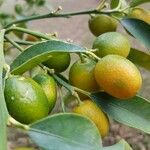
Fortunella margarita
Nagami kumquat · Oval cumquat · Oval kumquat · Nagami cumquat
Description
Source: leafsnapFortunella margarita, commonly known as the Kumquat tree, is a small evergreen tree that belongs to the Rutaceae family. Native to China and Southeast Asia, it is widely cultivated around the world for its edible fruit. The Kumquat tree can grow up to 4 meters in height and boasts a dense canopy of glossy, green, oval-shaped leaves with serrated edges. The fruit of Fortunella margarita is small and either round or oval-shaped, turning bright orange when ripe. It has a sweet-tart flavor and an edible peel that can be eaten raw or used in cooking and baking. The fruit is rich in vitamin C, fiber, antioxidants, and other essential nutrients. The Kumquat tree prefers warm climates but can tolerate some cold temperatures. It thrives in well-drained soil and requires regular watering during its growing season, although it should be allowed to dry out slightly between waterings during the winter months. In addition to its fruit, the Kumquat tree offers ornamental value thanks to its attractive foliage and fragrant white flowers, which bloom in spring or summer, followed by colorful fruits later on. It makes an excellent addition to gardens or landscapes as an accent plant and can also be grown in containers for patios or balconies. Overall, the Fortunella margarita plant offers both aesthetic value through its attractive foliage and fragrant flowers, as well as nutritional benefits through its delicious and nutritious fruits. This makes it an excellent choice for gardeners seeking a plant that combines beauty and utility.
🌳 Aside from being eaten, the kumquat's peel is rich in essential oils that are used in aromatherapy and perfumery. Its complex aroma carries sweet, tangy, and floral notes, making it popular for creating rich, evocative fragrances. Additionally, kumquat essential oil has potential for use as a natural antiseptic because of its antimicrobial properties.
🎭 prosperity
Care Guide
💧 Water Every 7 days
☀️ Light Full sun
Kumquat prefers direct, unobstructed sunlight and does well even under a partly cloudy sky. Native to sun-rich environments, the plant has an inherent need for strong light. Insufficient sunlight can slow its growth, while excess light may cause the leaf edges to become yellowish.
🌡️ Temperature 20–37.8°C
The kumquat requires warm, sunny conditions to thrive. Its native temperature-related habitat is in tropical to subtropical zones, with average temperatures of 20 to 38 ℃ (68 to 100.4 ℉). In winter, temperatures should not drop below 5 ℃ (41 ℉) to avoid cold damage. It is advisable to keep the plant in a warm, sheltered spot during the colder months.
💨 Humidity
🪴 Soil 6-7
🌱 Fertilizer
Choose organic fertilizers (e.g., fish emulsion or compost) instead of chemical fertilizers for Kumquat. Supply higher nitrogen and phosphorus to young plants during spring. Incorporate compost or fertilizer before or after planting. For mature plants, supplement in spring with a balanced fertilizer or one targeted to specific deficiencies. Nutrient deficiency causes small leaves, short branches, yellow or bronze leaves, acidic fruits, premature fruit fall, and splitting.
🪴 Pot & Repot 2-3 years
When repotting Kumquat, choose a pot 1-2 inches (2.5–5.1 cm) larger with ample drainage. Use a well-draining potting mix. Repot in spring or fall, ensuring that the root ball is slightly lower than the rim of the flower pot. Water thoroughly after repotting and place in a warm spot with indirect sunlight.
✂️ Pruning
🌿 Propagating
🐛 Diseases & pets
☠️ Toxicity
Characteristics
- Plant Type
- Shrub
- Life Cycle
- Perennial
- Genus
- Fortunella
- Family
- Rutaceae
- Hardiness Zone
- 9-11
- Mature Height
- 2.13 m to 4.88 m
- Mature Spread
- 1.83 m
- Leaf Color
- Green
- Leaf Type
- Evergreen
- Flower Color
- White
- Flower Size
- 0.51 cm to 0.76 cm
- Bloom Time
- Mid spring, Late spring, Early summer
- Planting Time
- Spring, Autumn
- Harvest Time
- Early spring, Mid summer, Late summer, Fall, Winter
- Native Area
- Vietnam, Laos, China