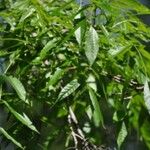
Fraxinus uhdei
Shamel ash · Evergreen ash · Tropical ash
Description
Source: leafsnapFraxinus uhdei, commonly known as Shamel Ash or Mexican Ash, is a deciduous tree belonging to the Oleaceae family. Native to Mexico and Central America, this tree is widely cultivated around the world due to its ornamental value and rapid growth rate. It can reach heights of 20 to 30 meters, with a broad crown that provides ample shade. The leaves are compound, consisting of 5 to 9 dark green, glossy, lance-shaped leaflets. In autumn, these leaves turn yellow before falling off. The bark of Fraxinus uhdei is grayish-brown with deep furrows as it matures. In spring, the tree produces small greenish-white flowers, which emerge before the leaves. These flowers later develop into winged fruits called samaras, or keys. Fraxinus uhdei thrives in full sun exposure but can also tolerate partial shade. It grows well in well-drained soils and can even withstand poor soils, as long as they are not waterlogged. The wood of Fraxinus uhdei is strong yet flexible, making it ideal for furniture, flooring, and sports equipment like baseball bats, thanks to its shock-absorbing properties. Although this tree is prized as an ornamental species for landscaping worldwide, it has been listed as an invasive species in some countries, such as Australia. There, it poses a threat by outcompeting native vegetation and leading some plant species towards extinction. Controlling the spread of Fraxinus uhdei is crucial for conservation efforts, particularly in regions where it has become invasive outside its natural range.
🌳 Tropical ash is frequently undervalued for its range of uses. Beyond its familiar applications, it has potential for various uses because of its structural properties. The wood, being robust, can be used to make durable furniture. Likewise, the leaves and bark may contain substances suitable for natural dyes in the textile industry, although substantial research and development would be necessary to fully exploit this potential.
🎭 Safeguarding, Wealth, Maritime Rituals
Care Guide
💧 Water Every 7 days
The Tropical ash thrives in humid, tropical environments and requires a balanced amount of water. To maintain its health, it should be watered every 1 to 2 weeks. As an evergreen tree, it retains its leaves throughout the year and needs consistent moisture, even during its dormant period.
☀️ Light Full sun
The tropical ash does best with abundant sunlight, although it can tolerate environments with a moderate amount of shade. Native to sun-filled habitats, its best health and growth rely on substantial light exposure. With diminished light its growth may slow, while excessive light can lead to leaf burn.
🌡️ Temperature 20–35°C
Tropical ash, native to warm climates, needs temperatures of 68 to 95 ℉ (20 to 35 ℃) to flourish. During colder periods, it may benefit from slight temperature adjustments to keep it within its preferred range.
💨 Humidity
🪴 Soil 6-7
🌱 Fertilizer
To encourage healthy growth, fertilize your Tropical ash in early spring. Consistent feeding boosts overall health, producing vigorous growth, greater tolerance of challenging conditions, and enhanced resistance to diseases and pests. Keep to a regular fertilization schedule for your Tropical ash to maintain vibrant, deeply colored foliage and a lush appearance.
🪴 Pot & Repot
✂️ Pruning
Tropical ash is a fast-growing tree that develops a thick canopy. To maintain its health and appearance, it is important to prune it properly. Focus on removing dead branches, thinning out crowded areas, and shaping the tree to ensure structural integrity. Ideally, this should be done in early spring. Regular pruning helps control the tree's size, strengthens its branches, reduces the risk of storm damage, and promotes healthy growth.
🌿 Propagating
🐛 Diseases & pets
☠️ Toxicity
Characteristics
- Plant Type
- Tree
- Life Cycle
- Perennial
- Genus
- Fraxinus
- Family
- Oleaceae
- Hardiness Zone
- 9-10
- Mature Height
- 21.34 m to 24.38 m
- Mature Spread
- 7.62 m to 14.94 m
- Leaf Color
- Green
- Leaf Type
- Semi-evergreen
- Flower Color
- Green, White, Yellow
- Flower Size
- 2.54 cm
- Bloom Time
- Mid spring, Late spring, Early summer
- Planting Time
- Spring, Autumn
- Harvest Time
- Mid summer
- Native Area
- Honduras, Mexico, Guatemala, Costa Rica