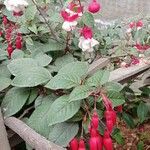
Fuchsia hybrida
Hybrid fuchsia · Common Fuschia · Fuchsia
Description
Source: leafsnapFuchsia hybrida, commonly known as fuchsia, is a flowering plant that belongs to the Onagraceae family. Native to Central and South America, it has been widely cultivated as an ornamental plant globally. Fuchsia hybrida is a shrub that can grow between 1 to 3 meters tall. It has an upright growth habit with arching branches and dark green, ovate or lanceolate leaves with serrated edges. The flowers of Fuchsia hybrida are pendulous and bell-shaped, featuring four petals that are usually brightly colored in shades of pink, purple, or red. These flowers bloom from summer through fall and are known to attract hummingbirds and butterflies. Fuchsia hybrida prefers well-drained soil rich in organic matter and thrives in partial shade to full sun exposure. It requires regular watering during the growing season but should be allowed to dry out slightly between waterings. Various hybrids of Fuchsia have been developed for their ornamental value, including unique flower shapes, colors, and sizes. They are also popular for use in hanging baskets or container gardens, both indoors and outdoors. Overall, Fuchsia hybrids are excellent additions for gardeners seeking colorful plants that attract pollinators. They are easy to grow and suitable for both indoor and outdoor settings!
Care Guide
💧 Water Every 3 days
The hybrid fuchsia requires consistent watering, particularly during the summer months. For potted plants, it's advisable to check the moisture level daily. Although in-ground plants need less frequent watering, it's still important to monitor soil moisture. Furthermore, the hybrid fuchsia thrives in humid conditions. Indoor environments may need regular misting to maintain the plant's optimal health.
☀️ Light Partial sun
hybrid fuchsia naturally occurs in habitats like forest understories or rocky areas, where it grows in natural shade. It prefers partial sun but can adapt to full sun or full shade, showing its versatile and hardy nature.
🌡️ Temperature 10–35°C
Hybrid fuchsia is fairly adaptable to temperature, able to withstand higher heat and broader temperature fluctuations. In hot weather, attention should be paid to watering and providing appropriate shade to avoid sunburn. On the other hand, hybrid fuchsia is comparatively sensitive to low temperatures: it can tolerate some cold, but very low temperatures may cause frost damage.
💨 Humidity high (>60%)
This plant needs special care because it loves high humidity levels of 60-80% or more. The best way to achieve this is by placing a humidifier near the plant. Daily misting is also essential! Make sure the room has good ventilation.
🪴 Soil 6-7
🌱 Fertilizer
Timing is essential when fertilizing hybrid fuchsia. Begin feeding in early spring and continue once a month until early summer. Fertilizer promotes attractive blooms and supplies energy both during dormancy and periods of active growth.
🪴 Pot & Repot
✂️ Pruning
Most types of hybrid fuchsia are annuals, but they can be cut back and regrown. To encourage new growth, prune them in early spring down to 4 to 6 inches. Avoid pruning in the fall to prevent potential winter damage. Additionally, pinching the shoots in the spring can promote better flowering.
🌿 Propagating
🐛 Diseases & pets
☠️ Toxicity
The Fuchsia plant is non-toxic for people and pets. The roots, flowers, and berries are not considered poisonous. The berries are often harvested for jams, jellies, pies, and other dishes. Consuming large quantities of the berries may cause a mild stomach upset, though rarely fatal.
Characteristics
- Plant Type
- Shrub
- Life Cycle
- Perennial
- Genus
- Fuchsia
- Family
- Onagraceae
- Hardiness Zone
- 6-9
- Mature Height
- 46 cm to 91 cm
- Mature Spread
- 30 cm to 61 cm
- Leaf Color
- Green, Dark Green
- Leaf Type
- Deciduous
- Flower Color
- Purple
- Flower Size
- 3.05 cm to 7.62 cm
- Bloom Time
- All year round
- Planting Time
- Spring, Summer, Autumn, Winter
- Harvest Time
- All year round