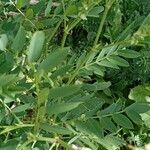
Galega officinalis
Goat's Rue · Galega · Professor-weed · Common goat's rue · French lilac
Description
Source: leafsnapGalega officinalis, commonly known as goat's rue, is a perennial herbaceous plant in the Fabaceae family. Native to Europe and western Asia, it has been introduced and naturalized in other parts of the world. The plant can grow up to 1.5 meters tall and features a woody stem with numerous branches. The leaves of Galega officinalis are pinnate with 7 to 13 leaflets that are oblong or lanceolate in shape. The flowers, which are pink or white, are arranged in dense spikes at the ends of branches and bloom from June to August. For centuries, Galega officinalis has been used for medicinal purposes due to its various therapeutic properties, including antidiabetic, diuretic, lactogenic (stimulating milk production), antipyretic (reducing fever), anti-inflammatory, and antimicrobial effects. The plant contains several active compounds such as guanidine derivatives (galegine), flavonoids (quercetin), and alkaloids (metformin). These compounds have been studied for their potential use in treating type 2 diabetes because of their ability to lower blood glucose levels by increasing insulin sensitivity. Despite its medicinal benefits, Galega officinalis should be used with caution, as it contains toxic compounds that can cause serious side effects if consumed excessively or without proper guidance from a healthcare professional.
Care Guide
💧 Water Every 3 days
Goat's-rue thrives in moist, temperate regions and enjoys consistent moisture, ideally being watered every two weeks. As an herbaceous perennial, it benefits from regular watering during its active growing season to support optimal foliage and flower development.
How should I water my Goat's-rue plant?
To properly water the Goat's-rue, follow these steps: 1. Use filtered water at room temperature: It's important to use filtered water for this plant, as tap water may contain harmful particles. 2. Avoid cold water: The Goat's-rue originates from a warm environment, so cold water can be a shock to its system. Use water that is at room temperature or slightly warm. 3. Do not use overhead watering: Instead of spraying water on the foliage, focus on applying filtered room temperature water directly to the soil. 4. Soak the soil completely: Make sure to water the soil until it is entirely soaked. This is beneficial for the plant as it ensures that the roots are moist and can continue to spread through the soil, collecting the necessary nutrients.
What should I do if I give my Goat's-rue too much or too little water?
Overwatering and underwatering can harm your Goat's-rue plant, but overwatering is a more common problem. When the plant gets too much water, its stems and leaves may wilt and turn yellow. Overwatering for a long time can also cause diseases like root rot, mold, and mildew, which can kill the plant. Underwatering is less likely for the Goat's-rue since it can tolerate drought. However, it's still a possibility, and you'll notice brittle, brown leaves if it happens. It's important to recognize signs of overwatering early to prevent irreversible damage. If you see signs, reduce watering and check the soil drainage. If the soil doesn't drain well, replace it with a loose, well-draining potting mix. On the other hand, if you see signs of underwatering, simply water more regularly until the signs improve.
How frequently should I water my Goat's-rue plant?
If your Goat's-rue plant is in a pot, the most precise way to determine if it needs water is by checking the soil moisture. Simply stick your finger into the soil and if you find that the top two to three inches are dry, then it is time to water it. If you have your Goat's-rue plant planted directly in the ground outdoors, you can use a similar method to assess the soil moisture. Once again, if you feel that the top few inches of soil have become dry, then it is time to give it some water. Typically, in the spring and early fall, you will need to water this plant about once a week using this method. However, during extremely hot weather, you may need to increase the frequency to about twice or more per week. It is worth noting that mature and well-established Goat's-rue plants have an impressive ability to withstand drought.
How much water does my Goat's-rue plant need?
To properly water your Goat's-rue, don't be hesitant in providing an ample amount of water. It's best to water when the top few inches of soil are dry. Give the plant a deep watering so that the entire soil gets soaked. You'll know you've added enough water when it starts to drain through the bottom drainage holes of the pot. If you don't see any excess water draining, it means you haven't given enough water. However, be careful not to let water accumulate in the soil, as that can harm the plant. On the other hand, if water doesn't drain properly, it could be a sign of poorly draining soils, which can negatively impact the plant's health. If the plant is outdoors, 1 inch of rain per week should be sufficient.
How do I water my Goat's-rue plant at different stages of growth?
The water needs of the Goat's-rue can vary depending on its growth stages. In the first few years and after transplanting, it requires more water as it focuses on developing new roots for future growth. These new roots need extra moisture to thrive. As the plant matures, it will require less water. Another stage that may require more water is during the bloom period when the flower development relies on a significant amount of moisture.
☀️ Light Full sun
Goat's-rue grows best when it receives abundant sunlight throughout the day. It can also do well in places with moderate light. If it doesn't get enough sun, its growth can be limited and its leaves may wilt. In its natural habitat, the plant is found in open fields that receive plenty of sunlight.
What are the sunlight requirements for Goat's-rue?
Goat's-rue requires significant exposure to sunlight to thrive optimally. It grows best in full sun conditions, which means it should receive above 6 hours of sunlight daily. It can also adapt to partial sun, getting about 3-6 hours of sunlight. In its natural habitat, Goat's-rue is accustomed to open fields bathed in plenty of sunlight. Insufficient sunlight can stunt the plant's growth and cause the leaves to wither. Observing how sunlight moves through your garden and selecting spots that provide a harmonious balance of light and shade will ensure your plants' health and happiness.
How can artificial lighting be used for Goat's-rue indoor cultivation?
When natural sunlight is lacking, especially during winter or in less sunny spaces, artificial lighting becomes crucial for the growth of indoor Goat's-rue plants. LED lights are a recommended option because they can be tailored to provide specific wavelengths needed by the plants. Full sun plants require 30-50W/sq ft, partial sun plants need 20-30W/sq ft, and full shade plants require 10-20W/sq ft of artificial light. The light source should be placed 12-36 inches above the plant to mimic natural sunlight, ensuring that most plants receive 8-12 hours of light per day for healthy growth.
What are common symptoms of insufficient light in Goat's-rue?
Symptoms of inadequate lighting in Goat's-rue include smaller new leaves, leggy or sparse growth, faster leaf drop, slower or no new growth, and lighter-colored new leaves. Conditions such as chlorosis, where leaves lose their green color and turn yellow, and sunscald, which damages plant tissues with intense sunlight, may also occur. Leaf curling, wilting, and leaf scorching are additional signs that a Goat's-rue plant is not receiving enough light.
What solutions are available for Goat's-rue plants experiencing light deficiency?
To address light deficiency in Goat's-rue, gradually acclimatize the plant to receive at least 6 hours of direct sunlight daily. This can be achieved by moving the plant to a sunnier spot each week, preferably near a south-facing window. If the plant is too large or not easily movable, supplementing with artificial light, such as desk lamps or professional grow lights, for at least 8 hours a day can be beneficial. Outdoor plants should also be moved gradually to sunnier locations to prevent sunburn. For ground plants, reduce obstructions by pruning or possibly transplanting the plant during its dormant period to a sunnier location with good drainage. It's important to note that parts of the plant affected by insufficient light may not recover, but new growth should be healthy with improved light conditions.
🌡️ Temperature 5–32.2°C
Goat's-rue naturally occurs in areas with moderate temperatures and does best at about 68 to 95 °F (20 to 35 °C). To maintain healthy growth, adjust the temperature according to seasonal shifts, especially during very cold or very hot periods.
What is the ideal temperature range for Goat's-rue to thrive?
Goat's-rue, or Galega officinalis, is best suited to moderate temperatures, flourishing in environments where the temperature ranges from 68 to 95°F (20 to 35°C). Its growth benefits from adjustments to the local temperature, particularly during times of extreme cold or heat, to maintain this ideal range.
How does Goat's-rue handle cold weather?
Goat's-rue exhibits strong resistance to cold, usually negating the need for special frost protection measures during the winter months. If the temperature is expected to fall below -30°C, however, it's important to take steps to protect the plant. This can include covering it with soil or straw. Additionally, watering the plant abundantly before the first freeze of autumn to ensure the soil stays moist can help it withstand winter and early spring by preventing drought and water scarcity.
What should I do if Goat's-rue is exposed to temperatures below 0°C?
While Goat's-rue is cold-tolerant and can handle temperatures above 0°C, exposure to temperatures below -30°C might not show immediate damage during winter but can lead to a decrease in sprouting or completely inhibit sprouting during the following spring. In such cases, any parts of the plant that fail to sprout in spring should be removed to promote new growth.
How does Goat's-rue react to high temperatures, and what are the remedies?
During the summer, it's important to ensure that the temperature around Goat's-rue does not exceed 35°C. Exposing the plant to temperatures above 38°C can cause the leaves to lighten in color, curl, become prone to sunburn, and in severe cases, the entire plant may wilt and dry out. To mitigate these issues, trim away the sunburned and dried-up parts of the plant. Relocating the plant to a spot with afternoon shade or using a shade cloth can protect it from intense sunlight. Additionally, watering the plant in the morning and evening will help keep the soil moist and support the plant's health.
💨 Humidity
🪴 Soil 6-7
🌱 Fertilizer
The best time to fertilize a Goat's-rue is in early spring, as it comes out of dormancy and begins active growth. Fertilization supplies essential nutrients for healthy development. Although Goat's-rue has fairly low fertilizer requirements, a yearly application can improve its survival and encourage better, longer-lasting flowers.
Why do I have to add fertilizer to my Goat's-rue plant?
Fertilization is important for the Goat's-rue because it provides necessary nutrients for the plant's growth. Although Goat's-rue generally has low fertilization needs and can survive without it, annual fertilization can greatly benefit the plant. It not only helps keep the plant alive but also promotes the development of better and longer-lasting flowers. Therefore, those who want their Goat's-rue to thrive should consider yearly fertilization.
When should I fertilize my Goat's-rue plant?
Fertilizing a Goat's-rue is best done in late winter to early spring when the plant is transitioning from dormancy to active growth. This promotes healthy growth, setting the plant up for a successful season. Although early spring is the optimal time, fertilizing in the fall is also acceptable. However, it is not recommended to fertilize during summer or winter.
When is the best time to not use fertilizer on my Goat's-rue plant?
It is best to only fertilize your Goat's-rue in late winter and early spring, as this plant has low fertilization needs and one feeding per year is usually enough. Fertilizing during spring, summer, and fall can easily lead to overfertilization and its complications, unless you haven't fertilized in spring, then it is okay to feed it in the fall. Additionally, it is not necessary to fertilize the plant during winter as it is in a dormant phase and does not produce new growth.
What kind of fertilizer does my Goat's-rue need?
For a Goat's-rue, any general-purpose fertilizer with a balance of the three main nutrients will work well. However, some nutrient blends can be even more beneficial. Gardeners who want stronger roots and better flowers often prefer higher levels of phosphorus, which is ideal for a flowering plant like Goat's-rue. You can use granular or liquid fertilizer as long as it is nutrient-rich. In addition to manufactured fertilizers, compost, manure, and similar organic materials can greatly improve the soil for your Goat's-rue, creating a healthy growing medium.
How can I make my Goat's-rue plant grow better?
To fertilize a Goat's-rue, the most common method is to apply granular or pellet fertilizer to the soil around the plant. It's important to fertilize when the plant is transitioning from its winter dormant growth phase to active growth. In early spring, wait for the plant to start sending shoots through the soil before applying fertilizer. Alternatively, some people prefer to use liquid fertilizer, which should be diluted with water before application. Regardless of the type of fertilizer used, it's best to moisten the soil before, during, and after applying it.
🪴 Pot & Repot
✂️ Pruning
Goat's-rue benefits from regular pruning, ideally done from early to late spring. This helps enhance the plant's foliage and prevent it from becoming leggy. Pruning shapes the plant, removes dead stems, improves air circulation, and controls invasive growth, promoting overall health and vigor.
🌿 Propagating
🐛 Diseases & pets
☠️ Toxicity
Characteristics
- Plant Type
- Herb
- Life Cycle
- Perennial, Annual
- Genus
- Galega
- Family
- Fabaceae
- Hardiness Zone
- 4-8
- Mature Height
- 40 cm to 91 cm
- Mature Spread
- 61 cm to 91 cm
- Leaf Color
- Green
- Leaf Type
- Deciduous
- Flower Color
- Lavender, White
- Flower Size
- 1.02 cm to 1.52 cm
- Bloom Time
- Summer
- Planting Time
- Spring, Summer
- Harvest Time
- Late summer, Early fall, Mid fall
- Native Area
- Turkey, Austria, Czech Republic, Slovakia, Montenegro, Bulgaria, Pakistan, Armenia, Poland, Croatia, Slovenia, Morocco, Greece, Ukraine, Serbia, Russia, Hungary, Germany, Italy, Spain, France, Iran, Albania, Azerbaijan, Algeria, Romania, Portugal