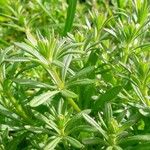
Galium aparine
Stickywilly · Cleavers · Goose Grass · Bedstraw · Sticky weed
Description
Source: leafsnapGalium aparine, commonly known as cleavers or stickyweed, is a herbaceous annual plant belonging to the Rubiaceae family. Originally native to Europe and Asia, it has now spread worldwide. This plant typically grows to a height of 1-2 meters and features a sprawling habit with thin stems covered in small hooked hairs, enabling it to cling to other plants for support. The leaves of Galium aparine are arranged in whorls of six or eight around the stem, exhibiting a narrow form with pointed tips. Its small white flowers, each with four petals, bloom from May through August and grow on long stalks emerging from the leaf axils. Known for its medicinal properties, Galium aparine contains compounds such as citric acid, tannins, flavonoids, and coumarins. These compounds have diuretic properties that help flush out toxins from the body and possess anti-inflammatory properties useful for treating skin conditions like eczema. Beyond its medicinal uses, Galium aparine serves as a valuable food source for wildlife. Birds consume its seeds, while rabbits feed on its leaves. This plant plays a crucial role in maintaining ecological balance by providing food for various species and offering medicinal benefits to humans when used appropriately under medical supervision.
🌳 The history of cleavers reveals a range of uses that go beyond common knowledge. It has been a source for extracting essential oils and provides a natural, wild aroma prized in organic perfumery. Historically, it was even employed in tanneries, using its enzymes to soften tough leather and improve both its suppleness and durability.
🎭 Obligatory, matters relating to commitment, annoyance
Care Guide
💧 Water Every 3 days
Cleavers thrive in moderately moist conditions, preferring soil that remains consistently damp and benefits from weekly watering. This hardy species, usually grown outdoors, conserves water during its dormant period and maximizes water uptake during the growing season. Its water management strategy aligns with that of many deciduous plants.
How much water does my Cleavers plant need?
When it comes to watering your Cleavers, there are a few different approaches you can take. Some people prefer to check the moisture level of the soil and water until the top six inches are moist. Others opt for a specific measurement, like two gallons per week, depending on the weather conditions and how quickly the soil dries out. However, it's important to consider the needs of your plant and avoid overwatering if it requires less than two gallons. If you're growing Cleavers in a container, a different method is needed. You should water enough to dampen all dry layers of soil, which you can determine by feeling the soil with your finger or by noticing a slight trickle of excess water from the pot's drainage holes.
☀️ Light Full sun
Cleavers tends to prefer locations where sunlight is plentiful throughout the day, though it can also tolerate moderate light. In its natural habitats it does well with abundant light, which supports healthy growth. Both too much and too little light can negatively affect its development.
What kind of sunlight conditions are required for Cleavers (Galium aparine)?
Cleavers (Galium aparine) thrives in conditions where it can receive ample sunlight throughout the day, with a preference for full sun or partial sun exposure. Full sun is defined as receiving over 6 hours of sunlight daily, while partial sun refers to about 3-6 hours of sunlight. Despite its preference for generous light, Cleavers can also manage moderate sunlight exposure. It's crucial to observe your garden's light conditions, aiming for spots that strike a perfect balance between light and shade, to ensure the plant's well-being and healthy growth.
How can artificial lighting support the growth of Cleavers indoors?
Indoor plants like Cleavers require adequate lighting for optimal growth, especially in conditions where natural sunlight is lacking, such as during winter or in less sunny spaces. Artificial lighting serves as an essential alternative, encouraging faster, healthier growth. LED lights are recommended for their ability to provide specific wavelengths of light needed by plants. The amount of artificial light needed varies: full sun plants need 30-50W/sq ft, partial sun plants 20-30W/sq ft, and full shade plants 10-20W/sq ft. The ideal placement is 12-36 inches above the plant, mimicking the natural sunlight, with a duration of 8-12 hours of light per day to simulate natural daylight hours adequately.
What are common symptoms of inadequate light in Cleavers?
Cleavers shows several symptoms when exposed to inadequate light. These include smaller new leaves, leggy or sparse growth, faster leaf drop, slower or halted new growth, and lighter-colored new leaves indicating a lack of chlorophyll. Additionally, conditions such as chlorosis, where leaves turn yellow, sunscald, leaf curling, wilting, and leaf scorching may occur due to insufficient or excessive sunlight. These symptoms provide vital clues that the plant needs a change in its light environment to thrive.
What solutions can be applied to address Cleavers' light conditions both indoors and outdoors?
For Cleavers facing inadequate light conditions, a gradual adjustment to more suitable light environments is recommended. Indoors, gradually move the plant to a sunnier location each week, ensuring at least 6 hours of direct sunlight daily, utilizing a south-facing window. Artificial lighting, such as desk or ceiling lamps for at least 8 hours daily or professional plant grow lights, can provide additional light if moving the plant isn't feasible. Outdoors, move the plants to a spot with better sunlight gradually to prevent sunburn, making slight adjustments each week. When dealing with obstructions like trees, consider pruning to allow more sunlight through. For smaller plants, transplanting during their dormant period can also help ensure they get enough sunlight, by moving them to a location with better light exposure and drainage. It's important to note that parts of the plant that have already been affected by light deficiency may not recover, but new growth should be healthy following these adjustments.
🌡️ Temperature 0–32.2°C
Cleavers is native to temperate regions and is well-suited to temperatures of 68 to 95 °F (20 to 35 °C). During colder seasons, gradually acclimate it to lower temperatures. Take care not to expose it to freezing temperatures.
What is the ideal temperature range for growing Cleavers?
Cleavers, known botanically as Galium aparine, thrives in temperate climates, ideally suited to temperatures ranging from 68 to 95 °F (20 to 35 °C). Its indigenous regions are characterized by these temperature norms, making it a versatile plant within this range. Although Cleavers possesses strong cold resistance and does not usually require special frost protection measures, it is important to gradually adapt the plant to lower temperatures as the colder seasons approach to avoid shock from sudden freezing conditions.
How should I protect Cleavers from extreme cold?
Despite Cleavers' strong cold resistance, it does need protection when winter temperatures are expected to plummet below -35°C. Protection can be given by covering the plant with insulating materials such as soil or straw to shield it from the harsh cold. Additionally, before the onset of the first freeze in autumn, it's beneficial to water the plant abundantly. This ensures the soil around Cleavers is moist when it freezes, helping to prevent drought and water scarcity during the winter and the early spring months.
How does Cleavers react to low temperatures, and what solutions are recommended?
Cleavers is cold-tolerant and fares best in temperatures above 20°C, ideally kept above freezing point during winter. However, when temperatures fall below -35°C, you might not notice immediate changes, but there could be a significant impact on its ability to sprout when spring arrives, either leading to reduced sprouting or none at all. The recommended solution for any parts of the plant that fail to sprout in spring is to simply remove them, encouraging healthy growth and revitalization for the coming season.
What are the signs of Cleavers experiencing too much heat, and how can I mitigate them?
During the hotter summer months, Cleavers should ideally be kept below 35°C to avoid heat stress. Signs that the plant is suffering from excessive heat include leaves becoming lighter in color, curling, susceptibility to sunburn, and in severe cases, wilting or drying out completely. To mitigate these issues, trim away any sunburned or dried parts of the plant. Relocate Cleavers to a shaded area or use a shade cloth to protect it from the midday and afternoon sun. Keeping the soil moist by watering in the morning and evening can also help in maintaining the plant's health during high temperatures.
💨 Humidity
🪴 Soil 6-7
🌱 Fertilizer
Cleavers respond well to regular, dilute fertilizer applications to encourage healthy leaf development. You should feed cleavers roughly once a month during the summer. Nitrogen is important for foliage, and adding nitrogen-rich fertilizers helps cleavers do well.
🪴 Pot & Repot
✂️ Pruning
🌿 Propagating
🐛 Diseases & pets
☠️ Toxicity
Characteristics
- Plant Type
- Herb
- Life Cycle
- Annual, Biennial
- Genus
- Galium
- Family
- Rubiaceae
- Hardiness Zone
- 3-8
- Mature Height
- 0.2 m to 2.13 m
- Mature Spread
- 91 cm
- Leaf Color
- Green
- Leaf Type
- Deciduous
- Flower Color
- White
- Flower Size
- 0.15 cm to 0.20 cm
- Bloom Time
- Mid spring, Late spring, Early summer
- Planting Time
- Spring
- Harvest Time
- Early summer, Mid summer
- Native Area
- Libya, Turkey, Sweden, India, Austria, Slovakia, Montenegro, Pakistan, Slovenia, Morocco, Croatia, Belarus, Uzbekistan, Russia, Iraq, Germany, Estonia, Romania, Latvia, Belgium, Portugal, Nepal, Saudi Arabia, Netherlands, France, Tajikistan, Tunisia, Czech Republic, Cyprus, Bulgaria, Poland, Greece, Ukraine, Serbia, Lebanon, Lithuania, Norway, Afghanistan, Syria, Kyrgyzstan, Kazakhstan, Italy, Spain, Switzerland, Denmark, Finland, Iran, Albania, Ireland, United Kingdom, Hungary, Algeria, Turkmenistan