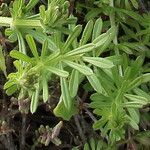
Galium verrucosum
Southern Cleavers · Warty bedstraw · Cleavers · Warty Cleavers
Description
Source: leafsnapGalium verrucosum, commonly known as Warty Bedstraw, is a perennial herbaceous plant in the Rubiaceae family. Native to North America, it thrives in diverse habitats, including meadows, forests, and wetlands. This sprawling plant can grow up to 1 meter tall, featuring square-shaped stems adorned with small hairs. The leaves of Galium verrucosum are arranged in whorls of four around the stem. They are lance-shaped with pointed tips and have rough surfaces due to small bumps or warts on the upper side. The plant blooms from June through August, producing clusters of flowers at the ends of stems or branches. The flowers have four white petals that form a star shape with yellow centers. They produce small fruits called nutlets, which contain seeds for reproduction. Galium verrucosum has a history of medicinal use by Native Americans, who utilized it as an herbal remedy for various ailments such as fever, headaches, stomachaches, and skin irritations. Overall, Galium verrucosum is a fascinating herbaceous perennial known for its distinctive warty leaves, making it easily identifiable within its habitat range.
Care Guide
💧 Water Every 7 days
Southern cleavers thrive in moist, well-drained soil and require consistent hydration, though they can withstand short periods of dryness. For optimal growth, water them weekly. While they are commonly cultivated outdoors and benefit from natural rainfall, it’s important to consider the local climate to determine if additional watering is needed.
How should I water my Southern cleavers properly?
There are various ways to water Southern cleavers, such as using a garden hose with a spray nozzle, a watering can, or any common watering tool. They are not particular about the type of water they receive, whether it is rainwater, tap water, or filtered water. It's best to avoid watering this plant from above, as it can harm the leaves and flowers and potentially cause disease. A drip irrigation system is often recommended as it provides even and direct watering to the soil. When watering a Southern cleaver in a container, you can use a cup, watering can, or tap to water the soil directly.
What should I do if I give my Southern cleavers too much water or too little water?
The solution for underwatered Southern cleavers is simple: water it more regularly when you see that it lacks moisture. However, overwatering can be a more serious issue if not caught early. When your Southern cleavers is overwatered, it can get sick and eventually die. To prevent this, choose a growing location with ample sunlight to dry the soil and good drainage to prevent water from pooling. If you overwater a potted Southern cleaver, you may need to change to a new pot with better drainage and loose soil for repotting.
How often does my Southern cleavers need to be watered?
To ensure the health of your Southern cleavers plants, it is important to provide adequate water throughout the growing season. In spring, aim to water the plant once a week. As the season progresses and temperatures rise, you may need to increase watering to two to three times per week. However, be cautious not to overwater as it can harm the plant. It is crucial to maintain moist soil for the Southern cleavers, but avoid making it too wet. When growing Southern cleavers in a pot, it is necessary to water more frequently. The soil in pots tends to heat up and dry out faster compared to ground soil. Therefore, plan to water container-grown Southern cleavers a few times per week, as opposed to just once per week for plants in the ground.
How much water does my Southern cleavers plant require?
There are a few ways to determine how much water to give your Southern cleavers. One method is to feel the soil for moisture and water until the first six inches are moist. Another option is to use a set measurement, like two gallons per week, depending on temperature and soil dryness. However, following strict guidelines can lead to overwatering if your plant needs less. When growing in a container, you should moisten all dry soil layers or look for excess water from drainage holes.
How can I know if I'm giving enough water to my Southern cleavers?
Avoiding overwatering can be challenging for Southern cleavers. On one hand, these plants need weekly watering due to their deep roots. On the other hand, Southern cleavers are highly prone to root rot and browning when overwatered. Underwatering is less of a concern as these plants can survive without extra water for a while. But if you wait too long to water them, they will likely wilt and develop dry leaves.
☀️ Light Partial sun
Southern cleavers comes from habitats with dappled light, such as forest understories or rocky spots that provide natural shade. It does well in partial sun but can also adapt to full sun conditions.
What are the sunlight requirements for Southern cleavers (Galium verrucosum)?
Southern cleavers (Galium verrucosum) thrives best in environments that replicate its native habitat, which consists of dappled sunlight locations like forest understories or rocky areas with natural shade. It generally prefers partial sun, meaning it should receive about 3-6 hours of sunlight daily, but it can also tolerate full sun conditions, which means receiving more than 6 hours of sunlight daily. It's crucial to observe the movement of sunlight through your garden to choose spots that offer a balanced exposure of light and shade, ensuring the plant's growth and happiness.
How can artificial lighting be used for indoor Southern cleavers plants?
For Southern cleavers plants grown indoors, adequate lighting is essential for optimal growth, especially in conditions where natural sunlight is insufficient, like during winter or in less sunny spaces. Artificial lights can provide a vital solution, with LED lights being a popular choice due to their ability to be customized to deliver specific wavelengths needed by the plants. Full sun plants require 30-50W/sq ft of artificial light, partial sun plants need 20-30W/sq ft, and full shade plants need 10-20W/sq ft. The light source should be placed 12-36 inches above the plant to mimic natural sunlight effectively. Additionally, most plants benefit from 8-12 hours of light per day to promote faster and healthier growth.
What are the symptoms of inadequate light for Southern cleavers, and how can they be addressed?
When Southern cleavers are grown indoors or in conditions of inadequate light, several symptoms can manifest. These include smaller new leaves, leggy or sparse growth, faster leaf drop, slower or no new growth, lighter-colored new leaves, chlorosis, sunscald, leaf curling, wilting, and leaf scorching. To address these issues for indoor plants, gradually shift them to sunnier spots each week until they receive 3-6 hours of direct sunlight daily or use artificial light if the plant is large or not easily movable, keeping a lamp on for at least 8 hours daily. Outdoors, gradually move your plants to sunnier spots to adapt without shock. For ground plants, reduce obstructions like tree branches that block sunlight or consider transplanting during the plant's dormant period to a location with better light exposure and drainage. It's important to note that parts of the plant affected by insufficient light may not fully recover, but new growth should be healthy with improved light conditions.
🌡️ Temperature 15–35°C
Southern cleavers can adapt to a wide range of temperatures, but its distribution may still be restricted by various combinations of water and heat conditions. It does best in warm summer climates with sufficient rainfall or watering. Extended periods of cloudy, rainy weather or prolonged high temperatures can raise the likelihood of Southern cleavers dying. In winter, adequate protection from cold can increase the plant's survival rate.
What is the botanical name of Southern cleavers?
The botanical name of Southern cleavers is Galium verrucosum. Southern cleavers, known by its scientific name Galium verrucosum, is a species with specific characteristics but further details on its essentials and symptoms are not provided.
💨 Humidity
🪴 Soil 6-7
🌱 Fertilizer
Southern cleavers respond well to regular, weak fertilizer applications to encourage healthy leaf development. You should feed Southern cleavers about once a month during the summer. Nitrogen is essential for foliage, and adding nitrogen-rich sources helps Southern cleavers do well.
🪴 Pot & Repot
✂️ Pruning
Prune southern cleavers between early and late spring to encourage healthy growth and prevent overcrowding. Trim any overgrown or damaged stems just above a leaf node to promote bushier growth. To preserve the flowers, avoid heavy pruning during the blooming season. Regular pruning not only improves appearance but also reduces the risk of disease.
🌿 Propagating
🐛 Diseases & pets
☠️ Toxicity
Characteristics
- Plant Type
- Herb
- Life Cycle
- Annual
- Genus
- Galium
- Family
- Rubiaceae
- Hardiness Zone
- 7-10
- Mature Height
- 10 cm to 49 cm
- Mature Spread
- 20 cm to 40 cm
- Leaf Color
- Green
- Leaf Type
- Deciduous
- Flower Color
- White
- Flower Size
- 0.20 cm to 0.25 cm
- Bloom Time
- Mid spring, Late spring, Early summer
- Planting Time
- Spring, Summer, Autumn
- Harvest Time
- Summer
- Native Area
- Tunisia, Portugal, Italy, Spain, Cyprus, Albania, Algeria, Greece, Croatia, Morocco, Lebanon, France