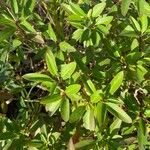
Galphimia gracilis
Goldshower · Rain-of-gold · Spray-of-gold · Thryallis · Shower-of-gold
Description
Source: leafsnapGalphimia gracilis, a species in the genus Galphimia of the family Malpighiaceae, is native to eastern Mexico. It is widely cultivated in warm regions throughout the world, often under the common names gold shower or shower-of-gold, slender goldshower or sometimes thryallis. In horticultural publications, in the nursery trade, and on websites, this species is commonly but mistakenly referred to as Galphimia glauca, Galphimia brasiliensis, Thryallis glauca, Thryallis gracilis, or often in South America, Thryallis brasiliensis. Galphimia gracilis is easily told apart from the true G. glauca and G. brasiliensis by the flowers. In G. gracilis the petals fall as the fruit matures; in G. glauca the petals are persistent even in fruit. In G. gracilis many flowers of a dense inflorescence are open at one time, and the petals (claw and limb) are 8–14 mm (0.31–0.55 in) long and 4–8 mm (0.16–0.31 in) wide; in G. brasiliensis only two or three small flowers are open at one time on a sparse inflorescence, and the petals are only 4–5 mm (0.16–0.20 in) long and ca. 3 mm (0.12 in) wide. Pollens are spherical, approximately 16-18 microns in diameter.
🌳 The slender goldshower is a graceful tropical shrub known for its vibrant golden-yellow flowers and rapid growth. It thrives in warm climates and can be planted in groups or used to enhance perennial borders and foundation plantings. Additionally, it serves as a unique and attractive informal hedge. Due to its fast growth, the slender goldshower can even be grown as an annual in areas with cold winters.
Care Guide
💧 Water
The slender goldshower plant thrives in environments with high humidity and consistent moisture and does best in lightly moist soil. To maintain this balance, water the plant every 1 to 2 weeks, ensuring both proper hydration and good drainage. During the growing season, adequate watering enhances the plant's ability to produce vibrant blooms.
☀️ Light Full sun
Slender goldshower does best with plentiful light, although it can also do well under moderate light levels. Plenty of sunlight promotes healthy growth, while inadequate light may hinder development. This preference reflects the sunny conditions of its native habitat. Both excessive and insufficient light can potentially cause stress to the plant.
What are the sunlight requirements for slender goldshower plants?
Slender goldshower plants require full sun, which means they thrive in areas that receive more than 6 hours of sunlight daily. They can also grow in partial sun, with about 3-6 hours of sunlight. When selecting a location for your slender goldshower, it's essential to observe how sunlight moves through your garden to find spots that offer the right balance of light and shade, ensuring the plants' well-being.
Can slender goldshower plants grow under artificial lighting?
Yes, slender goldshower plants can grow under artificial lighting, especially when natural sunlight is not sufficient, such as in winter or less sunny spaces. The use of artificial lights, like LED lights, can be customized to provide the specific wavelengths needed for optimal growth. The general guidelines for artificial lighting suggest that full sun plants require 30-50W/sq ft, partial sun plants need 20-30W/sq ft, and full shade plants need 10-20W/sq ft of light. The artificial light source should be positioned 12-36 inches above the plant to mimic natural sunlight and be kept on for 8-12 hours per day to mimic the length of natural daylight.
What are the symptoms of light deficiency in slender goldshower plants?
Slender goldshower plants may exhibit several symptoms when they don't receive sufficient light, including smaller new leaves, leggy or sparse growth, faster leaf drop, slower or no new growth, and lighter-colored new leaves. Other symptoms indicative of stress from excessive sunlight or insufficient light include chlorosis (leaves turning yellow), sunscald (damage from intense sun exposure), leaf curling (as a defense mechanism against sunlight), wilting (due to excessive water loss), and leaf scorching (characterized by brown, dry, crispy leaf edges). These symptoms highlight the importance of providing the right light conditions to maintain plant health.
How can I address insufficient light for my slender goldshower plant?
To address insufficient light for your slender goldshower plant, gradually move the plant to a sunnier location, aiming for at least 6 hours of direct sunlight daily. For indoor plants, using a south-facing window and keeping curtains open during daylight can maximize sunlight exposure. Additionally, consider using artificial lighting such as desk or ceiling lamps on for at least 8 hours daily, or invest in professional plant grow lights. For outdoor plants, it's crucial to move them to sunnier spots gradually to avoid sunburn. Reducing obstructions, such as by pruning trees or transplanting smaller plants to sunnier locations, can also help improve light exposure. Note that parts of the plant affected by previous light deficiency may not recover, but new growth should be healthy with improved light conditions.
🌡️ Temperature 20–37.8°C
Slender goldshower is native to areas with warm temperatures of 20 to 38 ℃ (68 to 100 ℉). It prospers in locations with consistently mild to hot conditions and may need shade during the height of summer heat. In colder months, this plant might have to be brought indoors or shielded from frost to maintain optimal growth.
What is the native climate for Slender goldshower?
Slender goldshower, also known by its botanic name Galphimia gracilis, is native to regions where the climate remains warm, with temperatures ranging from 20°C (68°F) to 38°C (100°F). It prospers in environments that offer consistent mild to hot temperatures, but may require some shade during the more intense summer heat to thrive optimally. When temperatures start to drop in the colder seasons, Slender goldshower can benefit from being moved indoors or protected from frost to maintain optimal growth conditions. This plant is extremely fond of heat, and exposure to cold temperatures can be detrimental.
How should Slender goldshower be cared for in low temperatures?
Slender goldshower prefers warm temperatures and does not tolerate low temperatures well. It thrives best when the temperature stays above 20°C. During winter periods, keeping the plant above 0°C is crucial, and it should absolutely never be exposed to temperatures below -5°C, as this can lead to the lightening of leaf color and subsequent color changes to brown or black after frost damage, along with wilting and drooping. To mitigate these risks, it's recommended to trim off the frost-damaged parts and move the plant to a warm, indoor environment immediately. Positioning the plant near a south-facing window ensures it receives ample sunlight, and it's also important to avoid placing it near heaters or air conditioning vents, which can cause excessive dryness in the air.
What measures should be taken for Slender goldshower during high temperatures?
During the peak summer months, it's advisable to keep Slender goldshower's exposure to temperatures below 38°C to prevent heat stress. If temperatures rise above 43°C, the leaves of the plant may lighten, indicating the onset of sunburn. To care for a plant suffering from sunburn, trim away the sunburned and dried parts, and relocate the plant to a spot where it can be shielded from the harsh midday and afternoon sun. It's also crucial to water the plant in the early morning and evening to help maintain soil moisture levels, thus aiding in its recovery and continued health.
💨 Humidity normal (40-60%)
This plant will thrive in moderate humidity, which is probably the level in your home. However, misting it a few times a week can be very beneficial. Make sure the room has good ventilation.
🪴 Soil 6-7
🌱 Fertilizer
The best time to fertilize a Slender goldshower is in early spring, when it is coming out of dormancy. This supports overall growth and the development of flowers. Fertilizing improves the foliage, stems, and branches, and encourages flowers that are large, vibrant, and long-lasting. It also helps move nutrients from the roots to the flowers and enhances the plant's health and resistance to disease.
🪴 Pot & Repot 2-3 years
When repotting Slender goldshower, pick a container 1-2 inches (2.5-5.1 cm) larger that offers good drainage. Use a well-draining potting mix. Repot in spring or fall, positioning the root ball slightly below the rim of the flower pot. Water thoroughly after repotting and place it in a warm spot with indirect sunlight.
✂️ Pruning
The slender goldshower plant produces delicate yellow flowers and thrives with some attention in late spring. To promote healthy growth, you should remove any dead branches to enhance airflow and shape the plant. Light trimming encourages more blooms and maintains a compact form. Be sure to avoid heavy pruning, as it can stress the plant. For best results, use clean tools to make precise cuts, which will help maintain the plant's health.
🌿 Propagating
🐛 Diseases & pets
☠️ Toxicity
Characteristics
- Plant Type
- Shrub
- Life Cycle
- Perennial
- Genus
- Galphimia
- Family
- Malpighiaceae
- Hardiness Zone
- 9-11
- Mature Height
- 1.83 m to 3.05 m
- Mature Spread
- 1.83 m to 3.05 m
- Leaf Color
- Green
- Leaf Type
- Evergreen
- Flower Color
- Yellow
- Flower Size
- 1.27 cm
- Bloom Time
- Late spring, Summer
- Planting Time
- Spring, Autumn
- Harvest Time
- Summer, Early fall
- Native Area
- Mexico