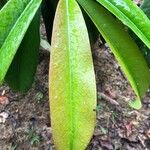
Garcinia atroviridis
Asam gelugur · Asam Gelugor
Description
Source: leafsnapGarcinia atroviridis, known as asam gelugur, asam gelugo, or asam keping (in Malay, Thai: ส้มแขก) is a large rainforest tree native to Peninsular Malaysia and Sumatra . This species grows wild throughout Peninsular Malaysia but is also widely cultivated, especially in the northern states, owing to its economic and medicinal value. Garcinia atroviridis is a large perennial plant commonly found in evergreen forests in the southern region of Thailand and Malaysia.
Care Guide
💧 Water
Asam gelugur thrives in high humidity and can withstand moderate drought. For optimal health, it should be watered every 2-3 weeks. Being an evergreen plant, asam gelugur retains moisture throughout the year, which helps maintain its lush foliage. It is suitable for cultivation both indoors and outdoors.
☀️ Light Full sun
Asam gelugur comes from open habitats, for example sunlit meadows and forest margins, where light is plentiful. It does best in Full Sun but can also tolerate Partial Sun, adapting well to different sunlight levels.
What are the sunlight requirements for Asam Gelugur?
Asam Gelugur thrives best in full sun conditions, which means it requires more than 6 hours of sunlight daily. However, it can also tolerate partial sun, receiving about 3-6 hours of sunlight. It's important to monitor how sunlight traverses your garden to find spots that offer the right balance of light and shade, ensuring optimal growth and happiness for your plants.
What are the essential conditions for growing Asam Gelugur?
Asam gelugur naturally grows in open environments like sunny meadows and forest edges, which offer plenty of light. These conditions are critical since the plant is accustomed to full sun but can adapt to partial sun, making it versatile in various sunlight conditions. For indoor plants lacking natural sunlight, especially in winter or less sunny areas, artificial lighting can be a vital solution. Indoor plants benefit from adequate lighting to support their growth, with LED lights being a popular choice because they can provide specific wavelengths needed by plants. Full sun plants should have 30-50W/sq ft of artificial light, partial sun plants 20-30W/sq ft, and full shade plants 10-20W/sq ft. The artificial light source should be placed 12-36 inches above the plant, mimicking natural sunlight as closely as possible, with the duration matching the natural daylight hours, usually 8-12 hours per day.
What are the symptoms of light deficiency in Asam Gelugur?
When Asam Gelugur does not receive adequate sunlight, it may show several symptoms indicative of light deficiency. Such symptoms include smaller new leaves, leggy or sparse growth, faster leaf drop, slower or no new growth, lighter-colored new leaves, chlorosis (leaves turning yellow), sunscald (damage from intense sunlight exposure), leaf curling (to minimize water loss), wilting (loss of turgor pressure), and leaf scorching (brown, dry edges on leaves). These symptoms highlight the plant's struggle in suboptimal lighting conditions.
How can I address light deficiency problems in Asam Gelugur?
To address light deficiency in Asam Gelugur, consider gradually moving your plants to sunnier locations to ensure they receive at least 6 hours of direct sunlight daily. For indoor plants, using a south-facing window or keeping a desk or ceiling lamp on for at least 8 hours daily can help. If the plant is large or not easily movable, investing in professional plant grow lights can provide sufficient light. Outdoors, avoid drastic changes in sunlight exposure to prevent sunburn and gradually adjust the plant to sunnier spots. Additionally, minimizing obstructions that block sunlight, such as pruning trees, or transplanting smaller plants to more sunlit areas with good drainage, can significantly improve light exposure. It's important to note that while increasing sunlight exposure can promote new healthy growth, parts of the plant that have been significantly affected by insufficient light may not recover.
🌡️ Temperature 20–37.8°C
Asam gelugur comes from tropical areas where the climate is usually warm and humid. Therefore it is adapted to high temperatures and moisture. It is not fond of sudden temperature shifts and prefers a steady thermal environment, so indoor temperature fluctuations should be avoided. It typically cannot tolerate cold and needs relatively high temperatures to grow. If the environmental temperature falls too low, growth may stop or the plant could die.
What is Asam gelugur?
Asam gelugur, known botanically as Garcinia atroviridis, is a plant species recognized for its significance in various applications, although the provided information does not specify its uses, essentials, or symptoms related to its consumption or application.
💨 Humidity
🪴 Soil 5-6
🌱 Fertilizer
Use organic fertilizer (e.g., fish emulsion, compost) instead of chemical fertilizers for Asam gelugur. Supply higher nitrogen and phosphorus to young plants in spring. Incorporate compost or fertilizer before or after planting. For mature plants, supplement in spring with a balanced fertilizer or one targeting specific deficiencies. Nutrient deficiency causes small leaves, short branches, yellow/bronze leaves, acidic fruits, premature fruit fall, and splitting.
🪴 Pot & Repot
✂️ Pruning
The Asam gelugur plant, known for its attractive broad leaves, is often used in cooking and traditional medicine. To promote its growth, improve air circulation, and boost its resistance to pests and diseases, it's beneficial to prune dead branches and shape the plant during its dormant period, which occurs from early to late winter.
🌿 Propagating
🐛 Diseases & pets
☠️ Toxicity
Characteristics
- Plant Type
- Tree
- Life Cycle
- Perennial
- Genus
- Garcinia
- Family
- Clusiaceae
- Hardiness Zone
- 10-12
- Mature Height
- 20.12 m
- Mature Spread
- 4.88 m to 10.06 m
- Leaf Color
- Green
- Leaf Type
- Evergreen
- Flower Color
- Yellow
- Flower Size
- 3.05 cm to 4.57 cm
- Bloom Time
- Late spring, Early summer, Mid summer
- Planting Time
- Spring, Summer, Autumn
- Harvest Time
- Late summer, Fall
- Native Area
- India, Malaysia, Indonesia, Myanmar, Singapore, Thailand