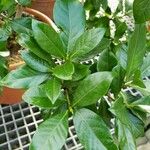
Gardenia augusta
Gardenia · Cape jasmine · Common gardenia · Cape jessamine
Description
Source: leafsnapGardenia augusta, commonly known as Cape Jasmine, is a popular evergreen shrub native to Asia. Widely cultivated for its fragrant white flowers and glossy dark green leaves, this plant can grow up to 6 feet tall and 4 feet wide, forming a dense, bushy habit. The flowers of Gardenia augusta are large and either white or cream-colored, emitting a sweet fragrance that fills the air. They typically bloom in late spring or early summer and continue to bloom intermittently throughout the summer months. The plant prefers well-drained soil enriched with organic matter. It requires regular watering during dry periods but can be susceptible to root rot if overwatered. Gardenia augusta thrives in partial shade but can tolerate full sun if provided with adequate moisture. Historically, Gardenia augusta has been used in traditional medicine for its anti-inflammatory properties and its ability to alleviate anxiety and depression through its calming fragrance. Overall, Gardenia augusta is an attractive shrub that enhances any garden or landscape with its beauty and fragrance while also offering potential health benefits through traditional medicinal practices.
🌳 For generations, the fruit of the gardenia has been more than a reproductive component. It has played a significant role in producing red and yellow tones, particularly in textiles and sweets. The fruit's extract dyes fabrics and food, offering a sustainable coloring option. However, it should be noted that excessive ingestion can cause the skin to take on a blue-gray tint because the pigments are absorbed and metabolized by the human body. The extract's use should be handled with caution.
🎭 Innocence, Tender love, You are lovely, honor, female beauty
Care Guide
💧 Water Every 7 days
☀️ Light Partial sun
A gardenia's ideal light exposure is a consistent blend of sun and shade, with more weight given to shade. It can, however, tolerate full-day sun or remain in complete shade. This flexibility mirrors the varying sunlight conditions of its native habitat. Excessive sun can scorch the leaves, while too little light may hamper growth and flowering.
🌡️ Temperature 15–37.8°C
A gardenia native to warm areas prefers temperatures between 59 and 100 ℉ (15 and 38 ℃). For best growth, provide high humidity and keep the soil moist. In winter, protect it from cold drafts and maintain temperatures of 60 to 65 ℉ (16 to 18 ℃).
💨 Humidity
🪴 Soil 5-6
🌱 Fertilizer
The timing of fertilizing Gardenia is crucial. Apply fertilizer in early spring and continue once a month until early summer. Fertilizer promotes attractive blooms and supplies energy during both dormant and active growth stages.
🪴 Pot & Repot 2-3 years
When repotting a gardenia, pick a pot 1-2 inches (2.5–5.1 cm) larger that provides ample drainage. Use a well-draining potting mix. Repot in spring or fall, ensuring the root ball sits slightly lower than the rim of the flower pot. Water thoroughly after repotting and place it in a warm spot with indirect sunlight.
✂️ Pruning
🌿 Propagating
🐛 Diseases & pets
☠️ Toxicity
Characteristics
- Plant Type
- Shrub
- Life Cycle
- Perennial
- Genus
- Gardenia
- Family
- Rubiaceae
- Hardiness Zone
- 8-11
- Mature Height
- 0.91 m to 1.83 m
- Mature Spread
- 0.61 m to 2.44 m
- Leaf Color
- Green
- Leaf Type
- Evergreen
- Flower Color
- White
- Flower Size
- 10.16 cm
- Bloom Time
- Early spring, Late summer, Fall, Winter
- Planting Time
- Spring, Autumn
- Harvest Time
- Mid summer, Late summer
- Native Area
- India, Cambodia, Vietnam, Japan, Koppen, Laos, Pakistan, South Korea, China