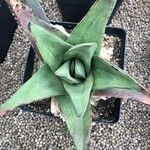
Gasteria excelsa
Ox tongue
Description
Source: leafsnapGasteria excelsa, commonly known as the ox tongue plant due to its long, tongue-shaped leaves, is a succulent belonging to the Asphodelaceae family. Native to South Africa, this plant features dark green leaves adorned with white spots, giving it a distinctive appearance. Gasteria excelsa can reach up to 30 cm in height and 60 cm in width, making it an excellent choice for both indoor and outdoor decoration. It requires minimal care and can thrive in a range of light conditions, from full sun to partial shade. During the summer months, Gasteria excelsa produces small tubular flowers in shades of pink or red. These flowers grow on long stems that rise above the plant's foliage, adding to its ornamental appeal. Besides its aesthetic value, Gasteria excelsa has several medicinal properties. The plant's gel-like sap has been used for centuries by indigenous South Africans to treat a variety of ailments, including burns, cuts, insect bites, and skin irritations. In summary, Gasteria excelsa is a visually appealing, low-maintenance succulent with unique foliage patterns. Its combination of attractiveness and ease of care makes it a standout member of the succulent family.
Care Guide
💧 Water Every 7 days
☀️ Light Partial sun
Blade Oxtongue comes from habitats with dappled light, like the understory of forests or rocky sites that provide natural shade. It favors partial sun but can also endure full sun.
🌡️ Temperature 20–37.8°C
Although Blade Oxtongue can tolerate some heat, it mainly does best and grows during cooler periods, becoming dormant in summer. In very hot summer conditions, it should be shaded to avoid scorching from intense sun. Watering ought to be reduced or stopped during the hottest months to prevent root rot. Blade Oxtongue shows vigorous growth in winter and spring, and provided temperatures do not fall too low, it will continue to grow steadily.
💨 Humidity
🪴 Soil 6-7
🌱 Fertilizer
Blade Oxtongue only needs light fertilizer once or twice a year during the growing season. Do not fertilize in winter or in summer when it is dormant. Cut back on fertilizer for recently repotted plants and wait a couple of months after repotting before applying any. Fertilizing helps maintain healthy growth and encourages flowering.
🪴 Pot & Repot Every 2 years
When repotting Blade Oxtongue, choose a pot slightly larger than the current one that provides good drainage. Use a gritty, well-draining succulent or cactus mix. Gently remove the plant from its old container, brush off excess soil, and replant it at the same depth. Wait a few days before watering to let any root damage heal. Repot in spring or fall and place it in a brightly lit spot.
✂️ Pruning
🌿 Propagating
🐛 Diseases & pets
☠️ Toxicity
Characteristics
- Plant Type
- Succulent, Herb
- Life Cycle
- Perennial
- Genus
- Gasteria
- Family
- Asphodelaceae
- Hardiness Zone
- 9-11
- Mature Height
- 30 cm to 61 cm
- Mature Spread
- 20 cm to 40 cm
- Leaf Color
- Dark Green, Light Green
- Leaf Type
- Evergreen
- Flower Size
- 1.02 cm to 2.03 cm
- Bloom Time
- Spring, Summer
- Planting Time
- Spring, Autumn
- Harvest Time
- Late spring, Summer, Early fall, Mid fall
- Native Area
- South Africa