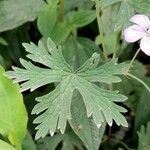
Geranium bicknellii
Bicknell's Cranesbill · Northern Crane's-bill · Bicknell's Geranium · Northern Cranesbill · Bicknell's Crane's-bill
Description
Source: leafsnapGeranium bicknellii, commonly known as Bicknell's geranium, is a perennial herbaceous plant that belongs to the Geraniaceae family. Native to North America, it is found in the eastern United States and Canada. This plant typically grows to a height of 30-60 cm and has a spreading habit with deeply lobed green leaves. The flowers of Geranium bicknellii are pink or purple with five petals, blooming from May to July. The plant thrives in moist soils and is commonly found in meadows, woodlands, or along stream banks. Native Americans have used Geranium bicknellii for medicinal purposes, treating ailments such as diarrhea, dysentery, wounds, and fever. Its attractive flowers also give it ornamental value, making it a popular choice for gardens. Overall, Geranium bicknellii is an appealing perennial herbaceous plant with both medicinal properties and ornamental appeal, making it an important part of North American flora.
Care Guide
💧 Water Every 7 days
Bicknell's cranesbill, a plant native to temperate regions, flourishes in environments with moderate moisture. It prefers consistently moist soil that is not waterlogged. To keep the plant healthy, it's best to water it once a week. Well-suited for outdoor growth, Bicknell's cranesbill goes dormant when watering is reduced to match its lower metabolic needs.
☀️ Light Full sun
Bicknell's cranesbill comes from bright, open habitats and performs best in full sun. It will tolerate partial shade but prefers direct sunlight for optimal growth. This plant, which can be annual or biennial, is notable for its sun-loving habit.
What are the sunlight requirements for Bicknell's cranesbill?
Bicknell's cranesbill thrives best in full sun, requiring more than 6 hours of sunlight daily, but it can also grow in partial sun, with about 3-6 hours of sunlight. It's important to observe how sunlight moves through your garden to choose the ideal spots for your plants, ensuring a perfect balance of light and shade for optimal growth.
How does artificial lighting support plant growth?
For indoor plants, when natural sunlight is not sufficient, artificial lighting becomes a crucial support mechanism. Artificial lights, such as LED, can be tailored to provide the specific wavelengths needed by plants. The amount of artificial light required varies: full sun plants need 30-50W/sq ft, partial sun plants 20-30W/sq ft, and full shade plants 10-20W/sq ft. The light source should be placed 12-36 inches above the plant, and most plants will need 8-12 hours of light per day to mimic natural daylight hours effectively.
What are the symptoms of light deficiency in Bicknell's cranesbill?
When Bicknell's cranesbill receives inadequate light, it may display symptoms such as smaller new leaves, leggy or sparse growth, faster leaf drop, slower or no new growth, lighter-colored new leaves or chlorosis, sunscald, leaf curling, wilting, and leaf scorching. These signs indicate that the plant needs more light to maintain healthy growth.
How can you address light deficiency for indoor and outdoor plants?
To address light deficiency, gradually relocate your plants to areas with more sunlight. For indoor plants, move them closer to a south-facing window or use artificial lights for at least 8 hours a day. For outdoor plants, find the best spot with ample sunlight, moving them gradually to avoid sunburn. If necessary, prune obstructions or transplant smaller plants to sunnier locations. However, be mindful that parts of the plant damaged by insufficient light may not recover, but new growth should be healthy with increased light exposure.
🌡️ Temperature 10–35°C
Bicknell's cranesbill can tolerate a wide range of temperatures, yet its distribution may still be restricted by particular combinations of moisture and heat. It does best in warm summer conditions with adequate rainfall or watering. Extended periods of cloudy, rainy weather, as well as prolonged high temperatures, can increase the chances of Bicknell's cranesbill dying. In winter, appropriate protection from cold can improve the plant's survival.
What are the optimal growing conditions for Bicknell's cranesbill?
Bicknell's cranesbill, or Geranium bicknellii, adapts well to various temperature conditions, but its growth is optimized in warm climates with ample summer rainfall or consistent watering. It has a strong resistance to cold, thriving best when the summer temperature is adequately warm, and does not generally require special frost protection measures during winter. However, in extremely cold winter conditions, where temperatures are expected to fall below -25°C, it’s important to protect the plant by covering it with soil or straw to improve survival rates. Additionally, ensuring the soil is moist before the first freeze can help the plant through winter and early spring by preventing drought and water scarcity.
How does Bicknell's cranesbill respond to low temperatures, and what measures should be taken?
Bicknell's cranesbill exhibits a high degree of cold tolerance, ideally thriving when temperatures remain above 0°C, but best above 20°C. Despite its resilience, exposure to temperatures below -25°C can lead to a reduction or absence of sprouting in spring. In such cases, it is recommended to remove any parts of the plant that fail to sprout as the weather warms. The plant does not usually show noticeable changes during winter, even in extreme cold, but the effects may become evident in the plant's ability to sprout in the following spring.
What are the effects of high temperatures on Bicknell's cranesbill, and how can they be mitigated?
Bicknell's cranesbill should ideally be maintained below 35°C during the summer to prevent stress from high temperatures. Exceeding 38°C can cause the plant's leaves to lighten in color, curl, become prone to sunburn, and, in severe cases, lead to the wilting and drying of the entire plant. To mitigate these effects, it is advisable to trim away any sunburned or dried parts of the plant, relocate the plant to a shaded area or use a shade cloth to protect it from midday and afternoon sun. Additionally, maintaining soil moisture through watering in the morning and evening can help the plant withstand the heat.
💨 Humidity
🪴 Soil 6-8
🌱 Fertilizer
Bicknell's cranesbill does well with regular, light applications of fertilizer to encourage healthy leaf growth. You should fertilize about once a month during the summer. Nitrogen is important for foliage, and providing nitrogen-rich sources helps Bicknell's cranesbill thrive.
🪴 Pot & Repot
✂️ Pruning
Bicknell's cranesbill flourishes with its vibrant flowers and benefits greatly from pruning between early and late spring. To maintain a compact shape, remove any dead stems and trim back excessively long growth. Pruning not only enhances air circulation and reduces the risk of disease but also encourages blooming. For the best results, be sure to use clean, sharp tools.
🌿 Propagating
🐛 Diseases & pets
☠️ Toxicity
Characteristics
- Plant Type
- Herb
- Life Cycle
- Annual, Biennial
- Genus
- Geranium
- Family
- Geraniaceae
- Hardiness Zone
- 6-9
- Mature Height
- 20 cm to 30 cm
- Mature Spread
- 20 cm to 40 cm
- Leaf Color
- Green, Dark Green
- Leaf Type
- Semi-evergreen
- Flower Color
- Pink
- Flower Size
- 1.02 cm to 1.52 cm
- Bloom Time
- Late spring, Early summer, Mid summer
- Planting Time
- Spring, Autumn
- Harvest Time
- Mid summer, Late summer, Early fall