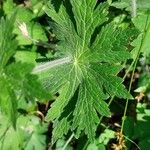
Geranium phaeum
Dusky crane's-bill · Black-widow · Mourning Widow · Dusky cranesbill · Smeđa iglica var. Samobor
Description
Source: leafsnapGeranium phaeum, commonly known as Dusky Cranesbill or Mourning Widow, is a herbaceous perennial belonging to the Geraniaceae family. Native to Europe and Asia, this resilient plant can reach a height of up to 60 cm. Its foliage consists of deeply lobed, dark green leaves with a velvety texture. The flowers are small and cup-shaped, each featuring five petals adorned with dark purple veins. Geranium phaeum thrives in partial to full shade and prefers moist soils such as loam or clay. It blooms from late spring to early summer, attracting bees and butterflies with its nectar-rich flowers. This plant offers several medicinal benefits. When applied topically to wounds or bruises, it exhibits anti-inflammatory properties. Additionally, it contains tannins, which have astringent properties that help reduce bleeding from cuts. Overall, Geranium phaeum is not only an attractive addition to any garden but also provides valuable medicinal benefits when used appropriately.
🌳 Dusky crane's-bill is not merely an attractive plant. The species has been used for its properties as a natural dye. The flowers' dusky, muted tones can be extracted to create colors for dyeing textiles, a practice that harks back to a time when synthetic dyes did not exist. This highlights the plant's potential to re-emerge as a biodegradable and sustainable alternative in the textile industry, a selling point that is increasingly relevant in today's eco-conscious market.
Care Guide
💧 Water Every 7 days
The dusky crane's-bill thrives in consistently moist soil and needs regular watering, ideally once a week. Although it can withstand short periods of dryness, it's important to keep an eye on rainfall levels, especially during its active growing season, to ensure optimal health and flowering.
How should I water my Dusky crane's-bill plant?
To properly water the Dusky crane's-bill, use filtered water at room temperature or slightly warmer. Tap water may contain harmful particles, so filtering it is preferable. The Dusky crane's-bill is accustomed to a warm environment, so using cold water can be a shock to its system. It is also best to avoid overhead watering to prevent foliage issues. Instead, apply the filtered room temperature water directly to the soil until it is completely soaked. This helps to moisturize the roots and promote their spread for better nutrient collection.
What do I do if I give my Dusky crane's-bill plant too much or too little water?
Taking proper care of your Dusky crane's-bill involves avoiding both overwatering and underwatering. However, overwatering is more commonly seen and can cause the stems and leaves to wilt and turn yellow. Prolonged overwatering also increases the risk of diseases like root rot, mold, and mildew, which can be fatal to your plant. Underwatering is less common for the Dusky crane's-bill as it can tolerate some drought, but it is still a possibility. In such cases, the leaves may become brittle and brown. It is important to recognize the signs of overwatering early on, as some resulting diseases may be irreversible if not addressed promptly. If you spot signs of overwatering, reduce your watering schedule and check the soil's drainage. If the soil drains poorly, replace it with a well-draining potting mix. Conversely, if your Dusky crane's-bill lacks water, simply increase your watering frequency until the signs improve.
How frequently should I water my Dusky crane's-bill plant?
If your Dusky crane's-bill plant is in a pot, the most precise way to determine if it needs water is to check the soil by plunging your finger into it. If you find that the top two to three inches of soil are dry, then it's time to water the plant. If you have the Dusky crane's-bill plant growing outdoors in the ground, you can use a similar method to test the soil. Once again, if you find that the top few inches of soil have dried out, it's time to water the plant. Typically, during the spring and early fall, you will need to water this plant about once a week using this method. However, during extremely hot weather, you may need to increase your watering frequency to twice a week or even more. It's important to note that mature and well-established Dusky crane's-bill plants have a remarkable ability to withstand drought.
How much water does my Dusky crane's-bill require?
Here are some tips on watering your Dusky crane's-bill plant to ensure its health: - When watering, don't hold back. Make sure to give it a good amount of water. - Wait until the top two to three inches of soil are dry before watering. - Water the plant until the soil is completely soaked. - Be mindful of the excess water draining out of the pot's holes. If you don't see any excess water, you may not have given enough water. - However, be cautious of letting water accumulate in the soil, as it can harm the plant. - If water doesn't drain well from the pot, it might indicate poor soil drainage, which can negatively affect the plant's well-being. Avoid this. - If the plant is outdoors, approximately 1 inch of rain per week will be sufficient.
How do I water my Dusky crane's-bill plant as it grows?
The water needs of the Dusky crane's-bill can change depending on its growth stages. In the first few years of its life or when it has been newly transplanted, it will require more water than usual. During these stages, it focuses on developing new roots that will support future growth, and these roots require additional moisture. However, after a few seasons, the Dusky crane's-bill will need less water. Another stage in which it may require more water is during the bloom period when the development of flowers consumes a significant amount of moisture. Therefore, during this time, the Dusky crane's-bill may need extra watering.
☀️ Light Partial sun
The dusky crane's-bill grows best in spots with moderate sunlight, though it can tolerate both strong sun and heavy shade. Coming from habitats with varied light conditions, too much sun can cause its leaves to wilt, while too little light may impede its growth.
What are the sunlight requirements for Dusky crane's-bill?
Dusky crane's-bill requires moderate sunlight to thrive well. It can endure both intense sun and significant shade. This plant is adaptable to environments with varying light exposures; however, too much sun may cause the leaves to wilt, while insufficient light can hinder its growth. For optimal development, it's crucial to monitor sunlight exposure, aiming for about 3-6 hours of sunlight for partial sun conditions, and more than 6 hours for full sun or full shade conditions. Observing how sunlight moves through your garden and choosing spots that provide a balance of light and shade will ensure the well-being of your plants.
How can artificial lighting benefit indoor Dusky crane's-bill plants?
Indoor Dusky crane's-bill plants benefit from artificial lighting, especially when natural sunlight is inadequate, such as during winter or in less sunny spaces. Artificial lights, like LED lights, can be customized to provide specific wavelengths necessary for plant growth, promoting faster and healthier development. For full sun plants, 30-50W/sq ft of artificial light is recommended, while partial sun plants require 20-30W/sq ft, and full shade plants need 10-20W/sq ft. The light source should be placed 12-36 inches above the plant, mimicking natural sunlight, and it's crucial to match the length of natural daylight hours, generally 8-12 hours of light per day, depending on the plant species.
What are symptoms of insufficient or excessive light in Dusky crane's-bill?
Dusky crane's-bill exhibits various symptoms when facing insufficient or excessive light conditions. Symptoms of insufficient light include small, new leaves, leggy or sparse growth, faster leaf drop, delayed or halted growth, lighter-colored new leaves, indicative of a lack of chlorophyll. Conversely, symptoms of excessive sunlight exposure include chlorosis, or yellowing leaves due to chlorophyll breakdown, sunscald characterized by pale or necrotic areas on plant tissue, leaf curling as a defense mechanism against water loss, wilting from increased transpiration, and leaf scorching, showing brown, dry edges on leaves. These symptoms highlight the need for balanced light conditions to maintain plant health.
What solutions exist for Dusky crane's-bill experiencing light-related issues?
For Dusky crane's-bill experiencing light-related issues, several solutions are available. Indoors, gradually shift plants to sunnier spots each week until they receive 3-6 hours of direct sunlight daily, or use artificial light if the plant is not easily movable, ensuring at least 8 hours of light daily. Outdoors, similarly, move plants to sunnier locations gradually to prevent sunburn, emphasizing the importance of avoiding sudden changes in light exposure. Additionally, if sunlight is obstructed, consider reducing obstructions by pruning or transplanting smaller plants during their dormant period to areas with better sunlight and drainage. While parts of the plant affected by insufficient sunlight may not recover, new growth should be healthy after adjusting light exposure.
🌡️ Temperature 0–35°C
Dusky crane's-bill is native to areas where temperatures fall between 68 and 95 °F (20 to 35 °C). It performs best when temperatures remain consistently within that span. If seasonal temperatures deviate substantially from this range, it is recommended to alter the surrounding temperature accordingly.
What temperature conditions are ideal for growing Dusky crane's-bill?
Dusky crane's-bill, also known by its botanical name Geranium phaeum, is indigenous to regions that experience temperatures ranging from 68 to 95 °F (20 to 35 °C). It flourishes best within this temperature range. To ensure the plant thrives, it is advisable to adjust the surrounding temperature accordingly with each season, especially if the natural temperature significantly varies from this preferred range. Although Dusky crane's-bill has strong cold resistance, making special frost protection measures unnecessary in most winter conditions, it is critical to provide cold protection if temperatures are expected to drop below -35°C. This can be done by covering the plant with soil or straw. Additionally, watering the plant abundantly before the first freeze in autumn to keep the soil moist can help prevent drought and water scarcity during winter and early spring.
How does low temperature affect Dusky crane's-bill and what are the solutions?
Dusky crane's-bill is tolerant to cold weather, optimally thriving when temperatures stay above 20°C. Throughout the winter season, it is recommended to maintain the temperature above 0°C for the plant's well-being. Exposure to temperatures below -35°C might not show immediate adverse effects during the winter, but can lead to a reduced or complete lack of sprouting in the following spring. To counteract this, any parts of the plant that have failed to sprout in spring should be removed as part of the care regimen.
How does high temperature affect Dusky crane's-bill and what are the solutions?
During the hotter months, it is crucial to keep Dusky crane's-bill's surrounding temperature below 35°C, as exceeding 38°C can lead to several adverse effects. These include a noticeable lightening of the leaves, a predisposition to curling, an increased susceptibility to sunburn, and in severe cases, wilting and drying of the entire plant. To mitigate high temperature stress, it is recommended to trim away the sunburned and dried-up parts of the plant. Relocating it to a spot with shade from the midday and afternoon sun, or improvising shade using a cloth can be beneficial. Moreover, watering the plant during the morning and evening to maintain soil moisture is advisable.
💨 Humidity
🪴 Soil 5-7
🌱 Fertilizer
The best time to fertilize a Dusky crane's-bill is in early spring, when it is coming out of dormancy and entering active growth. Fertilization supplies essential nutrients for healthy development. Although Dusky crane's-bill has relatively low fertilizer requirements, annual feeding can improve its survival and produce better, longer-lasting flowers.
Why should I put fertilizer on my Dusky crane's-bill plant?
Fertilization is important for the Dusky crane's-bill for a few reasons. First, it provides essential nutrients for the plant to grow both above and below the ground. However, the Dusky crane's-bill generally has low fertilization needs and can sometimes survive without it. Nonetheless, annual fertilization can be highly beneficial for this plant, as it helps maintain its health and may even improve flower quality and duration. Therefore, if you want your Dusky crane's-bill to thrive and look its best, it's recommended to fertilize it annually.
When should I fertilize my Dusky crane's-bill plant?
The best time to fertilize a Dusky crane's-bill is from late winter to early spring, when it is transitioning from dormancy to active growth. Fertilizing during this time will promote healthy growth and give the plant a strong start for the season. While early spring is generally the most advantageous time to fertilize, it is also acceptable to fertilize in the fall. However, it is not recommended to fertilize during the summer or winter seasons.
When is not a good time to fertilize my Dusky crane's-bill plant?
To care for your Dusky crane's-bill, it's best to fertilize only in late winter and early spring. This plant doesn't require much fertilizer, so one feeding per year is sufficient. Overfertilizing throughout spring, summer, and fall can cause problems. However, if you didn't fertilize in spring, it's okay to feed it in the fall. It's important to note that no fertilization is needed in winter when the plant is dormant and not growing.
What kind of fertilizer does my Dusky crane's-bill plant require?
For a Dusky crane's-bill plant, most general-purpose fertilizers with a balanced blend of the main plant nutrients will work well. However, there are specific nutrient blends that can provide even more benefits. Some gardeners believe that higher levels of phosphorus contribute to stronger roots and better flowers, which is important for a flowering plant like the Dusky crane's-bill. So, using a fertilizer rich in phosphorus may be the best option. Whether it's granular or liquid, the important thing is to make sure there are plenty of nutrients present. In addition to manufactured fertilizers, you can also improve the soil for your Dusky crane's-bill using organic methods like compost and manure. These materials can significantly enhance the growing medium and promote overall plant health.
How can I help my Dusky crane's-bill plant grow better?
To fertilize a Dusky crane's-bill, the most common method is to use granular or pellet fertilizer around the plant's soil. The best time to fertilize is when the plant is transitioning from its dormant phase to active growth, typically in early spring. Once the plant starts emerging shoots through the soil, you can apply the fertilizer. Some people prefer using liquid fertilizer, which should be diluted with water before applying. Whether you choose granular or liquid fertilizer, it is important to moisten the soil before, during, and after fertilizing.
🪴 Pot & Repot Every 12 months
✂️ Pruning
Pruning dusky crane's-bill in early to late spring encourages new growth by removing dead stems and spent blooms. This practice improves air circulation and reduces the risk of disease, helping to maintain the plant's shape and vitality. As a result, dusky crane's-bill becomes a healthier and more attractive addition to gardens.
🌿 Propagating
🐛 Diseases & pets
☠️ Toxicity
Characteristics
- Plant Type
- Herb
- Life Cycle
- Perennial, Annual
- Genus
- Geranium
- Family
- Geraniaceae
- Hardiness Zone
- 3-9
- Mature Height
- 46 cm to 76 cm
- Mature Spread
- 30 cm to 46 cm
- Leaf Color
- Green
- Leaf Type
- Deciduous
- Flower Color
- Purple, White, Pink, Violet, Blue, Red, Brown, Black
- Flower Size
- 4.06 cm
- Bloom Time
- Late spring, Early summer, Mid summer
- Planting Time
- Spring
- Harvest Time
- Early summer, Mid summer
- Native Area
- Austria, Czech Republic, Slovakia, Romania, Bulgaria, Poland, Croatia, Slovenia, Belarus, Ukraine, Germany, Italy, Spain, Switzerland, Albania, Hungary, France