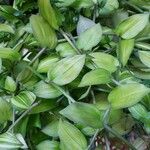
Gibasis geniculata
Tahitian Bridalveil · Tahitian bridal veil · Fern-leaf inch plant
Description
Source: leafsnapGibasis geniculata, commonly known as Tahitian Bridal Veil or Dwarf Tradescantia, is a small perennial plant belonging to the Commelinaceae family. Native to Central and South America, this plant is widely cultivated as an ornamental due to its attractive foliage and delicate flowers. The plant features slender stems that can grow up to 30 cm in length. Its lance-shaped leaves are green on top and purple underneath, arranged alternately along the stem, which gives the plant a bushy appearance. The flowers of Gibasis geniculata are small yet striking, with three white petals surrounding a yellow center. They bloom in clusters from spring through fall. Tahitian Bridal Veil thrives in bright, indirect light but can tolerate some direct sunlight. It requires well-draining soil and regular watering but can endure short periods of drought. Gibasis geniculata is an easy-to-grow houseplant that enhances any indoor or outdoor garden space. Its low maintenance requirements make it an ideal choice for beginners or anyone looking for a fuss-free plant addition.
Care Guide
💧 Water Every 7 days
☀️ Light Partial sun
The Tahitian bridal veil naturally occurs in habitats like forest understories or rocky areas, where it grows in natural shade. It prefers partial sun but can tolerate full sun or full shade, showing its adaptable, hardy nature.
🌡️ Temperature 20–37.8°C
Tahitian bridal veil comes from tropical areas, where the climate is usually warm and humid. Consequently, it is adapted to high temperatures and humidity. It does not tolerate sudden temperature changes and prefers a consistent temperature, so avoiding indoor temperature fluctuations is important. It generally cannot endure cold temperatures and needs higher temperatures to grow. If the surrounding temperature falls too low, the plant may stop growing or even die.
💨 Humidity high (>60%)
This plant needs special care because it loves high humidity levels of 60-80% or more. The best way to achieve this is by placing a humidifier near the plant. Daily misting is also essential! Make sure the room has good ventilation.
🪴 Soil 5-6
🌱 Fertilizer
Proper feeding is essential for the Tahitian bridal veil's health and appearance. Fertilize the Tahitian bridal veil during summer, repeating the treatment monthly throughout the season. Nutrients support growth and help maintain the plant’s parts. Fertilization improves the plant’s flower display, ensuring the best possible blooms.
🪴 Pot & Repot 2-3 years
When repotting Tahitian bridal veil, choose a pot 1–2 inches (2.5–5.1 cm) larger with ample drainage. Use a well-draining potting mix. Repot in spring or fall, making sure the root ball sits slightly lower than the rim of the flower pot. Water thoroughly after repotting and place it in a warm spot with indirect sunlight.
✂️ Pruning
🌿 Propagating
🐛 Diseases & pets
☠️ Toxicity
Characteristics
- Plant Type
- Herb
- Life Cycle
- Perennial
- Genus
- Gibasis
- Family
- Commelinaceae
- Hardiness Zone
- 9-11
- Mature Height
- 91 cm
- Mature Spread
- 91 cm
- Leaf Color
- Green, Dark Green
- Leaf Type
- Evergreen
- Flower Size
- 1.02 cm to 1.52 cm
- Bloom Time
- All year round
- Planting Time
- Spring, Summer, Autumn
- Harvest Time
- All year round
- Native Area
- Belize, Honduras, Mexico, Guatemala, Peru, Panama, Colombia, Cuba, Bolivia, Venezuela, Guyana, El Salvador, Nicaragua, Brazil, Ecuador, Costa Rica