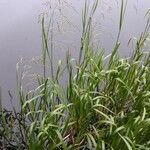
Glyceria maxima
Reed sweet grass · Reed-meadow grass · Water-meadow grass · Reed Manna Grass · Reed mannagrass
Description
Source: leafsnapGlyceria maxima, commonly known as Reed Sweetgrass or Tall Glyceria, is a perennial grass species belonging to the Poaceae family. Native to Europe and Asia, it has also been introduced and naturalized in many parts of North America. This plant typically thrives in wetlands, marshes, and along the banks of streams or ponds. It can grow up to 2 meters tall, with long, flat, and narrow green leaves. The inflorescence consists of dense clusters of greenish-brown spikelets. Reed Sweetgrass is vital for wildlife, providing food and habitat for species such as waterfowl, muskrats, beavers, and other wetland animals. It also helps stabilize soil along waterways, reducing erosion. Beyond its ecological significance, Glyceria maxima has been historically utilized by humans for various purposes. Its stems were traditionally used for weaving baskets or mats, while its leaves served as fodder for livestock. Overall, Glyceria maxima plays a crucial role in maintaining healthy wetland ecosystems and has provided valuable resources for human use throughout history. This makes it a significant plant species both ecologically and culturally.
Care Guide
💧 Water Every 3 days
☀️ Light Full sun
Reed mannagrass performs best in areas with abundant sunlight. It evolved in conditions of constant sun exposure, which encourages healthy growth. It can tolerate changes in light levels during its various growth stages. However, insufficient or excessive sunlight can damage its development.
What are the sunlight requirements for Reed mannagrass?
Reed mannagrass requires above 6 hours of sunlight to thrive optimally. It's essential to observe how sunlight moves through your garden to find locations that offer a perfect balance of light and shade for your plants. This ensures their well-being by providing the necessary conditions for healthy growth. Reed mannagrass has evolved in environments with abundant sunlight, making it capable of tolerating various sunlight exposures at different growth stages. However, too little or too much sunlight can adversely affect its growth.
How can artificial lighting benefit indoor Reed mannagrass plants, and what are the recommendations?
Indoor Reed mannagrass plants benefit significantly from artificial lighting when natural sunlight is insufficient, especially during winter or in less sunny spaces. Artificial lights, particularly LED lights, are recommended because they can be customized to provide specific wavelengths of light needed by the plants. For optimal growth, full sun plants require 30-50W/sq ft of artificial light, partial sun plants need 20-30W/sq ft, and full shade plants should get 10-20W/sq ft. The artificial light source should be placed 12-36 inches above the plant to mimic natural sunlight, and plants most often need 8-12 hours of light per day.
What are common symptoms of insufficient light in Reed mannagrass?
Inadequate lighting can lead to several symptoms in Reed mannagrass, which may include small and lighter-colored new leaves, leggy or sparse growth, accelerated leaf drop, slower or halted growth, and symptoms of chlorosis (yellowing leaves). Additionally, excessive sunlight can cause symptoms such as sunscald, leaf curling, wilting, and leaf scorching. These symptoms highlight the plant's struggle with inappropriate light levels, and it's crucial to monitor these signs closely to ensure the health of Reed mannagrass.
What solutions are available to address insufficient light for indoor, outdoor, and ground Reed mannagrass?
To address insufficient light for Reed mannagrass, gradual adjustments and artificial lighting can be beneficial. For indoor plants, gradually moving them to sunnier locations and utilizing a south-facing window or artificial grow lights can ensure they receive at least 6 hours of direct sunlight daily. Outdoor plants should be moved gradually to prevent sunburn, aiming for gradual adaptation to sunnier spots. For plants in the ground, reducing obstructions like pruning trees and transplanting to sunnier locations with good drainage can improve light exposure. It's important to note that while parts of the plant affected by light deficiency may not recover, new growth should be healthy with improved light conditions.
🌡️ Temperature 5–35°C
Reed mannagrass originates from temperate regions and performs best at temperatures between 68 and 95 °F (20 to 35 °C). Cooler temperatures are ideally avoided. Temperature adjustments may be necessary as seasons change to maintain optimal growth.
What is the best temperature for Reed mannagrass?
The optimal temperature for Reed mannagrass depends on the season. During the growing season, which is when the plant starts to sprout, the ideal temperature range is 65-80℉ (18-27℃). If it gets colder than 15℉ (-10℃), the plant may suffer and its leaves might turn brown and wilt. However, if it's just a short cold spell, Reed mannagrass may survive with some assistance. In the warmer months, it's important to protect the plant from excessively high temperatures. Anything above 95-105℉ (35-40℃) can harm the foliage and blooms of Reed mannagrass. High temperatures can cause wilting, drooping, and even sunburn on the leaves, making it difficult for the plant to recover. Luckily, there are several easy and effective methods to address this issue.
The first year or young Reed mannagrass needs a specific temperature to grow well.
If this is the first year you have a Reed mannagrass plant outdoors, it will require extra care during the coldest months. Frost can cause significant damage to a first-year Reed mannagrass and prevent it from growing back healthily in spring. To ensure its survival, the plant should be kept at or above 40℉(5℃) until it is established. You can achieve this by either bringing the plant inside or using mulch or fabric barriers to protect it from frost. During the first year or two, it is advised to plant Reed mannagrass in a shadier location. Smaller and weaker plants struggle to maintain their own temperatures in extreme heat. Therefore, it is recommended not to expose first-year Reed mannagrass to more than five hours of direct sunlight per day, especially if the temperature reaches above 80℉(27℃). To control summer heat, using shadecloth and providing frequent watering or misting are essential.
How can I keep Reed mannagrass safe from really hot or cold weather?
If the growing season experiences cold temperatures below 15℉ (-10℃), there are measures you can take to protect Reed mannagrass from frost or cold damage. If it's in a container, bring it inside with bright, indirect light until temperatures rise. For ground-planted Reed mannagrass, use mulch or horticultural fabric to create a protective barrier against frost and cold wind. If temperatures exceed 80℉ (27℃) in the shade, limit Reed mannagrass's sunlight exposure to six hours or less, ideally in the morning. Set up shade cloth or a fine plastic mesh to reduce direct sunlight during the hottest parts of the day. Additionally, installing a misting system that emits cooling mist around the plant's base can lower ground temperatures.
Suggestions for the ideal temperatures during the dormant season for Reed mannagrass.
Reed mannagrass needs a certain amount of cold during winter to remain dormant until it's time to sprout. If it sprouts too early, before the last frost has passed, it may not survive, especially if it has already started growing before the frost arrives. Ideally, winter temperatures should stay below 32℉ (0℃), but if they reach up to 40℉ (5℃), it's still okay. In more temperate climates like woodland rainforests, unexpected warm spells can cause Reed mannagrass to sprout prematurely. In such cases, if there is still a risk of frost, you can protect the new sprout by covering it with clear plastic on stakes. This cover can be removed once the danger of frost has passed. Although Reed mannagrass sometimes resprouts naturally at the proper time, using this method increases the chances of a successful second sprouting.
💨 Humidity
🪴 Soil
🌱 Fertilizer
🪴 Pot & Repot
✂️ Pruning
Reed mannagrass is a robust perennial grass that flourishes in wet environments. To encourage new growth, prune it in early spring by cutting old stems down to ground level. Regular pruning helps control its spread and improves its appearance. Always use clean tools to prevent disease, and avoid pruning during active growth periods to minimize stress on the plant.
🌿 Propagating
🐛 Diseases & pets
☠️ Toxicity
Characteristics
- Plant Type
- Grass
- Life Cycle
- Perennial, Annual
- Genus
- Glyceria
- Family
- Poaceae
- Hardiness Zone
- 5-9
- Mature Height
- 61 cm to 91 cm
- Mature Spread
- 49 cm to 91 cm
- Leaf Color
- Green
- Leaf Type
- Deciduous
- Flower Color
- Green, Purple, Brown
- Flower Size
- 0.20 cm to 0.25 cm
- Bloom Time
- Summer
- Planting Time
- Spring, Autumn
- Harvest Time
- Late summer, Early fall, Mid fall
- Native Area
- Turkey, Austria, Belarus, Russia, Germany, Estonia, Romania, Latvia, Belgium, Moldova, Netherlands, France, Bulgaria, Poland, Greece, Ukraine, China, Lithuania, Norway, Italy, Kazakhstan, Switzerland, Denmark, Japan, Finland, Ireland, Hungary