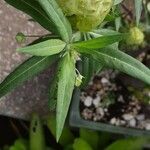
Gomphocarpus physocarpus
پنبه وحشی · Balloon cotton bush · Balloon Cottonbush · Balloon Plant · Bladderbush
Description
Source: leafsnapGomphocarpus physocarpus, commonly known as the balloon plant or hairy balls, is a species of milkweed native to Africa. This perennial herb grows up to 1.5 meters tall and features large, green leaves arranged alternately along the stem. During mid-summer to early autumn, the plant produces small clusters of white or pink flowers. The plant's most distinctive feature is its fruit pods, which resemble small balloons covered in soft hairs. These pods can grow up to 10 cm in diameter and contain numerous seeds with silky hairs that facilitate wind dispersal. Often cultivated as an ornamental, the balloon plant attracts butterflies and other pollinators with its unique fruit pods and appealing flowers. Additionally, various parts of the plant are used medicinally to treat ailments such as coughs, fever, and snake bites. It is important to note, however, that all parts of this milkweed species contain toxic compounds that can be harmful if ingested by humans or animals. Therefore, care should be taken when planting or harvesting it for medicinal purposes. In summary, Gomphocarpus physocarpus is an intriguing addition to any garden due to its unique appearance, but caution is necessary when handling it because of its toxic nature.
🌳 Beyond its biological charm, the balloon plant’s distinctive, attention-grabbing inflated pods are used as natural decoration in floral arrangements. These balloon-like structures add an unexpected, whimsical element to bouquets and artistic installations, serving as a novel complement to conventional greenery. Beyond ornamentation, the plant’s fibers are surprisingly durable and may hold untapped potential for producing sturdy yet lightweight materials. Also, the seeds are buoyant, which has led some to consider them for use in biodegradable packaging or flotation devices.
Care Guide
💧 Water Every 7 days
The balloon plant, native to regions with irregular rainfall, shows moderate drought tolerance and does well with weekly watering that balances moisture and drainage. It thrives in full sunlight and requires well-draining soil to prevent root rot caused by overwatering.
How should I water my Balloon plant to keep it healthy?
To properly water the Balloon plant, it's important to use filtered water at room temperature. Tap water may contain harmful particles, so filtered water is a safer choice. The plant prefers water that is at room temperature or slightly warmer because it is native to warm environments, and cold water can be a shock to its system. In addition, it's best to avoid overhead watering as it can cause problems with the plant's foliage. Instead, water the plant by applying filtered room temperature water directly to the soil until it is completely soaked. This method is beneficial because it moistens the roots and helps them spread through the soil to collect the necessary nutrients.
What should I do if I give my Balloon plant too much or too little water?
Overwatering and underwatering can both harm your Balloon plant, but overwatering is more common and has more severe consequences. When the plant gets too much water, the stems and leaves may wilt and turn yellow. Overwatering can also lead to diseases like root rot, mold, and mildew, which can kill the plant. Underwatering is less common because the plant can tolerate drought, but it can still happen. When underwatering occurs, the leaves become brittle and brown. It's important to recognize the signs of overwatering early so you can take action. Some diseases caused by overwatering, like root rot, may not be fixable if you wait too long. If you see signs of overwatering, reduce your watering schedule immediately. Check the soil quality as well. If it doesn't drain well, replace it with a loose, well-draining potting mix. If you notice signs of underwatering, simply increase your watering frequency until the signs disappear.
How frequently do I need to water my Balloon plant?
If your Balloon plant is in a pot, the easiest way to determine if it needs watering is by sticking your finger in the soil. If the top two to three inches of soil feel dry, it's time to water. The same method can be used for outdoor Balloon plants in the ground. When the first few inches of soil are dry, it's time to water. Typically, in spring and early fall, watering once a week is sufficient. However, during hot weather, watering may need to be increased to twice or more per week. It's important to note that mature, well-established Balloon plants can withstand drought well.
How much water does my balloon plant require?
To properly water your Balloon plant, don't be afraid to give it a generous amount of water. Make sure the top two to three inches of soil are dry before watering. Water the plant thoroughly, ensuring the soil is completely soaked. The water should be enough to drain through the holes at the bottom of the pot. If you don't see excess water draining, it means you haven't watered enough. On the other hand, avoid letting water accumulate in the soil, as it can harm the plant. If there is no water draining from the pot, it may indicate poor soil drainage, which is not good for the plant's health. If the plant is outside, about 1 inch of rain per week should be sufficient.
How do I water my Balloon plant as it grows?
The water needs of the Balloon plant can vary depending on its growth stages. During the first few years or after transplanting to a new location, more water will be necessary. This is because the plant is busy developing new roots that will support future growth, and these roots need extra moisture to thrive. As the Balloon plant matures, it will require less water overall. Additionally, the bloom period is another stage when increased water may be needed since flower development requires a significant amount of moisture.
☀️ Light Full sun
Balloon plant experiences healthy growth and does best when exposed to a large amount of sun each day. It can still endure lower amounts of sunlight. Both in its native habitat and at various growth stages it requires a range of sunlight. Too much or too little light exposure can negatively affect its condition.
What are the sunlight requirements for a balloon plant?
A balloon plant thrives best with a high volume of sun each day, requiring more than 6 hours of direct sunlight to be considered in full sun, and about 3-6 hours to be in partial sun. It's vital to observe how sunlight moves through your garden to ensure you find the perfect balance of light and shade for your plants, maximizing their growth and health. The plant's native habitat and growth stages demand a spectrum of sunlight exposure, and both too much or too little can harm its health.
How does artificial lighting benefit indoor balloon plants?
Indoor balloon plants require adequate lighting for optimal growth, especially when natural sunlight is insufficient, like in winter or less sunny spaces. Artificial lights, such as LED, can be a vital solution, promoting faster, healthier growth by mimicking natural sunlight. For full sun plants, 30-50W/sq ft of artificial light is recommended, 20-30W/sq ft for partial sun plants, and 10-20W/sq ft for full shade plants. The appropriate placement is 12-36 inches above the plant, simulating natural light for 8-12 hours daily.
What are the key symptoms of insufficient sunlight in balloon plants?
When balloon plants do not receive enough sunlight, several symptoms may appear. These include smaller new leaves, leggy or sparse growth making the plant appear thin and stretched out, early leaf drop to conserve resources, slower or halted growth, pale or irregularly colored new leaves, and a series of conditions such excessive sunlight exposure leading to chlorosis, sunscald, leaf curling, wilting, and leaf scorching. These symptoms indicate a lack of essential sunlight or overexposure, affecting the plant's health.
What solutions can be applied to alleviate light-related issues in balloon plants?
To ensure optimal growth and alleviate light-related issues in balloon plants, gradually move them to receive at least 6 hours of direct sunlight daily, using south-facing windows when indoors and considering artificial light if necessary. For outdoor plants, moving them to sunnier locations each week can help them adapt without getting sunburned. Reducing obstructions like pruning obstructing trees and transplanting to sunnier locations with good drainage can significantly benefit the plants. It's important to note that while parts of the plant damaged by insufficient sunlight might not recover, new growth can be healthy with improved light exposure.
🌡️ Temperature 20–41.1°C
The optimal temperature range for balloon plant growth is 68 to 105 ℉ (20 to 41 ℃). It prefers warm conditions but can tolerate slightly cooler temperatures. During the summer months, it is advisable to keep the plant in a shaded area during the hottest parts of the day to prevent heat stress.
What is the ideal temperature range for growing Balloon plants?
The ideal temperature for Balloon plant growth ranges between 68 to 105°F (20 to 41°C). These plants are well-suited to warm environments and can tolerate slightly cooler temperatures. However, it is crucial to shield them from the hottest parts of the day during summer by placing them in shaded areas to prevent heat stress. As Balloon plants are extremely sensitive to cold, they should be moved indoors near a bright window in autumn, away from direct heat sources, to maintain a consistent temperature beneficial for their growth.
How do low temperatures affect Balloon plants and what are the solutions?
Balloon plants prefer warm temperatures and do not tolerate cold well. They thrive when the temperature is kept above a certain minimum suitable for growth. Exposing the plant to temperatures below the minimum tolerable limit during winter can lead to discoloration of the leaves, which may turn from light to brown or black, followed by wilting and drooping due to frost damage. To mitigate these effects, trim off the frost-damaged parts and move the plant indoors to a warmer environment, placing it near a south-facing window for ample sunlight while avoiding proximity to heaters or air conditioning vents to prevent air dryness.
What should be done if a Balloon plant is exposed to high temperatures?
During summer, it's important to ensure that Balloon plants are kept below the maximum suitable growth temperature to avoid overheating. Exceeding the tolerable high temperature can cause the leaves to lighten in color and increase susceptibility to sunburn. To address this, trim away the sunburned and dried parts of the plant, relocate it to a shaded area during the midday and afternoon sun, and maintain soil moisture by watering in the morning and evening.
💨 Humidity normal (40-60%)
This plant will thrive in moderate humidity, which is probably the level in your home. However, misting it a few times a week can be very beneficial. Make sure the room has good ventilation.
🪴 Soil 5-7
🌱 Fertilizer
The balloon plant needs the most fertilizer during its active growth period, which occurs mainly in spring, summer, and early fall. Fertilizing supplies essential nutrients the soil may lack, supporting healthy root and stem growth and the attractive foliage that is a key feature of this plant.
Why should I put fertilizer on my Balloon plant?
All plants need soil nutrients for growth, including the Balloon plant. However, the soil your plants grow in may not always have all the necessary nutrients. To address this, fertilization and soil amendments help ensure your garden plants have both the basic nutrients they need and the specific nutrients they require. The Balloon plant specifically benefits from fertilizer to support healthy root and stem development throughout the growing season. Fertilization also enhances the appearance of its foliage, which is the main ornamental feature of this plant.
When should I fertilize my Balloon plant?
During the active growth phase, which usually occurs in spring, summer, and early fall, a Balloon plant requires the most fertilizer. After winter, feed the plant every two to four weeks until fall. As fall approaches, gradually decrease fertilizer application until you stop completely in preparation for the lower growth activity during winter.
When is it best not to add fertilizer to my Balloon plant?
During most of the year, including spring, summer, and most of fall, it is important to regularly feed your Balloon plant. However, if you notice that your plant has received too much fertilizer or if you have fertilized it incorrectly, causing issues like fertilizer burn, you should address this before continuing with regular feeding. The only exception to feeding your Balloon plant is during winter. If you grow this plant indoors in a cold winter area, it will go into a dormant phase during this time. Feeding the plant during its dormant phase is unnecessary, unhelpful for growth, and likely to cause fertilizer burn.
What kind of fertilizer does my Balloon plant need?
The fertilizer for a Balloon plant needs a specific blend of nutrients, each in small amounts. An ideal fertilizer has an N-P-K ratio of 3-1-2, but a general-purpose fertilizer with an even nutrient blend can also work well. However, even with a balanced fertilizer, the ratio of each nutrient should be 10 or lower. You can choose either granular or liquid fertilizer. If you use liquid fertilizer, it's best to dilute it by half. Granular fertilizer is generally fine, but using liquid fertilizer is more practical, especially if you water your Balloon plant while feeding it.
How do I give nutrients to my Balloon plant?
When purchasing fertilizer for your Balloon plant, there will typically be application instructions included. It is important to follow these instructions in most cases. For a Balloon plant, it is best to fertilize just before or during watering the soil to avoid damaging the plant's roots. If you are using a slow-release granular fertilizer, sprinkle it onto the soil and immediately water afterwards. On the other hand, if you are using a liquid-based fertilizer, dilute it with water and apply it to the soil. Then, give the plant a little extra water. In particular, it is important to dilute your fertilizer by at least half during the spring and fall when the plant's growth is increasing or decreasing.
🪴 Pot & Repot 2-3 years
When repotting Balloon plant, select a container 1-2 inches (2.5-5.1 cm) larger with ample drainage. Use a well-draining potting mix. Repot in spring or fall, making sure the root ball is slightly lower than the rim of the flower pot. Water thoroughly after repotting and place it in a warm spot with indirect sunlight.
✂️ Pruning
The balloon plant is known for its unique, balloon-like seed pods. To support its growth, it's beneficial to prune the plant in early spring. Start by removing any dead stems and thinning out crowded areas to improve air circulation. This will encourage bushier growth and enhance flowering. Additionally, make sure to sanitize your tools before pruning to prevent infections and support the plant's natural growth cycle, resulting in a vibrant display.
🌿 Propagating
🐛 Diseases & pets
☠️ Toxicity
Characteristics
- Plant Type
- Herb
- Life Cycle
- Perennial, Annual
- Genus
- Gomphocarpus
- Family
- Apocynaceae
- Hardiness Zone
- 10-13
- Mature Height
- 1.22 m to 1.83 m
- Mature Spread
- 1.52 m
- Leaf Color
- Green
- Leaf Type
- Deciduous
- Flower Color
- White
- Flower Size
- 2.54 cm
- Bloom Time
- Early summer, Mid summer
- Planting Time
- Spring
- Harvest Time
- Mid summer, Late summer
- Native Area
- Angola, Cameroon, Mozambique, Tanzania, Zimbabwe, South Africa, Sudan, Eswatini, Nigeria, Kenya, Congo (DRC), Uganda, Botswana, Central African Republic