Graptopetalum paraguayense
Ghostplant · Mother-of-pearl-plant · Mother-of-pearl plant · Rainbow Mandala Stonecrop · Rosita
Description
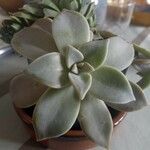
Source: leafsnapGraptopetalum paraguayense, commonly known as the Ghost Plant or Mother of Pearl Plant, is a succulent from the Crassulaceae family. This plant is native to Mexico and Paraguay. It features a rosette formation with fleshy, blue-green leaves that have a powdery coating, giving them a ghostly appearance. The leaves are arranged in opposite pairs, are triangular, and have pointed tips. During the summer, the Ghost Plant produces small, star-shaped flowers on tall stems. These flowers are either pink or white and each has five petals. This succulent is easy to care for, requiring minimal watering. It thrives both indoors and outdoors, provided it receives ample sunlight. The Ghost Plant prefers well-draining soil and good airflow around its roots. Beloved by succulent enthusiasts, the Ghost Plant is appreciated for its unique appearance, ease of care, and its ability to propagate effortlessly from stem or leaf cuttings. It's an excellent choice for rock gardens or container gardens because of its low-maintenance nature. In summary, Graptopetalum paraguayense is an attractive succulent that adds beauty wherever it is planted while demanding minimal care. Its low-maintenance requirements make it an ideal choice for beginners looking to add easy-to-care-for plants to their homes.
💡 Ghost plant leaves exhibit a light green hue with touches of purplish-pink on their tips. This plant can also be cultivated as a hanging bonsai, making it particularly lovely and beautiful whether viewed from a distance or up close.
🌳 Besides its striking appearance, the ghost plant is a hardy ornamental valued for its air-purifying properties. It can absorb pollutants, making it a promising option for biofiltration in homes and offices. Research on indoor plants indicates that succulents like the ghost plant can help remove volatile organic compounds from the air, indirectly enhancing air quality and public health.
🎭 Luck, spiritual life, perseverance
Care Guide
💧 Water Every 7 days
The Ghost Plant thrives in dry, arid environments thanks to its exceptional drought tolerance, needing water only once every three weeks. Its thick, fleshy leaves store moisture, allowing it to endure long periods without rain. This plant is particularly well-suited for indoor cultivation, but it requires well-draining soil to avoid root rot. To ensure optimal growth, it's important to balance dry air with occasional moisture.
When Should I Water My Ghost Plant?
Watering your Ghost Plant (Graptopetalum paraguayense) properly is vital for its health and growth. The top 1-2 inches of soil should dry out before watering again, and the plant’s leaves, which store water, should be firm. Leaf color changes can indicate watering issues: yellow leaves may suggest overwatering, while brown, shriveled leaves typically indicate underwatering. Pay attention to seasonal changes, as the plant needs more water during the growing seasons of spring and summer and less during its dormant period in fall and winter. Overwatering can lead to root rot, whereas underwatering may cause dehydration. Regularly checking the soil's dryness, the condition of the leaves, and adjusting for seasonal or environmental changes will help you water your Ghost Plant appropriately.
How Should I Water My Ghost Plant?
Watering your Ghost Plant correctly involves using the soak and dry method. This means thoroughly watering the plant until water runs out of the drainage holes to ensure the root ball is completely saturated, then allowing the soil to dry out completely before watering again. This method avoids root rot caused by overwatering. It's recommended to use a watering can with a narrow spout to direct water flow to the base of the plant, avoiding excessive wetting of the foliage, which can lead to targeted hydration at the root level.
How Much Water Does Ghost Plant Really Need?
The amount of water your Ghost Plant needs largely depends on plant size, root depth, and pot size. Larger plants or those in bigger pots require more water. However, the key is to water cautiously, only when the soil is completely dry, and provide a good soaking to mimic a substantial rainstorm. Overwatering can lead to soft, mushy, and discolored leaves, potentially causing the plant to die from root or stem rot. Underwatered plants will have shriveled or wilted leaves. Although Ghost Plants can recover quickly once proper watering resumes, it's essential to balance watering practices to maintain a healthy plant.
What Kind of Water is Best for Ghost Plant?
Ghost Plants prefer rainwater as it is natural and free of chemicals, making it the ideal choice for watering. Distilled and filtered water are suitable alternatives, as they are free from contaminants and minerals that could harm the plant. Tap water can be used if other options aren't available, but it's important to reduce chlorine content by letting the water sit for 24 hours before use to prevent leaf burn or stress from chlorine. Ghost Plants have moderate sensitivity to chlorine and low sensitivity to fluoride. Water temperature should be moderate, around 68-72°F (20-22°C), to avoid shocking the plant.
How Do Ghost Plant's Watering Needs Change with the Seasons?
Ghost Plant's watering needs vary with the seasons. In spring, during its active growth phase, maintain consistent soil moisture with regular watering. In summer, reduce watering frequency to allow the soil to dry slightly between watering periods, as the plant may enter a natural dormancy to conserve energy. During autumn, as the plant prepares for winter dormancy, gradually decrease watering frequency, ensuring the soil remains lightly moist. In winter, water sparingly, allowing the topsoil to dry out between waterings, as the plant requires minimal moisture during this dormant period.
☀️ Light Full sun
The ghost plant is hardy and favors spots with plenty of light, doing particularly well in bright, sunny conditions. It can, however, tolerate less luminous locations. Its native setting supports vigorous growth with ample light. Too much light intensity can scorch the leaves, while too little can make them appear faded.
What are the sunlight requirements for ghost plants?
Ghost plants require different amounts of sunlight depending on their specific needs. Full sun exposure means the plant should receive above 6 hours of sunlight, while partial sun exposure is about 3-6 hours of sunlight. It's important to watch how sunlight moves through your garden to choose spots that provide the right balance of light and shade, ensuring the plants' happiness and growth.
What are the essentials for growing a healthy ghost plant?
The ghost plant, Graptopetalum paraguayense, thrives in environments with ample exposure to light, doing well under clear skies but can also survive in less luminous spots. The plant's original habitat suggests it flourishes best with plenty of light, although too much can cause leaf scorching, and too little can lead to faded leaves. For indoor plants, artificial lighting can be a vital solution in low light conditions, with LED lights recommended for their ability to mimic the specific wavelengths needed by plants. Depending on the type of plant (full sun, partial sun, full shade), the wattage of artificial light and the distance and duration of exposure varies to best support growth.
What symptoms indicate a ghost plant is receiving inadequate light?
When a ghost plant is placed in suboptimal lighting conditions, it may exhibit symptoms indicating light deficiency. These include leggy or sparse growth, where the spaces between leaves or stems become longer, giving the plant a weak appearance. New leaves might develop lighter in color, indicating a lack of chlorophyll and essential nutrients. Chlorosis, or the yellowing of leaves due to chlorophyll breakdown; sunscald, which causes pale, bleached, or necrotic spots on plant tissue; leaf curling as a defense mechanism against too much sunlight; wilting from excessive water loss; and leaf scorching characterized by brown, dry patches on leaves are all potential indicators of inappropriate light exposure.
How can you address light-related issues in ghost plants?
To address light-related issues in ghost plants, consider the following solutions based on the setting. Indoors, gradually move plants to a sunnier location, aiming for at least 6 hours of direct sunlight daily, using a south-facing window. If the plant is large or not easily movable, supplement with artificial light, keeping a lamp on for at least 8 hours daily or investing in professional grow lights. Outdoors, move plants to sunnier spots gradually to prevent sunburn, understanding that affected parts may not recover but new growth will be healthy post adjustment. For ground plantings, reduce obstructions such as tree branches that block sunlight, or consider transplanting smaller plants during their dormant period to locations with better sunlight and drainage.
🌡️ Temperature 15–37.8°C
The ghost plant’s native habitat has temperatures of 20 to 30℃ (68 to 86℉) in summer and 5 to 10℃ (41 to 50℉) in winter. The plant prefers temperatures from 15 to 38℃ (59 to 100℉) and can be adjusted to seasonal temperature variations by reducing watering and avoiding direct sunlight during the hot summer months.
What are the ideal temperature conditions for a Ghost plant?
The Ghost plant thrives in a native growth environment with summer temperatures ranging from 20 to 30°C (68 to 86°F) and winter temperatures between 5 to 10°C (41 to 50°F). It prefers temperatures between 15 to 38°C (59 to 100°F) throughout the year. To adjust to seasonal temperature changes, reduce watering and avoid direct sunlight during hot summer months. Winter, being its growing season, requires maintaining temperatures above 15°C for optimal growth. If outdoor temperatures fall below -10°C, it's advised to move the plant indoors to a well-lit area. Watering should be increased with higher temperatures and reduced as it approaches -10°C. For overwintering outdoors, placing the plant in a sheltered area with adequate sunlight is recommended. If the temperature is consistently low, consider setting up a temporary greenhouse for protection and keep the plant adequately moist.
How does low temperature affect the Ghost plant and what are the solutions?
The Ghost plant is not tolerant of extreme cold temperatures and thrives best when the temperature is between 15°C and 38°C. During winter, it should be kept above -10°C. Exposure to temperatures below -15°C can lead to water-soaked necrosis and wilting of leaves. In cases of mild frost damage, leaves may significantly wilt and eventually fall off after a week. To mitigate frost damage, trim off the frostbitten areas and move the plant indoors to a warm environment or set up a makeshift greenhouse for cold protection. If moving the plant indoors, place it near a south-facing window to ensure it receives ample sunlight. When using a makeshift greenhouse, ensure there is proper ventilation to prevent plant decay due to poor airflow.
What should be done if the Ghost plant is exposed to high temperature?
During the summer, the Ghost plant should be kept below 38°C. Exposure to temperatures exceeding 43°C can cause the plant to enter a dormant state and become more prone to rot in high humidity conditions. To address high temperature exposure, remove any dry and rotten parts of the plant and move it to a partially shaded area to protect it from direct sunlight during the midday and afternoon. Stop watering the plant until the weather cools down, to prevent further stress and potential rot.
💨 Humidity dry (<40%)
This plant prefers dry conditions, so don't mist it. However, watering it less often can also thrive in higher humidity.
🪴 Soil 6-7
🌱 Fertilizer
For the Ghost plant, applying a light amount of fertilizer once or twice a year during the growing season is sufficient. Do not fertilize in winter or in summer when it is dormant. Reduce the amount of fertilizer for repotted plants and wait a couple of months after repotting before fertilizing. Fertilizing helps maintain healthy growth and promotes blooms.
🪴 Pot & Repot Every 2 years
When repotting a Ghost plant, pick a pot slightly larger than the current one that offers good drainage. Use a gritty, well-draining cactus or succulent mix. Gently remove the plant from its previous pot, brush off excess soil, and place it back in at the same depth. Wait a few days before watering so any root damage can heal. Repot during spring or fall and keep it in a brightly lit spot.
✂️ Pruning
To preserve the shape of a ghost plant, trim away any unnecessary or dense branches during the spring and autumn. Use a knife or scissors for this task, and be sure to apply sulfur powder to the cuts to prevent infection. For propagation, select sturdy stems with 5-6 leaves and cut them in the spring or autumn. Allow the cuts to heal before planting the stems in slightly moist soil.
🌿 Propagating
🐛 Diseases & pets
☠️ Toxicity
Ghost plants are non-toxic to people, dogs, and cats, making them a beautiful and safe addition to nearly any home.
Characteristics
- Plant Type
- Succulent, Herb
- Life Cycle
- Perennial
- Genus
- Graptopetalum
- Family
- Crassulaceae
- Hardiness Zone
- 7-12
- Mature Height
- 15 cm to 30 cm
- Mature Spread
- 61 cm to 91 cm
- Leaf Color
- Green, White
- Leaf Type
- Evergreen
- Flower Color
- White
- Flower Size
- 1.52 cm
- Bloom Time
- Late spring, Early summer, Mid summer
- Planting Time
- Spring, Autumn, Winter
- Harvest Time
- Mid summer
- Native Area
- Mexico