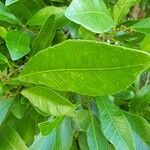
Gymnanthes lucida
Oysterwood
Description
Source: leafsnapGymnanthes lucida is a small evergreen tree or shrub that belongs to the Phyllanthaceae family. Commonly known as the "shiny-bark" or "smooth-bark" tree, it is notable for its smooth, glossy bark. Native to Central and South America, this plant thrives in various habitats, including forests, savannas, and disturbed areas. The leaves of Gymnanthes lucida are simple, alternate, and elliptical, featuring a glossy green surface. The plant produces small yellow-green flowers that are unisexual, with male flowers being more prominent than female ones. Its fruit is a small capsule containing one or two seeds. For centuries, indigenous people have used Gymnanthes lucida for various medicinal purposes. Traditionally, it has been an anti-inflammatory agent for treating skin conditions like eczema and psoriasis. Additionally, it has bronchodilator properties that make it effective in treating respiratory ailments, such as asthma. Beyond its medicinal uses, Gymnanthes lucida also holds potential for industrial applications due to the high oil content in its seeds. This oil can be extracted for use in cosmetics or biofuel production. Overall, Gymnanthes lucida is an intriguing plant with notable medicinal benefits. It warrants further research to fully explore its properties and potential applications, both traditional and modern.
Care Guide
💧 Water Every 7 days
Oysterwood thrives in humid environments and is well-adapted to consistent moisture levels, although it can tolerate moderate drought. To keep it healthy, it's important to water it weekly. Oysterwood grows best outdoors, where it can benefit from natural rainfall and the seasonal changes that match its growth cycles.
☀️ Light Partial sun
Oysterwood is naturally found in habitats like forest understories or rocky areas, where it grows in natural shade. It favors partial sun but can tolerate full sun or full shade, demonstrating its versatile and hardy nature.
🌡️ Temperature 20–37.8°C
Oysterwood is fairly adaptable to temperature, able to endure higher heat and broader temperature swings. In hot conditions, care should be taken to water appropriately and offer suitable shade to prevent sunburn. Conversely, Oysterwood has limited tolerance for low temperatures. While it can handle some cold, overly frigid conditions can cause frost damage.
💨 Humidity
🪴 Soil 6-8
🌱 Fertilizer
Fertilize your Oysterwood in early spring to encourage healthy growth. Regular feeding improves its overall health, leading to vigorous development, increased tolerance of harsh conditions, and enhanced resistance to pests and diseases. Follow a consistent fertilization schedule for your Oysterwood to maintain vibrant, deeply colored, and lush foliage.
🪴 Pot & Repot
✂️ Pruning
Oysterwood, known for its dense foliage and attractive appearance, benefits from regular pruning to maintain its shape and health. It's best to prune during the dormant season, from early to late winter, to control its growth. Focus on removing dead branches and thinning out crowded areas. Light trimming not only enhances the plant's health but also reduces the risk of pests and diseases during the dormant months.
🌿 Propagating
🐛 Diseases & pets
☠️ Toxicity
Characteristics
- Plant Type
- Tree, Shrub
- Life Cycle
- Perennial
- Genus
- Gymnanthes
- Family
- Euphorbiaceae
- Hardiness Zone
- 10-12
- Mature Height
- 4.88 m to 10.06 m
- Mature Spread
- 3.05 m to 6.1 m
- Leaf Color
- Dark Green, Forest Green
- Leaf Type
- Evergreen
- Flower Color
- Green
- Flower Size
- 0.20 cm to 0.25 cm
- Bloom Time
- Early spring, Mid spring
- Planting Time
- Spring, Summer, Autumn
- Harvest Time
- Early summer, Mid summer
- Native Area
- Bahamas, Belize, Cuba, Honduras, Mexico, Guatemala, Jamaica