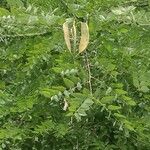
Gymnocladus dioicus
Kentucky Coffee Tree · Kentucky Coffeetree · Stump Tree · Gymnocladus dioica
Description
Source: leafsnapGymnocladus dioicus, commonly known as the Kentucky coffee tree, is a deciduous tree native to North America. As a member of the pea family, it can grow up to 100 feet tall with a spread of up to 50 feet. The tree features large bipinnate leaves that can reach up to three feet in length, and it produces small greenish-white flowers in the spring. Female trees generate large seed pods that resemble coffee beans, which is where the tree gets its common name. The Kentucky coffee tree is noted for its hardiness and its ability to adapt to various soil types and climates. Historically, Native Americans have used it for medicinal purposes and crafted tools from its wood. Today, the Kentucky coffee tree is often used in landscaping because of its unique appearance and its ability to provide shade during the hot summer months. However, it is important to note that all parts of this plant are toxic if ingested by humans or animals. Overall, Gymnocladus dioicus is an intriguing plant with historical significance and practical applications in modern landscaping.
🌳 The 'Kentucky coffee' tree, scientifically known as kentucky coffee tree, produces beans that were historically brewed as a coffee substitute despite containing little caffeine. The tree is noted not only for that beverage use but also for yielding strong wood prized for making durable, pest-resistant furniture and cabinets. Its wood is also sought after in the music industry for crafting hand drums because of its resonant qualities.
Care Guide
💧 Water Every 7 days
☀️ Light Full sun
The kentucky coffee tree does best when it receives unobstructed sunlight throughout the day. It can tolerate stretches when the light is somewhat filtered. In its native range it grows in places that receive abundant daily sunlight. Insufficient light can lead to less vigorous growth; conversely, too much light generally does not cause notable harm.
🌡️ Temperature 0–35°C
The natural temperature range suitable for the kentucky coffee tree is 0 to 35 ℃ (32 to 95 ℉). It is a temperate woody species that prefers moderate temperatures. In winter, with proper adjustment it can withstand temperatures as low as -30 ℃ (-22 ℉). In summer, it develops best at about 21 to 27 ℃ (70 to 80 ℉).
💨 Humidity
🪴 Soil 6-7
🌱 Fertilizer
Encourage healthy development by applying fertilizer to your Kentucky coffee tree at the beginning of spring. Frequent fertilization bolsters the tree's total well-being, leading to robust growth, the ability to withstand challenging environments, and heightened resistance to diseases and pests. Stick to a definite fertilization timetable for your Kentucky coffee tree to guarantee bright and deep-colored leaves with a full look.
🪴 Pot & Repot 2-3 years
During the repotting of a Kentucky coffee tree, select a container that is 1-2 inches (2.5-5 cm) bigger and has sufficient drainage. Utilize a potting mix that drains well. Repotting should be performed in spring or fall, with the root ball situated a bit below the pot's rim. After repotting, water the plant thoroughly and position it in a warm location with indirect sunlight.
✂️ Pruning
Late winter or early spring, when the coldest weather are no longer a threat, is the best time to prune the Kentucky coffee tree. Young trees won't require pruning in the first few years until the branches become injured because of its slow growth tendency. To encourage a stronger structure, however, unduly long (and hence weaker) branches should be clipped when they are young.
🌿 Propagating
🐛 Diseases & pets
☠️ Toxicity
Despite the fact that coffee plants develop quickly, it usually takes a few years for your plant to begin producing blooms and subsequent fruits. While the beans are edible to humans, the entire plant is poisonous to both animals and people. Early settlers used the seeds of the Kentucky coffeetree as a substitute for coffee.
Characteristics
- Plant Type
- Tree
- Life Cycle
- Perennial
- Genus
- Gymnocladus
- Family
- Fabaceae
- Hardiness Zone
- 3-9
- Mature Height
- 18.29 m to 22.86 m
- Mature Spread
- 13.41 m to 17.98 m
- Leaf Color
- Green, Yellow
- Leaf Type
- Deciduous
- Flower Color
- White, Green, Yellow
- Flower Size
- 2.54 cm
- Bloom Time
- Early summer, Mid summer
- Planting Time
- Spring, Autumn
- Harvest Time
- Mid summer, Late summer, Early fall
- Native Area
- Central US, Nebraska to Pennsylvania