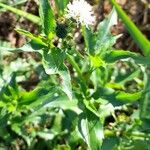
Gymnocoronis spilanthoides
Senegal tea plant · Senegal teaplant · Templeplant · Costata · Senegal tea
Description
Source: leafsnapGymnocoronis spilanthoides, commonly known as the Senegal tea plant or toothache plant, is a perennial herbaceous species within the Asteraceae family. Native to South America, it has also been introduced and naturalized in various parts of the world, including Africa and Asia. This plant features a bushy growth habit with long stems that can reach up to 1 meter in height. The leaves are alternate, simple, and toothed, displaying a dark green color on the upper surface and a lighter green underneath. The small flowers are white or yellowish-white, featuring five petals arranged in clusters at the ends of the stems. Gymnocoronis spilanthoides is widely used for its medicinal properties, particularly for its analgesic effects that can alleviate toothaches when chewed or applied topically as an ointment. Additionally, it has anti-inflammatory properties, making it useful for treating various inflammatory conditions. Beyond its medicinal applications, Gymnocoronis spilanthoides is also valued as an ornamental plant due to its attractive foliage and flowers. It thrives in full sun or partial shade but requires regular watering for optimal growth. Overall, Gymnocoronis spilanthoides is a versatile perennial herb that offers both medicinal benefits and ornamental appeal, making it a valuable addition to any garden or landscape design project.
Care Guide
💧 Water Every 7 days
Senegal tea flourishes in moist, aquatic environments and can tolerate overwatering better than many other plants. To maintain optimal soil moisture, it should be watered weekly. When grown outdoors, it exhibits robust growth, provided it receives enough nutrients and light to support photosynthesis.
☀️ Light Full sun
Senegal tea comes from habitats with plentiful sunlight, such as the shallow margins of ponds and lakes. It favors full sun but can also endure partial sun.
What are the sunlight requirements for Senegal tea plants?
Senegal tea plants, known botanically as Gymnocoronis spilanthoides, thrive in areas that receive full sun, defined as above 6 hours of sunlight daily. It's important to observe the way sunlight moves through your garden to identify spots that offer the ideal balance of light and shade. This careful selection of planting spots ensures your Senegal tea plants grow happily and healthily.
🌡️ Temperature 15–37.8°C
Senegal tea originates from tropical regions and naturally grows in temperatures of 59 to 100 °F (15 to 38 ℃). For best development, it favors the higher end of that range. In colder seasons, using indoor heat lamps or greenhouses is recommended to maintain the appropriate temperature.
What is the native habitat of Senegal tea?
Senegal tea, botanically known as Gymnocoronis spilanthoides, is native to tropical regions. It thrives naturally in temperatures ranging from 59 to 100 °F (15 to 38 °C), with a preference for the upper end of this temperature spectrum to ensure optimal growth.
How to maintain the proper temperature for Senegal tea in cooler seasons?
In cooler seasons, when temperatures fall below the optimal range for Senegal tea, it is recommended to use indoor heat lamps or greenhouses. These methods help in maintaining the suitable temperature range that Senegal tea requires for proper growth, ensuring it continues to thrive even in less than ideal conditions.
💨 Humidity
🪴 Soil
🌱 Fertilizer
🪴 Pot & Repot
✂️ Pruning
Senegal tea is a rapidly growing aquatic plant known for its vibrant green leaves and white flowers. To manage its growth and enhance air circulation, prune the plant in the spring. Ensure that you use clean tools to prevent the spread of disease, and refer to local horticultural guidelines for the best care practices.
🌿 Propagating
🐛 Diseases & pets
☠️ Toxicity
Characteristics
- Plant Type
- Herb
- Life Cycle
- Perennial
- Genus
- Gymnocoronis
- Family
- Compositae
- Hardiness Zone
- 8-11
- Mature Height
- 30 cm to 91 cm
- Mature Spread
- 30 cm to 91 cm
- Leaf Color
- Green
- Leaf Type
- Evergreen
- Flower Color
- White
- Flower Size
- 0.51 cm
- Bloom Time
- Summer, Early fall, Mid fall
- Planting Time
- Summer, Autumn
- Harvest Time
- Late summer, Fall, Early winter
- Native Area
- Uruguay, Paraguay, Argentina, Mexico, Bolivia, Peru, Brazil