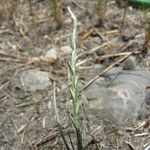
Hainardia cylindrica
Common barb grass · One-glume hard grass · Barbgrass · One-glumed Hard-grass · Thintail
Description
Source: leafsnapHainardia is a genus of coastal plants in the grass family, native to the Mediterranean Basin.The only known species is Hainardia cylindrica, known by several common names, including barbgrass, one-glumed hard-grass, and thintail. It is native to the Mediterranean and to nearby regions from Madeira and the Canary Islands east to Crimea and Iran. It is also reportedly naturalized in coastal regions in scattered locales in Australia, New Zealand, the United States (CA OR TX LA SC), Baja California, and temperate South America (Brazil, Uruguay, Argentina, Chile).Hainardia cylindrica is an annual grass of salt marshes and estuaries, thriving in saline and alkaline soils in aquatic habitats. It has a branching stem reaching a maximum height near half a meter. The thready leaves are ribbed and rough to the touch on the upper surfaces. The top few centimeters of the stem is made up of a cylindrical inflorescence with each spikelet embedded into it and dividing it into segments which can break off.
Care Guide
💧 Water
Barb grass thrives in coastal and riverside environments, where it requires regular watering to keep the soil moist without becoming waterlogged. To ensure its health, water it weekly. This plant prefers well-draining soil that remains consistently damp, similar to its natural waterside habitat. However, it can tolerate short periods of dryness.
☀️ Light Full sun
Barb grass is native to bright, open habitats and flourishes in full sun. It can tolerate partial sun but favors direct sunlight for optimal growth. This plant, which may be annual or biennial, is known for its sun-loving nature.
What are the sunlight requirements for Barb grass?
Barb grass, known botanically as Hainardia cylindrica, thrives in environments with abundant sunlight, requiring more than 6 hours of direct sunlight to flourish - which is termed as 'full sun'. It can also tolerate 'partial sun', defined as about 3-6 hours of sunlight daily. However, for optimal growth and health, direct sunlight is preferred. It’s essential to observe the movement of sunlight through your garden meticulously, selecting locations that guarantee an ideal mix of light and shadow to meet your Barb grass's needs efficiently.
How can artificial lighting support Barb grass indoors?
When natural sunlight is not sufficient, especially during winter or in less sunny areas, artificial lighting can be a crucial alternative for Barb grass's growth indoors. Adequate lighting promotes healthier, more robust growth. LED lights are recommended due to their ability to provide specific light wavelengths needed by plants. For plants requiring full sun, 30-50W/sq ft of artificial light is advisable; for partial sun plants, 20-30W/sq ft; and for full shade plants, 10-20W/sq ft. The artificial light source should be placed 12-36 inches above the plant to mimic natural sunlight and kept on for about 8-12 hours daily to emulate the length of natural daylight hours appropriate for the plant species.
What are the signs of inadequate lighting in Barb grass?
When Barb grass does not receive sufficient light, it may exhibit several symptoms indicative of light deficiency. These include smaller new leaves than previous ones, leggy or sparse growth due to elongated spaces between leaves or stems, early dropping of older leaves as a conservation strategy, sluggish or ceased growth as the plant enters survival mode, paler new leaves signaling low chlorophyll and nutrient levels, chlorosis or the yellowing of leaves because of chlorophyll breakdown, sunscald characterized by pale, bleached spots on the plant due to intense light exposure, leaf curling as a defense mechanism against excessive sunlight, wilting from loss of turgor pressure, and leaf scorching identified by brown, dry edges on leaves.
How can you manage sunlight exposure for Barb grass to ensure its health?
To ensure Barb grass's optimal growth, gradually transitioning the plants to areas with at least 6 hours of direct sunlight is crucial, especially for indoor plants. Utilize south-facing windows and keep curtains open to maximize sunlight exposure. For larger indoor plants or those not easily moved, artificial lighting, such as desk lamps or professional grow lights, should be used for at least 8 hours daily. Outdoor plants also require cautious relocation to sunnier spots, avoiding abrupt shifts to prevent sunburn. Reducing obstructions like pruning surrounding trees can increase sunlight access. Smaller plants might benefit from transplanting during their dormant phase to sunnier locations with better drainage.
🌡️ Temperature 15–35°C
Barb grass can adjust to a broad range of temperatures, yet its distribution can still be restricted by various combinations of moisture and heat. It performs best in warm summer climates with sufficient rainfall or irrigation. Extended periods of overcast, wet weather, as well as prolonged high temperatures, can raise the chance of Barb grass dying. In winter, suitable protection from cold can increase the plant's survival rate.
💨 Humidity
🪴 Soil 6-7
🌱 Fertilizer
🪴 Pot & Repot
✂️ Pruning
Barb grass has a cylindrical structure and benefits from being pruned from early to late spring. Pruning encourages growth and helps prevent over-seeding. To care for barb grass, trim any dead stems and thin out dense areas to improve air circulation. Make sure to use sterilized tools to prevent disease and promote healthy regrowth.
🌿 Propagating
🐛 Diseases & pets
☠️ Toxicity
Characteristics
- Plant Type
- Grass
- Life Cycle
- Annual
- Genus
- Hainardia
- Family
- Poaceae
- Hardiness Zone
- 7-10
- Mature Height
- 40 cm
- Mature Spread
- 10 cm to 20 cm
- Leaf Color
- Light Green
- Leaf Type
- Semi-evergreen
- Bloom Time
- Late spring, Early summer
- Planting Time
- Spring, Summer
- Harvest Time
- Mid summer, Late summer