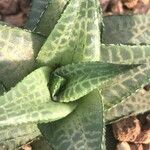
Haworthia tessellata
Description
Source: leafsnapHaworthiopsis tessellata, formerly Haworthia tessellata, is a species of the genus Haworthiopsis belonging to the family Asphodelaceae. It has been considered a subspecies of its close relative, Haworthiopsis venosa.
Care Guide
💧 Water
☀️ Light Partial sun
The alligator plant originates from settings with sporadic light like the understory of forests or rocky areas that offer natural shade. It has a preference for partial sun, but it can also withstand direct sunlight.
🌡️ Temperature 20–37.8°C
Although the Alligator plant tolerates some heat, it prefers cooler seasons and goes dormant in summer. In very hot weather give it shade to prevent scorching from strong sun. Reduce or stop watering during the hottest part of the year to avoid root rot. It grows vigorously in winter and spring, and if temperatures do not fall too low it will continue to grow steadily.
💨 Humidity
🪴 Soil 6-7
🌱 Fertilizer
For the Alligator plant, a mild quantity of fertilizer applied 1-2 times annually during its growth phase is adequate. Refrain from fertilizing during winter and summer as the plant is in a dormant state. Decrease the amount of fertilizer for repotted plants and delay fertilization for a few months post-repoting. The act of fertilizing aids in robust growth and promotes flowering.
🪴 Pot & Repot Every 2 years
When rehousing an Alligator plant, choose a container a little bit bigger than its current one, ensuring it has excellent drainage capabilities. Utilize a gritty succulent or cactus mix that offers optimal drainage. Gently take out the plant from the current pot, shaking off surplus soil and then reinstall it at the same level as before. Hold off on watering for several days to allow any damaged roots to recover. Rehouse during the spring or autumn, and place in a location with ample light.
✂️ Pruning
🌿 Propagating
🐛 Diseases & pets
☠️ Toxicity
Characteristics
- Plant Type
- Herb
- Life Cycle
- Perennial
- Genus
- Haworthia
- Family
- Xanthorrhoeaceae
- Hardiness Zone
- 9-11
- Mature Height
- 15 cm
- Mature Spread
- 15 cm to 23 cm
- Leaf Color
- White, Green
- Leaf Type
- Evergreen
- Flower Color
- White
- Flower Size
- 1.02 cm
- Bloom Time
- Summer
- Planting Time
- Spring, Summer, Autumn
- Harvest Time
- Late summer, Early fall, Mid fall
- Native Area
- South Africa, Namibia