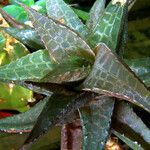
Haworthia venosa
Dragon scale haworthia
Description
Source: leafsnapHaworthia venosa is a small succulent belonging to the Asphodelaceae family. Native to South Africa, it is commonly found in rocky areas and on cliffs. This plant features thick, fleshy leaves that grow in a rosette pattern, forming a compact clump. The green leaves are adorned with white stripes or veins running along their length. During the summer months, Haworthia venosa produces small white or pink flowers on long stems. The flowers are tubular in shape and have six petals. This plant is easy to care for and can be grown both indoors and outdoors, provided it receives bright, indirect sunlight and is planted in well-draining soil. Haworthia venosa prefers dry conditions but can tolerate occasional watering. There are several cultivars of Haworthia venosa, each with different leaf shapes, colors, and patterns. These variations make it an attractive addition to any succulent collection or garden display. Its low maintenance requirements also make it an excellent houseplant. Overall, Haworthia venosa is a stunning succulent that adds interest with its unique foliage patterns. It is easy to care for, making it suitable for even novice gardeners to grow both indoors and outdoors!
Care Guide
💧 Water Every 7 days
☀️ Light Partial sun
Breede Haworthia comes from habitats with dappled light, such as forest understories or rocky areas that provide natural shade. It prefers partial sun but can also tolerate full sun.
🌡️ Temperature 20–37.8°C
Although Breede Haworthia can tolerate some heat, it mainly does best and grows during cooler periods and becomes dormant in summer. In hot summer weather, provide shade to avoid scorching from strong sunlight. Watering should be reduced or stopped during the hottest season to prevent root rot. Winter and spring are the times when Breede Haworthia grows vigorously. If temperatures do not fall too low, it will continue to grow steadily.
💨 Humidity
🪴 Soil 6-7
🌱 Fertilizer
For Breede Haworthia, light applications of fertilizer once or twice a year during the growing season are sufficient. Do not fertilize in winter or summer when the plant is dormant. Reduce the amount of fertilizer for repotted plants and wait a couple of months after repotting before applying fertilizer. Fertilizing helps maintain healthy growth and promotes flowering.
🪴 Pot & Repot Every 2 years
When repotting Breede Haworthia, choose a pot that is slightly bigger than the current one and has good drainage. Fill it with a gritty, well-draining succulent or cactus soil mix. Gently lift the plant from its old pot, brush away excess soil, and set it in the new pot at the same depth. Wait several days before watering so any damaged roots can heal. Repot during spring or fall and keep the plant in a brightly lit spot.
✂️ Pruning
🌿 Propagating
🐛 Diseases & pets
☠️ Toxicity
Characteristics
- Plant Type
- Succulent
- Life Cycle
- Perennial
- Genus
- Haworthia
- Family
- Xanthorrhoeaceae
- Hardiness Zone
- 9-11
- Mature Height
- 20 cm
- Mature Spread
- 30 cm
- Leaf Color
- Dark Green, Forest Green
- Leaf Type
- Evergreen
- Flower Color
- White
- Flower Size
- 0.51 cm to 0.76 cm
- Bloom Time
- Summer
- Planting Time
- Spring, Autumn
- Harvest Time
- Late summer, Early fall, Mid fall
- Native Area
- South Africa